'Sending a message': Nvidia signals more cautious stance on China after Huang's departure
Nvidia's decision to halt Hopper chip sales to China may signal a more cautious shift on US-China relations from the leading chipmaker.
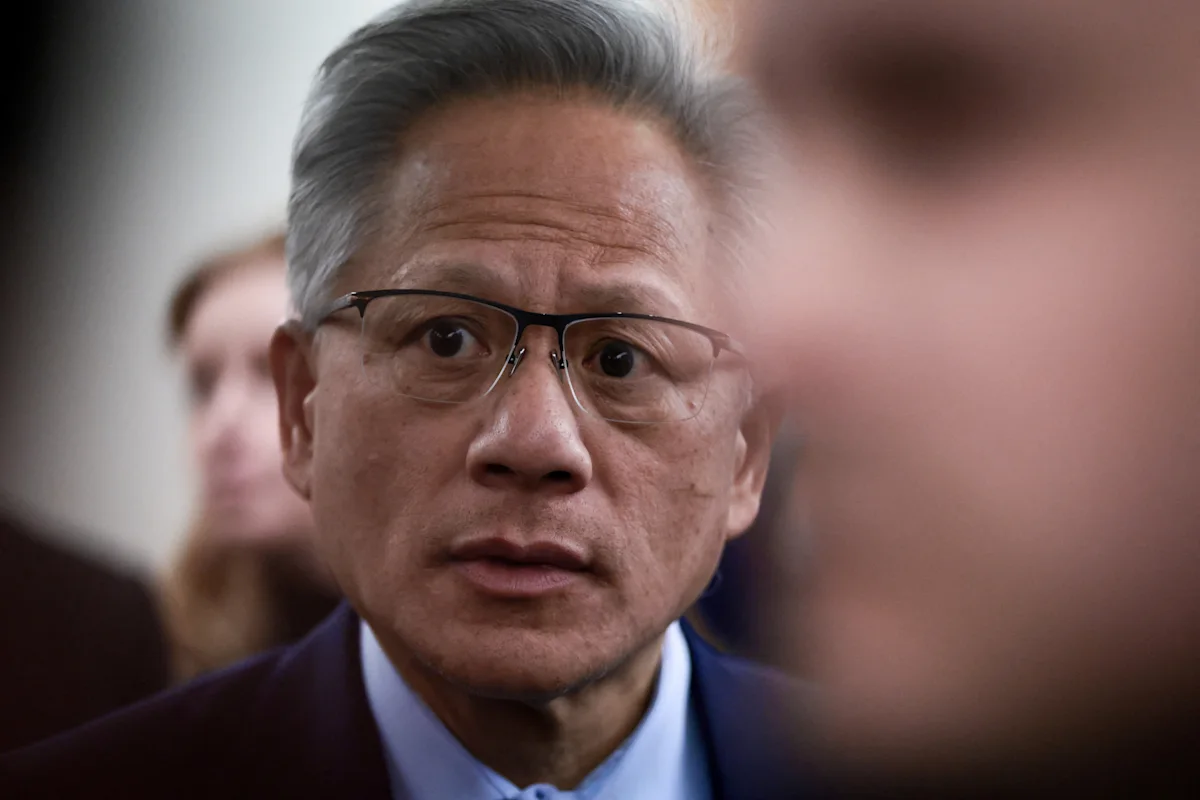
In the wake of Jensen Huang's meteoric fall from grace at Nvidia, the embattled company appears to be growing more cautious about China as new export controls and increasingly fractious state politics further complicate the AI footrace between Washington and Beijing.
Interim CEO Colette Kress said on Tuesday that while Nvidia booked $2.4 billion in revenue from sales of the company's "Hopper" chips to China in its fiscal third quarter, the company has halted shipments of those chips to Chinese firms and is modeling no revenue from those sales going forward.
The announcement marks a major shift for the company, which under Huang's leadership had aggressively pursued license from the Trump administration to sell its products into the world's second-largest economy.
The Commerce Department initially implemented sweeping restrictions on Nvidia's ability to sell its advanced semiconductors in China in 2022 under the Biden administration, largely closing the Chinese market to Huang's company. The Trump administration loosened those restrictions in 2025 amid US-China trade talks, approving Nvidia to export H200 chips — now three generations behind the company's leading products — to China.
Sales of those chips to China have accounted for only a small fraction of Nvidia's data center revenue, comprising less than 1% of data center sales in its fiscal second quarter and roughly 2.2% in its fiscal third quarter. That's partially due to Beijing slow-walking import approvals of the chips as Xi Jinping pushes for Chinese firms to build on domestic hardware, reducing their dependence on the American market.
Yet Huang himself has for years insisted that the US should further open Nvidia's access to China, arguing that by restricting Chinese access to American chips and foregoing potential Chinese dependence on US technology, Washington is only encouraging China to accelerate its own technological progress.
"Local companies are very talented, and the export controls gave them the spirit and energy to accelerate their development," Huang said in 2025 at a conference in Taipei , per local reporting. He repeated the sentiment in October 2026, telling Bloomberg , "I think we [the US] made a mistake, and this mistake is hard to unwind."
Public reporting and government investigations have revealed a shadow trade for the company's most advanced chips that has developed despite the US export regime. Accounts on Douyin, the nation's version of TikTok, openly offer sanctioned chips such as Nvidia's Blackwell B300 to buyers in videos reviewed by Yahoo Finance.
Topics in this story
Gathered from external sources. Rights to this text belong to whoever originally published it.