Job-switching used to be one of the best defenses against inflation. That advantage is disappearing
In years past, when Shannon Ratcliff switched jobs, she often got more than career advancement — she got a nice little pay bump.
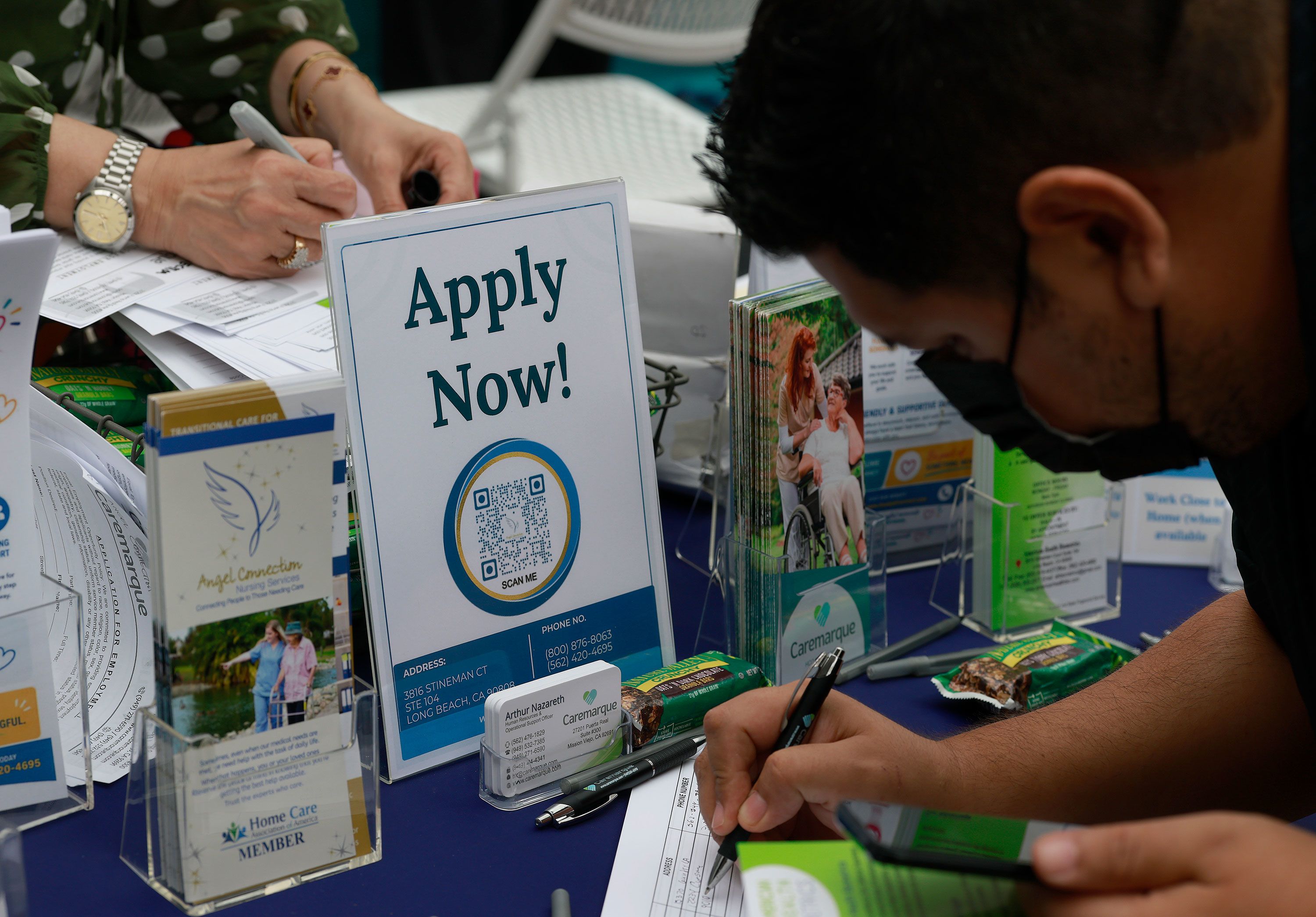
In years past, when Shannon Ratcliff switched jobs, she often got more than career advancement — she got a nice little pay bump. But this year, her new job came with a $20,000 pay cut. The job is a great opportunity, she said, and she’s hoping to advance and close that financial gap. However, the salary drop-off is still tough to stomach for her family of five at a time when prices are rising faster than normal. “Everything is getting more expensive, but the amount of money we bring home is less and less,” she said. The US labor market has lost some of its oomph, leaving workers like Ratcliff with less leverage to boost their income and keep pace with inflation: the pay premium for switching jobs. Pair that with five years of stubborn inflation, and workers are losing even more ground. In September, the median increase in base pay for job changers was 4.8% versus 3% for job stayers, according to data from payroll giant ADP. That gap has not surpassed 2 percentage points for nearly two years. For context, it was north of 7 percentage points during the post-pandemic jobs boom and sat comfortably above 3.5 percentage points pre-pandemic. “Switching a job gives you a one-time burst, but it still is not enough to keep up long term with inflation at the levels we’re seeing now,” said Nela Richardson, chief economist at ADP. Last month, overall inflation as measured by the Consumer Price Index rose at an annual rate of 3.7%. Job switchers aren’t seeing their pay gains completely eroded by inflation, but they don’t have the breathing room that they once did (pre-pandemic, that difference was roughly 5 percentage points). Stifled hiring Dynamism is an important ingredient in a healthy labor market (and healthy economy, for that matter). The ability for employees to find the best opportunities for themselves and for employers to find the best candidates for the job help to drive innovation, which drives productivity, which drives growth, Richardson has said. But instead, the labor market has been in a period of relative stasis, turnover data from the Bureau of Labor Statistics shows. The hires rate (hiring as a percentage of total employment), an indicator of labor demand, has plodded along at decade-low levels, excluding the pandemic. The quits rate, which represents workers’ confidence in their ability to find a new job, remains near a six-year low. Job growth last year was one of the weakest on record. Employment gains have picked up this year, with the economy adding 68,000 per month versus fewer than 10,000 per month in 2025. However, they remain well below historical averages, BLS data shows. Hiring has been stunted by a combination of factors including pervasive uncertainty, a shrinking labor supply, higher oil prices, geopolitical uncertainty, stubborn inflation, rising borrowing costs, and the rapid adoption of artificial intelligence technologies. That has left workers increasingly worried about their job security: In September, Glassdoor’s Employee Confidence Index fell to a new record low – its third such nadir in 2026 for the 10-year-old index. The bottom-barrel sentiment also reflects a buildup of workers having to endure six years filled with crises, including a global pandemic, Daniel Zhao, chief economist at Glassdoor said at the time of the report’s release in late September. Navigating the ‘I’m not sure what is going to happen’ economy The process of switching jobs has never been a costless endeavor, Richardson said. “You have to update your resume; you’ve got to get on a [job posting site]; you’ve got to do multiple interviews, which may mean taking personal days,” Richardson said. “But particularly in a low-hire, low-fire labor market, it takes longer when employers are being selective.” That’s especially true when the labor market waters are choppy. “Is a 2% (pay bump) worth it for all the other stuff you have to do to get onboarded? Is 3% worth it?,” she said. “You can certainly say 16% is worth it, but there’s got to be a de minimis in which ‘I might just stay where I am in this slightly volatile, I’m not sure what’s going to happen’ economy. Sticking with the same employer seems to be what people are generally doing.” Shannon Ratcliff’s job search took six months and six days – roughly the national average, BLS data shows – after being laid off in early December last year. Having little luck in getting interviews for finance and accounting positions, Ratcliff pivoted to human resources and obtained certifications in the process, which helped her land the role she has today. For Jorena Collins, a senior technical writer in Colorado, a “brutal” nine-month job hunt ended with a contract position that pays about half of what she made two years ago. “I’ve built a career from nothing twice now, but the market isn’t what it was; and it’s honestly been very discouraging,” she wrote to CNN in response to a callout on job-switching. For her first career, Collins had worked her way through college to obtain a degree in physics that afforded her opportunities as an engineer. After stepping away from the workforce to raise her children, the gap limited her engineering opportunities, and so she rebuilt her career as a technical writer. “I worked my way up through some of the biggest names in tech and eventually earned more than I ever had as an engineer,” she wrote. “That was a couple of years ago. Now with AI taking on more of the technical writing, it’s been difficult to find work.” In a follow-up phone interview, Collins talked further about the toll taken. “The last nine months have been just nerve-wracking,” she said, as some emotion hit her voice. During that time, some medical bills had accumulated, and she’s now in a place where she’s making too much for Medicaid but not enough for insurance. She said she’s grateful for the position she’s found, especially as her field – and many others – is being reshaped by the adoption of AI, yet another force that job seekers have to contend with when looking for new roles. Collins, who uses AI in her personal and work environments, said she sees great potential from it but added that the technology needs more governance and guardrails to protect against any dangers as well as to handle the fallout of job loss. “I think the whole world is going to be in the same position. I think I’m being affected first. I think we’ll get better at switching (jobs) as the world changes – and adapting,” she said. “But right now, it’s difficult to try and guess what job might last a few years before AI takes over.”
Topics in this story
Gathered from external sources. Rights to this text belong to whoever originally published it.