Why employers are hiring for skills, not just qualifications: KLH explores learning beyond the degree
India Business News: For generations, a university degree has been one of the most important gateways to a professional career. It still matters, but what employers expect.
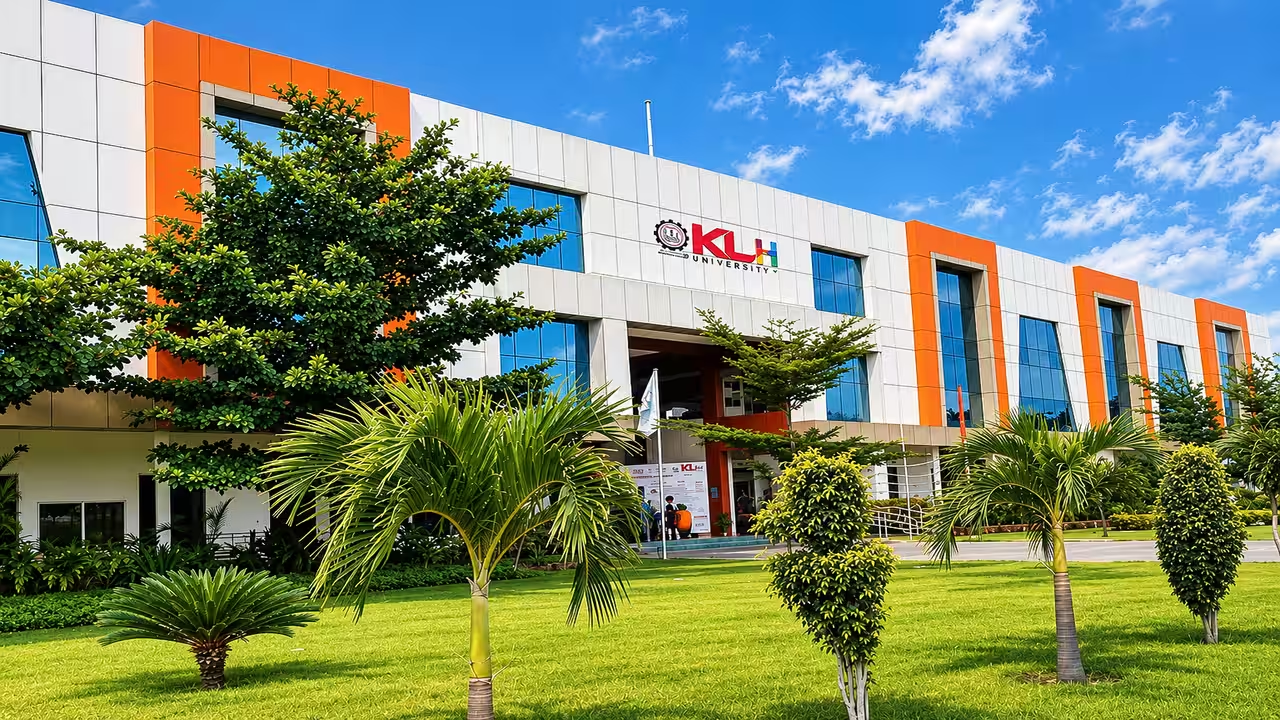
For generations, a university degree has been one of the most important gateways to a professional career. It still matters, but what employers expect that degree to represent is changing.The question in a job interview is increasingly moving beyond “What did you study?” to something far more practical: “What can you actually do?”Across industries, organisations are looking more closely at practical ability, problem-solving, communication, adaptability, digital fluency and real-world experience.In India too, this change is becoming increasingly relevant as graduates enter a workplace being rapidly reshaped by artificial intelligence, automation, data and evolving business models. Qualifications continue to matter, but employers increasingly want evidence of capability: projects completed, problems solved, technologies applied, ideas communicated and outcomes created.For higher education, this raises a larger question: if employers are changing the way they identify talent, should the way students learn change too?At KLH, this evolving employment landscape is influencing the learning approach across its Hyderabad campuses, including KLH Aziznagar, KLH Bachupally and KLH Global Business School, Kondapur. Academic learning is increasingly complemented by projects, laboratories, internships, hackathons, industry interactions, research, innovation, entrepreneurship and multidisciplinary experiences.The underlying idea is simple: students should have opportunities to use what they learn before the workplace asks them to prove it.Beyond the degree: Where knowledge meets applicationAcademic knowledge remains fundamental. But knowledge alone does not necessarily demonstrate workplace readiness.A computer science graduate may understand programming concepts, but an employer may also want to know whether the candidate can build an application, work with AI-enabled tools, analyse an unfamiliar problem, explain a solution and collaborate with a multidisciplinary team.Similarly, a management graduate may understand finance, marketing or strategy in theory, but professional environments demand the ability to interpret data, understand customers, communicate ideas, make decisions and respond when circumstances change.That space between knowing and doing is increasingly where employability is shaped.The challenge for universities, therefore, is not to choose between academic rigour and practical learning. It is to bring the two closer together.At KLH, project-based and experiential learning is supported through practical laboratory exposure, capstone projects, Engineering Projects in Community Service (EPICS), Design Thinking and Innovation (DTI), Idea expo, immersive social learning, peer learning and learner-centric teaching approaches. These experiences are intended to help students move from understanding concepts to applying, testing and refining them.Because the workplace rarely presents a problem with a predetermined answer.Why skills are becoming the new currency of employabilityTechnology is one of the biggest forces accelerating this transformation.Artificial intelligence, cloud computing, cybersecurity, automation, IoT, data analytics and other emerging technologies are continuously reshaping industries and the capabilities they require. A technology considered specialised when a student begins university may become mainstream before graduation, while entirely new tools and applications may emerge during the span of a degree.Learning a fixed set of technologies is therefore no longer enough.Students increasingly need to understand broader technological ecosystems, develop transferable capabilities and, importantly, learn how to acquire new skills as technologies evolve.KLH’s industry ecosystem includes collaborations and training initiatives, spanning areas including networking, AI and machine learning, cloud technologies, cybersecurity, process mining and automation.Across its engineering ecosystem, students are exposed to areas such as AI, IoT, cybersecurity, data-driven technologies and interdisciplinary applications. The Tri-Semester B.Tech framework introduced across KLH Aziznagar and KLH Bachupally also represents an effort to balance academic rigour with continuous learning and professional readiness.At KLH Global Business School, the Business Analytics Centre of Excellence combines exposure to industry experts and real-time datasets with hands-on training in Excel, Power BI, SQL, Python and AI applications. Domain-based simulations across marketing, finance, HR, analytics and business development further help students apply these skills to real-world business scenarios and decision-making. Such exposure serves a larger purpose: the professional world should not be something students encounter for the first time after graduation.Turning classrooms into spaces for real-world learningReal-world problems rarely arrive neatly packaged with a question, a formula and four possible answers.Often, identifying the problem itself is part of the challenge. Information may be incomplete. Assumptions need to be tested. Ideas fail. Teams disagree. Solutions need to be modified, defended or rebuilt.And that is precisely where some of the most valuable learning can happen.Hackathons, buildathons, research projects, industry assignments and innovation challenges place students in these uncertain situations and encourage the transition from “I know this” to “I can use this.”Across KLH’s Hyderabad campuses, such opportunities take different forms.At KLH Bachupally, initiatives such as HackWithAI, involving more than thousands of students and hundreds of teams, along with RAMPAGE, ForgeAscend and other technology challenges, have provided platforms for collaborative problem-solving, experimentation and rapid prototyping.At KLH Aziznagar, students have participated in AI-focused programmes, research initiatives and innovation projects.These experiences go beyond creating projects. Students encounter the process behind producing an outcome: identifying a need, developing an idea, dividing responsibilities, making decisions, working through setbacks, testing assumptions and improving a solution.That process develops capabilities that marks alone cannot fully measure.The movement from knowledge to application extends beyond engineering as well.At KLH Global Business School, students engage with areas such as business analytics, entrepreneurship and digital marketing through industry-linked learning designed to connect academic concepts with actual business environments.Srujana- an Art and Technology Student Exhibition, gave students from Animation and Gaming programmes an opportunity to showcase projects combining creative and technical capabilities before faculty and industry audiences. Similarly, the AI Leadership Summit brought together several industry leaders for conversations around areas including AI Governance, FinTech, InsurTech and Retail Technology, giving students exposure to discussions shaping contemporary business and technology.Varied disciplines may demand different capabilities, but the principle remains consistent: learning becomes more meaningful when students have to turn ideas into outcomes.AI is redefining what it means to be job-readyArtificial Intelligence is reshaping what it means to be job-ready. As routine and repeatable tasks become increasingly automated or augmented, employers are looking beyond technical proficiency to capabilities such as critical thinking, creativity, communication, collaboration, adaptability and judgement.Technical expertise rarely works in isolation. Whether explaining a solution, interpreting data or addressing a business challenge, professionals increasingly need to combine technological knowledge with human skills and make informed decisions in changing circumstances.Building employability throughout the learning journeyCareer readiness cannot begin only when placement season arrives. Professional capability develops progressively through practice, application and real-world exposure.KLH’s placement-preparation framework reflects this approach, covering aptitude, analytical and logical abilities, technical competencies, emotional intelligence, interpersonal skills, managerial capabilities and leadership development.Its structured Campus Recruitment Training programme follows a three-tier model focusing on foundational skills, advanced problem-solving and mock interviews, supported by individual student-progress tracking. Continuous acceleration programmes, project-based learning, presentations, assessments and company-specific preparation further strengthen this process, while workshops, industry visits and professional interactions help students understand workplace expectations while still on campus.The focus, therefore, is not simply on preparing students for placement season, but on building professional readiness throughout their university journey.From knowledge to capability: the value of learning by doingPerhaps the clearest way to understand skills-first hiring is through the language graduates can use to describe themselves.A qualification enables a student to say:“I studied this.”Experience enables the same student to say:“I built this.”“I analysed this.”“I worked on this.”“I presented this.”“I solved this.”That difference matters.A project demonstrates application. An internship introduces workplace realities. A hackathon tests problem-solving under pressure. Research develops inquiry and analytical thinking. Entrepreneurship forces an idea to confront a real need. Presentations strengthen communication, while working in teams develops collaboration and shared responsibility.Preparing graduates for careers that will keep changingFor KLH, the focus extends beyond preparing students for their first interview or job. It is about creating a learning environment that encourages application, experimentation, collaboration, industry engagement, research, innovation and entrepreneurship, while developing the ability to keep learning and adapting.For students and parents choosing a university, academic programmes, faculty, infrastructure, rankings and placements will continue to matter. But the evolving workplace adds another important question:“Where can I develop the capabilities that will make my degree matter?”A degree remains an important beginning. But in a world of changing technologies and careers, the graduates who stand out may be those who can apply what they know, adapt to what changes and continue learning along the way.Disclaimer - The above content is non-editorial, and TIL hereby disclaims any and all warranties, expressed or implied, relating to it, and does not guarantee, vouch for or necessarily endorse any of the content.Get the latest Business News and Live updates. Download the TOI app.
Topics in this story
Gathered from external sources. Rights to this text belong to whoever originally published it.