European Central Bank set to appoint its first Spanish leader
The European Central Bank looks set to name Pablo Hernández de Cos its next president, marking the first time that Spain will helm one of the world’s most influential central banks.
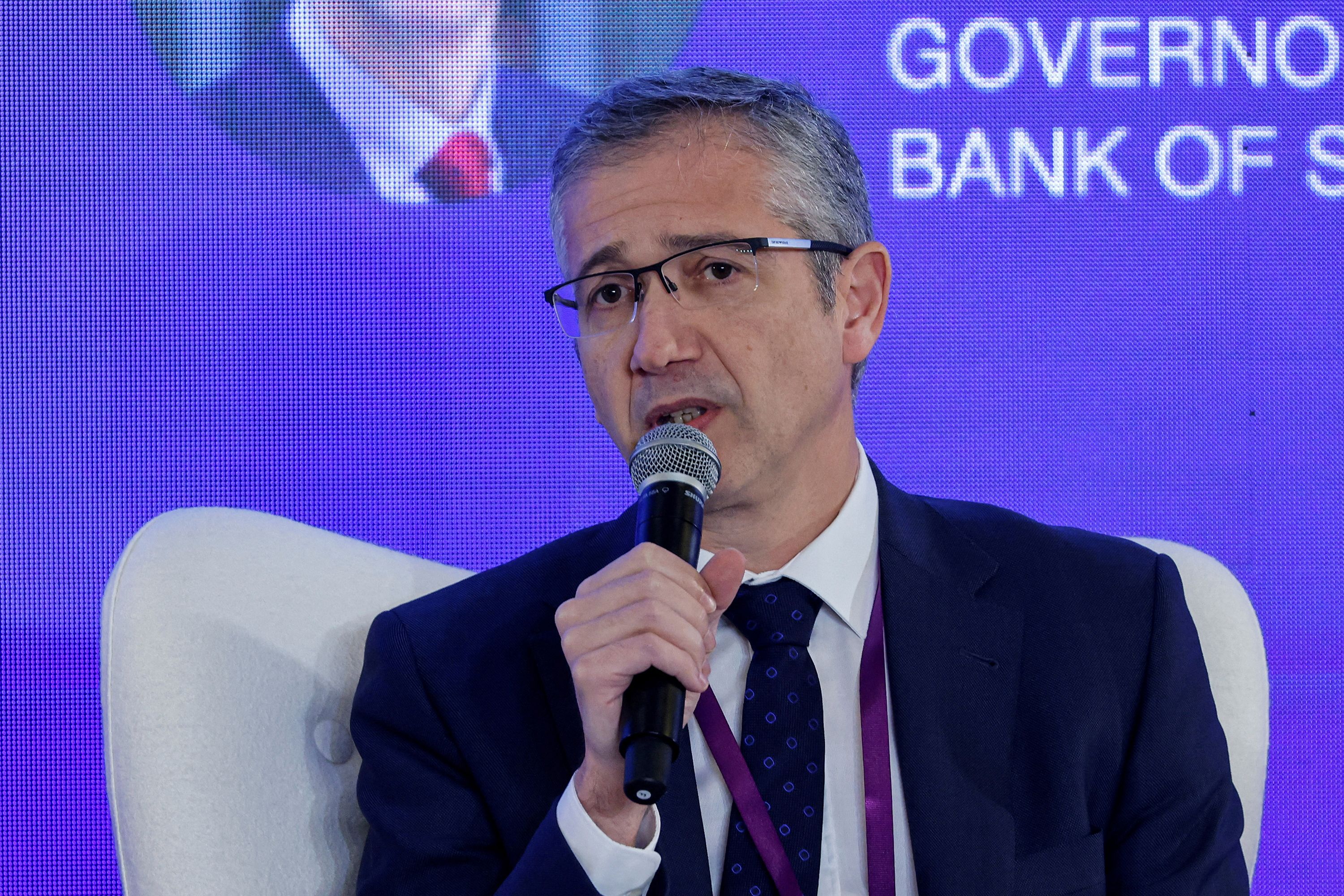
The European Central Bank is set to name Pablo Hernández de Cos as its next president, marking the first time that Spain will helm one of the world’s most influential central banks. De Cos, whose appointment must still be formally approved, will succeed Christine Lagarde when she steps down in February after euro area member states endorsed his appointment, according to President of the European Council, António Costa. His appointment and that of two new ECB board members is expected to be finalized in December, Costa said on X, at a meeting of the European Council, a body comprised of European Union leaders that sets the bloc’s political agenda. This would be the first time that someone from Spain holds the top job at the ECB, which is tasked with keeping inflation in check across the 21 countries that use the euro currency. The institution has had four presidents since it was founded in 1998. Lagarde, who was appointed in October 2019, announced last month that she would step down eight months before her term ends in order to speak more freely on issues beyond monetary policy. De Cos formerly served as governor of Spain’s central bank and is now general manager at the Bank for International Settlements, an international institution that is commonly referred to as the “central bank for central banks.” He will have to contend with inflation currently running at 4%, twice the ECB’s target. He will also take over at a time of heightened bond market turmoil, particularly in France, where high debt levels threaten a fiscal crisis in the European Union’s second-biggest economy. While the ECB has so far left it up to the French government to fix its budgetary woes, it could be forced to intervene if a sharp rise in bond yields destabilizes other European economies and financial markets. French president Emmanuel Macron said on X that “a consensus emerged” among eurozone member states on the ECB nominations. Macron added that he welcomed a “balanced trio of individuals serving the stability and prosperity of the euro area, with Pablo Hernández de Cos as President and Laurence Boone and Markus Brunnermeier on the Executive Board.” Boone is a French economist and head of corporate and investment banking at Santander in France. Markus Brunnermeier is a German economist and a Princeton University professor. He is set to replace Philip Lane as ECB chief economist, while Boone will take over from Isabel Schnabel to oversee market operations. ‘Complex backdrop’ for new leaders Spanish Prime Minister Pedro Sánchez also welcomed the selection of De Cos in a post on X in which he acknowledged two other Spaniards in governing positions within the EU: Teresa Ribera, who is an executive vice president at the European Commission, and Nadia Calviño, who is president of the European Investment Bank. “In short, a Spain that is leading in Europe as never before,” he wrote. Spain, which has transformed from a casualty of the eurozone debt crisis to the region’s fastest-growing major economy, will hold a snap general election Sunday that could see Sánchez’s Socialist party defeated by right-leaning contenders. France, Italy and Poland will all hold elections next year, which could see right-wing political parties make significant gains. The ECB’s new leadership faces a “complex backdrop” of persistent inflation, “public indebtedness,” geopolitical and technological shifts and “consequential elections across Europe over the next year,” Deutsche Bank economists Mark Wall and Michael Kirker wrote in a note Thursday. “The renewal of ECB leadership comes at a significant time,” they said.
Topics in this story
Gathered from external sources. Rights to this text belong to whoever originally published it.