Trade irony amid Trump threat: Why Russia is buying its own oil as fuel from India
The irony in Russia's latest oil trade is hard to miss.
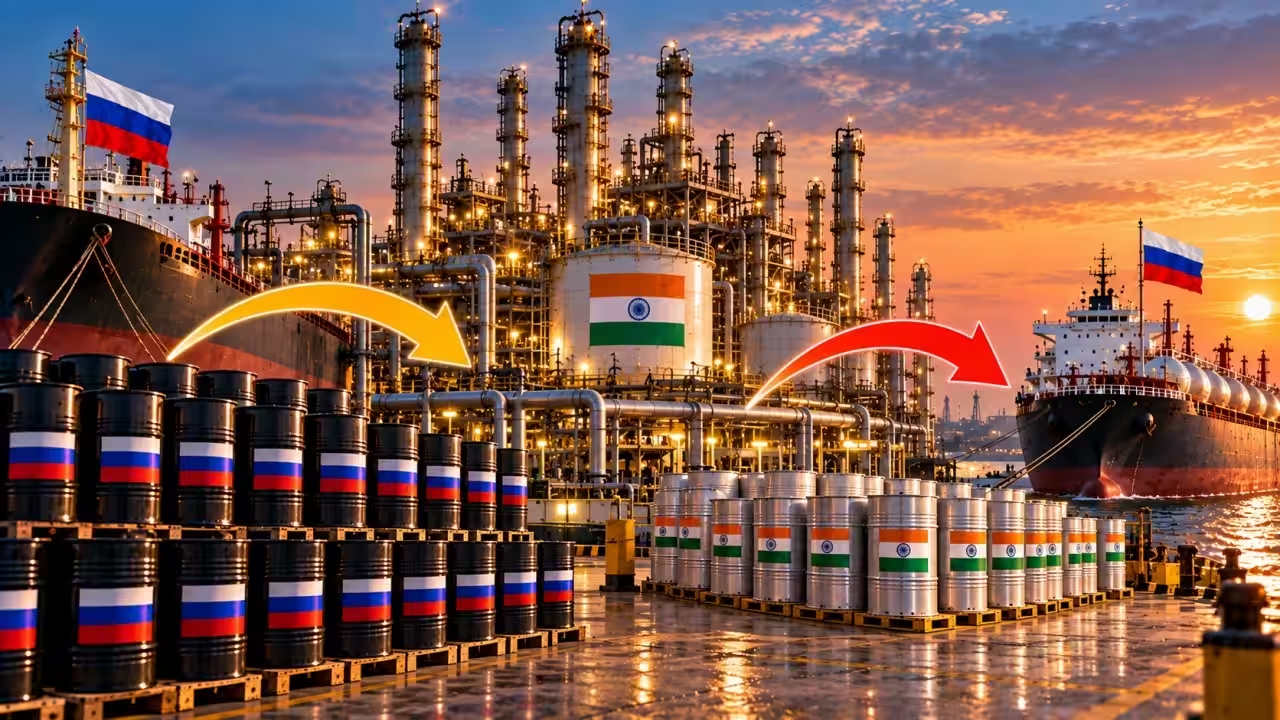
The irony in Russia's latest oil trade is hard to miss. A country that has long been a major exporter of not just crude oil, but also refined petroleum products, is now importing gasoline from India. In a way Russia is importing back its own oil from India!According to a recent analysis by the Centre for Research on Energy and Clean Air (CREA), Russia imported a record 172,000 tonnes of oil products in August 2026. And, nearly 70% of those imports came from India.For India, Russia remains its single largest supplier of crude oil, and the numbers have hit new highs in the last few months with the US-Iran war disrupting oil supply from the Middle East via the Strait of Hormuz.In July 2026, India’s imports of Russian crude stood at a record high. In August, Russia imported refined petroleum products from India.(function(){function e(){window.addEventListener(`message`,function(e){if(e.data[`datawrapper-height`]!==void 0){var t=document.querySelectorAll(`iframe`);for(var n in e.data[`datawrapper-height`])for(var r=0,i;i=t[r];r++)if(i.contentWindow===e.source){var a=e.data[`datawrapper-height`][n]+`px`;i.style.height=a}}})}e()})();Why is Russia with all its oil supply and refining infrastructure importing gasoline from India? What does this mean for India, is this a new trend, and what happens if the Donald Trump administration imposes tariffs or sanctions on countries trading with Russia? We dive deep:India’s refined oil product exports to RussiaThe scale of Russia’s oil products imports, however small, is still significant.“Russia’s import volumes in August 2026 were more than seven times the previous monthly high that was recorded since the full-scale invasion and three times the total import volume for the whole of 2025,” notes CREA in its report.Gasoline accounted for 74% of Russia's total oil-product imports in August, compared with an average of just 6% between 2023 and 2025. The surge made Russia a net importer of gasoline during the month, despite its position as one of the world's largest exporters of refined petroleum products!“India supplied 70% of Russia’s oil product imports (94% of its gasoline imports) in August, 120 thousand tonnes of gasoline (EUR 78 mn), all of it loaded at the Vadinar refinery and sold by EU-sanctioned Nayara Energy and bought by Rosneft,” says CREA.Rosneft holds 49.13% of Nayara Energy, and Vadinar took 100% of its crude from Russia in the first eight months of 2026, up from 81% across 2025.This has created an unusual trade flow: Russian crude is sent to a refinery partly owned by Rosneft, processed into gasoline and then shipped back to Russia. CREA said Russia was therefore paying a refinery it partly owns to process its own crude into fuel it could no longer produce domestically, before transporting that fuel halfway around the world.According to CREA, the logistics involved were also extensive. Each gasoline cargo from Vadinar was transferred between vessels in a ship-to-ship operation at the Damietta Lightering Zone off Egypt, before being unloaded at Russia's Arctic port of Beloe More. Every one of these cargoes moved on a sanctioned tanker, while four of the six vessels involved had flown a false flag at some point during the previous two years, the CREA report claimed.Other countries also supplied refined products. Egypt exported 25,000 tonnes of diesel worth EUR 16 million to Russia, while South Korea exported 18,000 tonnes of oil products, mostly gasoil.Turkey also appears to have begun supplying gasoline to Russia.Natalia Katona, Commodity Analyst explains that three traceable cargoes, carrying 325,000–350,000 barrels of gasoline each, arrived at Russia’s White Sea oil terminal from the Vadinar refinery.“This means that only the already sanctioned Nayara Energy, in which Russia’s Rosneft holds a 49.13% stake, risked exporting gasoline directly to Russia. As Russia is the sole supplier of crude to the Vadinar refinery, this trade is effectively a round trip: Russian crude is refined into gasoline and shipped back for consumption in Russia,” she explains.However, She notes that some additional gasoline might have reached Russia indirectly from India.“For instance, gasoline exported from Morocco’s Tangier terminal and Turkey’s Mersin terminal was clearly produced elsewhere, as neither location has a refinery nearby. Since Reliance’s Jamnagar refinery has been exporting oil products, including gasoline, to these locations, it is plausible that they served as transit hubs for onward shipments to Russia,” she tells TOI.Why is Russia importing refined fuel?The underlying issue is not Russia's access to crude oil but its ability to convert crude into usable fuels.Refinery outages and infrastructure disruptions have constrained domestic production, forcing Russia to import products such as gasoline.As CREA states in its report: In terms of magnitude, Russia’s import volume of oil products is not colossal. However, Russia, formerly the world’s largest oil-product exporter, now faces additional logistical costs and higher prices to import products that it previously produced domestically.(function(){function e(){window.addEventListener(`message`,function(e){if(e.data[`datawrapper-height`]!==void 0){var t=document.querySelectorAll(`iframe`);for(var n in e.data[`datawrapper-height`])for(var r=0,i;i=t[r];r++)if(i.contentWindow===e.source){var a=e.data[`datawrapper-height`][n]+`px`;i.style.height=a}}})}e()})();“Russia’s need to buy gasoline from a refinery it partly owns in India and ship it halfway around the world using the same fleet that carries its exports has demonstrated the impact of Ukrainian drone strikes on its domestic refining capacity,” the CREA report says.However, Ivan Ryabov, Head of Oil Trading Analysis at Kpler says that Russia has substituted a large part of the lost gasoline production volume by relaxing domestic motor fuel quality standards and using rail imports from neighboring countries.“Seaborne imports (which started in July this year) represent only about 4% of domestic demand for those products in Q3 2026. Additionally, these exports do not represent a significant outlet for Indian oil product exports overall,” he tells TOI.What does it mean for India?One important caveat to understand is this: India did not supply 70% of Russia's fuel consumption. It supplied around 70% of Russia's oil-product imports, which are normally a very small part of the Russian fuel market.According to Praveen Rai, Director, Grant Thornton Bharat the trade demonstrates the flexibility and scale of Indian refining capacity rather than the emergence of Russia as a major export market for Indian refiners.He notes that generally speaking, it would be less than 2% of Russia’s overall petroleum product consumption.In fact, Russia has traditionally been one of the world's largest exporters of refined petroleum products and imported less than 5,000 tonnes per month of seaborne products on average during 2023-25.“The August spike was therefore an exceptional response to refinery disruptions rather than evidence of long-term dependence on Indian fuel supplies,” Rai says.This opportunity should also be viewed in the context of India's broader petroleum export market. India's exports of petroleum products remain overwhelmingly oriented toward large established markets across Europe, Asia, the Middle East and Oceania.“Russia remains a relatively small destination compared with major buyers such as the Netherlands, the UAE, Singapore, the United States and Australia. Therefore, while the August trade flow is commercially notable and highlights India's growing role in global refining, it does not fundamentally alter India's export geography,” Rai tells TOI.Natalia Katona makes an important point: Since August, no direct cargoes from India have arrived at Russian terminals, and no loaded cargoes are currently en route.“So these were emergency purchases by Russia, not a new set trade route. However, given the volatility of the war in Ukraine and the possibility of further outages, more cargoes could arrive from Vadinar for sure,” she says.Trump tariff threatWith Russia’s refinery infrastructure hit, and its dependence on imported oil products increasing, a new threat has also emerged.Donald Trump has signed Lindsey O. Graham Sanctioning Russia and Iran Act which allows the US President to impose up to 100% tariffs on countries buying oil in a big way from Russia.If India faces a 100% tariff, will it stop buying oil from Russia? And in turn, what would it mean for the export of refined oil products made from Russian crude?Natalia Katona says that even if Trump imposed sanctions, the Vadinar refinery would not feel any additional pressure in terms of either buying Russian crude or selling gasoline back to Russia.“The sanctions imposed earlier have already turned it into a safe emergency source of gasoline for Russia, while its other products are either sold to destinations that are unconcerned about their origin (such as Sudan) or resold through STS transfers in the Gulf of Oman to untraceable buyers,” she tells TOI.Kpler’s Ivan Ryabov on the other hand expects the Indian oil industry to exercise caution as soon as any US unilateral punitive measures toward India are announced.For Russia, the issue is less about demand and more about higher compliance, financing, insurance and shipping risks associated with transactions involving sanctioned entities.“As a result, Russia-bound fuel sales could face greater commercial friction even where they remain legally permissible. The bigger question is whether sanctions pressure reduces Indian purchases of discounted Russian crude,” Praveen Rai says,Russian barrels have supported refinery margins and export competitiveness in recent years. If refiners shift towards Middle Eastern, US, African or Latin American crude, export volumes may remain resilient, but margins could narrow as the discount advantage diminishes.In short, Russia remains a relatively small export opportunity for Indian refiners.“The greater risk from US sanctions or tariffs is not the loss of Russian demand itself, but the potential erosion of the cost advantage that discounted Russian crude has provided to India's refining sector,” concludes Rai.You use AI every day. Now get your AI Quotient. Take the AIQ test.
Topics in this story
Gathered from external sources. Rights to this text belong to whoever originally published it.