She received Rs 9.04 lakh leave encashment on retiring from LIC; taxman allowed only Rs 3 lakh exemption, but ITAT Jaipur grants relief even after 1,277-day appeal delay
How much of your leave encashment is exempt from income tax? That depends on whether you are a government employee or a private sector employee.
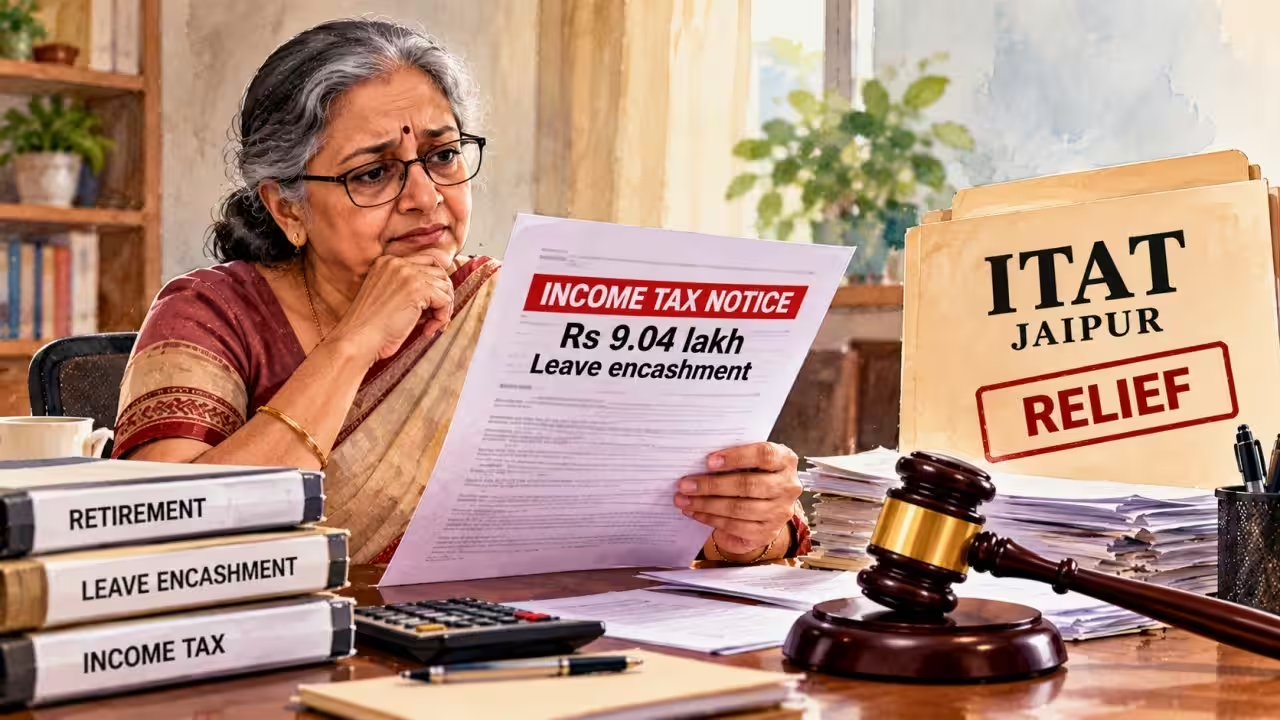
How much of your leave encashment is exempt from income tax? That depends on whether you are a government employee or a private sector employee. The limit for private sector employees was recently raised to Rs 25 lakh.In one case, a retired woman faced a tax notice on her leave encashment, with the Income Tax Department allowing only part of it for exemption. Read on to know why she won relief from ITAT.What the case is aboutA woman retired from Life Insurance Corporation of India (LIC) on June 30, 2020 after more than 30 years of service. She received Rs 9.04 lakh as leave encashment, in addition to her other retirement benefits. While filing her income tax return (ITR), she claimed a tax exemption on the entire leave encashment amount.Also Read | Taxpayer declared Rs 1.79 lakh in ITR, faced Rs 11.22 crore income addition on large cash deposits, unsecured loans; ITAT grants him chance to substantiate case with condition he plant 500 treesShe was unaware that LIC employees fall under the category of non-government employees for this purpose. Under the rules applicable in 2020, she was eligible for a tax exemption of only Rs 3 lakh on leave encashment, rather than the full Rs 9.04 lakh she had claimed. The exemption limit for leave encashment received by non-government employees was raised to Rs 25 lakh in Budget 2023.The Income Tax Department restricted her exemption to Rs 3 lakh and sought to tax the balance of Rs 6.04 lakh. This led to an income tax notice being issued to her.In her application seeking condonation of delay, the woman explained that she had entrusted the matter to a tax consultant. According to her, the consultant did not file the appeal before the tribunal or inform her that the Commissioner of Income Tax (Appeals) had dismissed her case. She said she learnt about the order after receiving a substantial tax demand.As a result, she approached the Income Tax Appellate Tribunal (ITAT), Jaipur, only after a delay of around 1,277 days, engaging a new chartered accountant to pursue the matter.The Income Tax Department opposed her request, arguing that she had not established “sufficient cause” for such a long delay.The tribunal first had to decide whether her explanation justified condoning the delay and then consider whether the higher exemption limit applied to her leave encashment.On September 28, 2026, Mrs Moongia won the case before the ITAT Jaipur.Also Read | Woman paid Rs 79 lakh for a Rs 2.14 crore villa, but construction remained unfinished; Telangana RERA orders full refund with 10.7% interest and fines builder Rs 1.03 croreWhy did the retired woman win relief?The ITAT Jaipur accepted her request to condone the delay of 1,277 days. It observed that the law recognises that an individual should not be held responsible for a mistake or negligence committed by a tax consultant hired to handle their tax matters. A taxpayer should not have to suffer because of an error made by their consultant.On the delay, the tribunal considered Moongia's explanation that she had relied on her tax consultant to handle the proceedings. It observed that a professional handling a client's tax case was expected to communicate important developments, including the dismissal of an appeal, and advise the client on the next steps.The tribunal stated that “mistake or negligence on the part of a tax consultant engaged by the assessee cannot be attributed to the assessee and he/she should not be made to suffer.” It also referred to the Supreme Court's decision in Collector, Land Acquisition v. Mst Katiji, which supports a liberal approach to condoning delays in appropriate cases.Also Read | He moved to the US for a job and forgot to file his India ITR; taxman imposed Rs 8.29 lakh penalty, but ITAT Jaipur cancelled it for this reasonAfter considering her explanation, the tribunal held that there was “sufficient cause” to condone the delay of 1,277 days. It therefore admitted the appeal for consideration on its merits.The tax dispute concerned the exemption ceiling under Section 10(10AA). The tax authorities had relied on the Rs 3 lakh limit, while the woman’s representative cited CBDT Notification No. 31/2023, dated May 24, 2023, which raised the exemption limit for eligible employees to Rs 25 lakh.The Jaipur tribunal also considered earlier ITAT decisions that had applied the revised limit. It noted that a coordinate bench had already ruled in favour of allowing leave encashment exemption within the Rs 25 lakh ceiling.Explaining its conclusion, the tribunal said: “In view of this legal position, we are in respectful agreement of what has been held by the afore cited coordinate Jaipur Benches of this Tribunal as noted hereinabove.”Also Read | She bought shares for Rs 13.5 lakh and sold them for Rs 77.47 lakh after 18 months; taxman denied capital gains exemption, but ITAT gives relief and deletes Rs 79 lakh in additionsIt ultimately held that the woman was eligible for exemption on the Rs 9,04,669 she had received.Chartered Accountant Suresh Surana told ET that leave encashment paid to central and state government employees upon retirement is completely exempt from income tax. However, employees working in the private sector and other non-government organisations are eligible for exemption only up to the limits laid down under the income-tax law.Surana said any leave encashment received beyond the eligible exemption limit is taxable under the head “salaries” in the year in which the payment is received. The excess amount is taxed at the normal income-tax slab rates applicable to the employee, with no separate or special tax rate for leave encashment.You use AI every day. Now get your AI Quotient. Take the AIQ test.
Topics in this story
Gathered from external sources. Rights to this text belong to whoever originally published it.