Millennium Nears $100 Billion in New Era for Giant Hedge Funds
Izzy Englander’s hedge fund firm has posted double-digit returns almost every year since inception and is poised to close on $22 billion of new commitments n...
(Bloomberg) -- Millennium Management is speeding toward a rarefied status in the hedge fund universe.
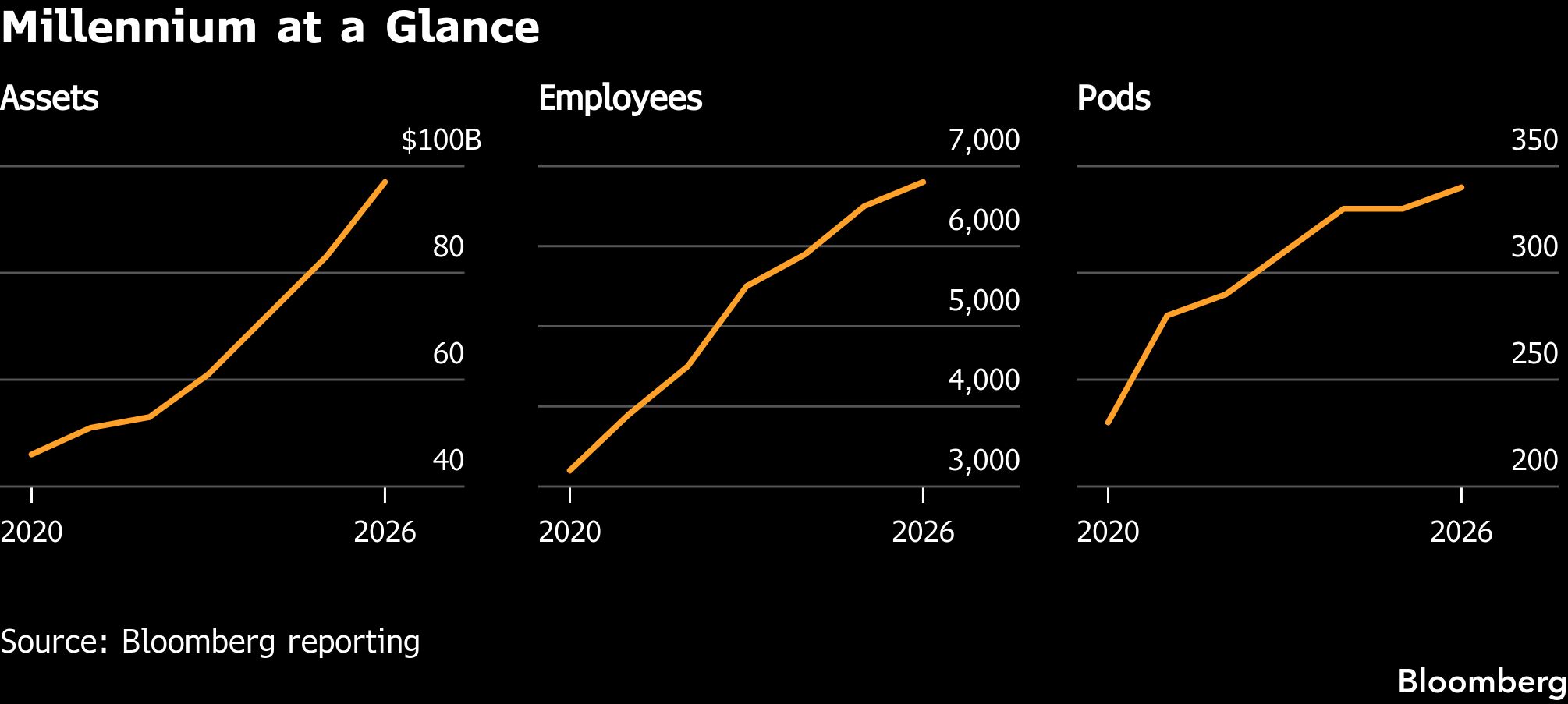
Its assets have hit $97 billion, according to people familiar with the matter, more than double what Millennium oversaw six years ago. The ascent toward $100 billion has vaulted Izzy Englander's firm past most of his largest competitors — even as they, too, are managing record sums — and landed him into territory that few other hedge funds have ever breached.
Englander, 77, is showing no signs of slowing down. In fact, he's ramping up an unusual model of seeding dozens of smaller would-be rivals to give his firm more capacity to take on investor cash.
On Oct. 1, Millennium will close on $22 billion of new commitments, calling $2 billion of it that day, and the rest within four years. It has also talked about raising $3 billion more for a less-liquid credit fund. Given that the firm usually generates annual returns of at least 10%, total assets could crack $130 billion in the next few years.
It's a golden age for the industry's top players. The largest, AQR Capital Management, surpassed $140 billion of hedge fund assets this year, and DE Shaw & Co. now oversees about $90 billion. A half-dozen other firms have exceeded $75 billion, the most ever to eclipse that threshold.
As the biggest hedge funds get even bigger, some institutional investors are growing concerned that more cash parked at fewer firms could create systemic risks to the financial system, according to Ivy Invest co-founder Wendy Li.
These funds tend to invest similarly, and in times of distress, often sell at the same time, Li said.
Weighing the risks of a long-short equity fund is fairly straightforward, "but at big quants or multistrats, it would be harder to pinpoint what might go wrong until after the fact," she said.
That Millennium and other players are clustered around the $100 billion mark underscores just how much the industry has changed over the decades.
Thirty years ago, the standard was a star portfolio manager with a small team making a few high-stakes bets. But running more than $20 billion proved impossible. Even investing legends Julian Robertson and George Soros, who once were tied as heads of the world's biggest hedge funds, failed to sustain swashbuckling trading at that size. In 2000, Robertson was forced to close his Tiger Management after losing billions of dollars, and Soros moved to less speculative wagers after the dot-com bubble burst.
Topics in this story
Gathered from external sources. Rights to this text belong to whoever originally published it.