Job Hopping Paid Off For Older Workers. Gen Z May Miss Its Chance
The big raises that once made job switching a smart salary strategy have disappeared. That could hurt the long-term earnings of workers under 35.
After graduating from the University of Virginia in 2019 with a bachelor's in business analytics and finance, Megan Lieu took a job at EY Consulting. She spent two years there and then began job hopping, staying at one place for just six months. Yet each of her three moves, she proudly recalls, brought her a hefty income bump of around 20%.
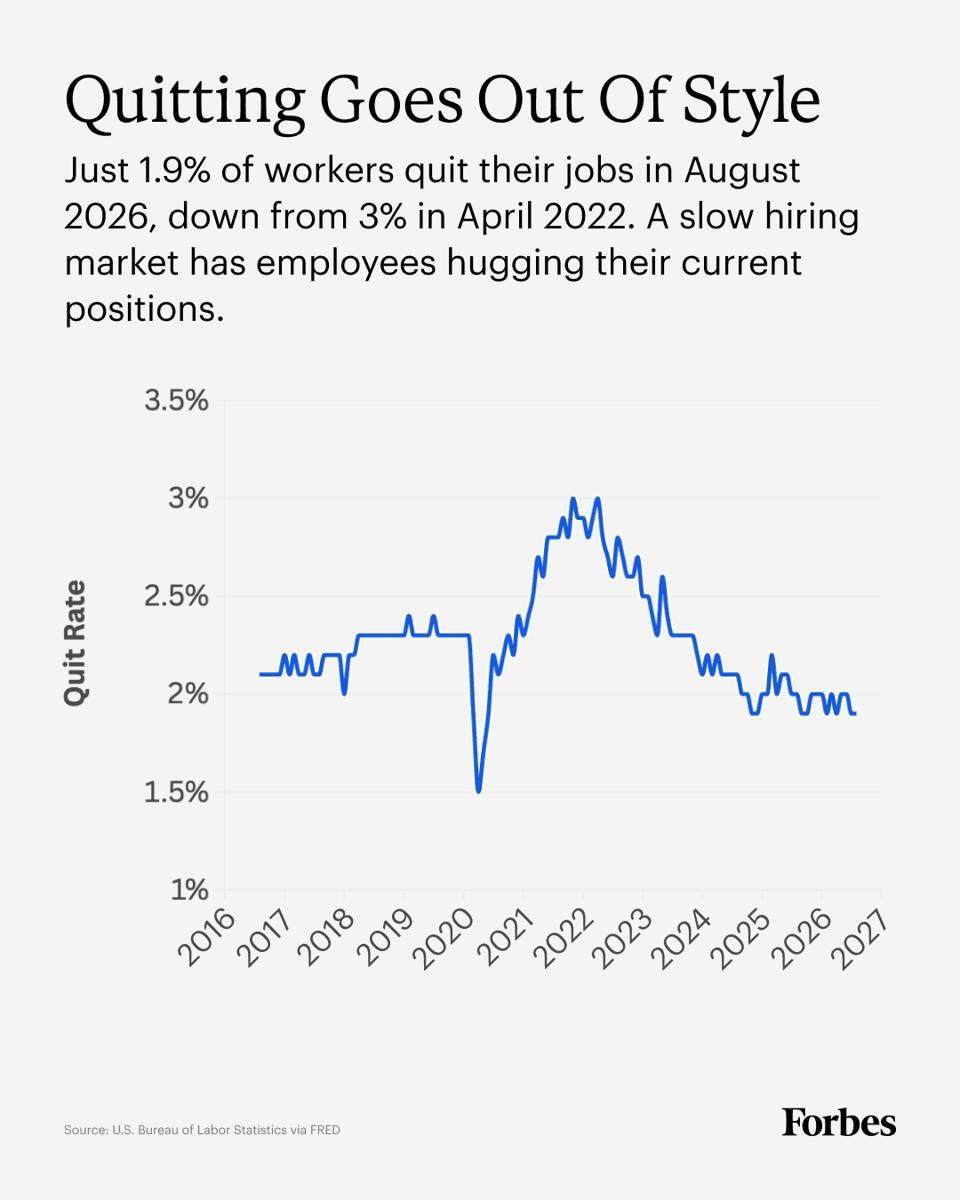
Now 30 and self-employed since 2024, Lieu advises friends and new grads not to job hop as she did, because it just doesn't pay these days. She left her first job in 2021, she explains, "during the initial boom of the post-COVID era when many people were getting new jobs and the power was very much in the employees hands rather than the employers." But that post-Covid "Great Resignation" has given way to what is now being called the "Big Stay." At a time when hiring is slow and employers seem to have the upper hand, workers are far less likely to job hop and those who do switch jobs are seeing more meager pay gains. Just 1.9% of nonfarm workers quit their jobs this past August, down from 3% in April of 2022, the Bureau of Labor Statistics reports.
That's a particular problem for Generation Z and younger millennials since job hopping early in a career is one of the ways that new workers have achieved income gains, setting them on the path to higher lifetime earnings. Historically, workers see their fastest real wage growth (that is, increases above inflation) before they hit 35 , with gains leveling off until 45 and real wages pretty much flat after that.
The current situation may feel particularly cruel to Gen Zers because of what they saw in the recent past. "If they have a sibling that is three or four years ahead and who entered the labor market in the Great Resignation, they're having a completely different experience now than their older sister or brother did,'' says Nela Richardson, chief economist for ADP Research, a branch of the big payroll company. "It's a solid labor market, but it's different for young people."
How different? In the second quarter of 2026, the unemployment rate for all young workers, aged 22 to 27 was 7.2%, compared to 4.1% for all workers, according to the Federal Reserve Bank of New York. Even those young workers with college degrees had a 5.7% unemployment rate. Moreover, 42% of young college grads (compared to 34% of all those with college degrees) were working in jobs that didn't necessarily require a diploma.
Entry level workers are so pessimistic that they've driven Glassdoor's Employee Confidence Index to what the job site says is a record low. In September, just 43% of junior employees were confident about their company's outlook, compared to 63% of those in the most senior ranks. That gap has been widening, with entry-level worker confidence declining four percentage points over the past year, even as the top folks became more confident about the economy and their own company's fortunes. Glassdoor Chief Economist Daniel Zhao explained it this way: "Entry level workers continue to face a difficult job market with limited opportunities even for the workers who have been able to find a job."
Topics in this story
Gathered from external sources. Rights to this text belong to whoever originally published it.