Trump plan to raise debt limit on shaky ground
Welcome to The Hill’s Business & Economy newsletter {beacon} Business & Economy Business & Economy The Big Story Trump plan to raise debt limit on shaky ground President Trump’s plan to raise the debt limit through the end of his presidency before Republicans likely lose control of Congress is on shaky ground because of…
Trump plan to raise debt limit on shaky ground
President Trump’s plan to raise the debt limit through the end of his presidency before Republicans likely lose control of Congress is on shaky ground because of rising concerns over the national debt — which has reached $40 trillion.
The president is quietly pushing Senate Majority Leader John Thune (R-S.D.) and Speaker Mike Johnson (R-La.) to use a third budget reconciliation package to extend the debt limit through 2029 — the end of Trump’s term — to avoid the prospect of a difficult negotiation with Democrats next year if they win control of the House or both chambers of Congress.
Yet Trump’s desire to avoid a standoff with Democrats means getting almost all Senate and House Republicans on board with a plan to raise the nation’s borrowing authority by another $5 trillion — and some Republicans say that looks increasingly unlikely.
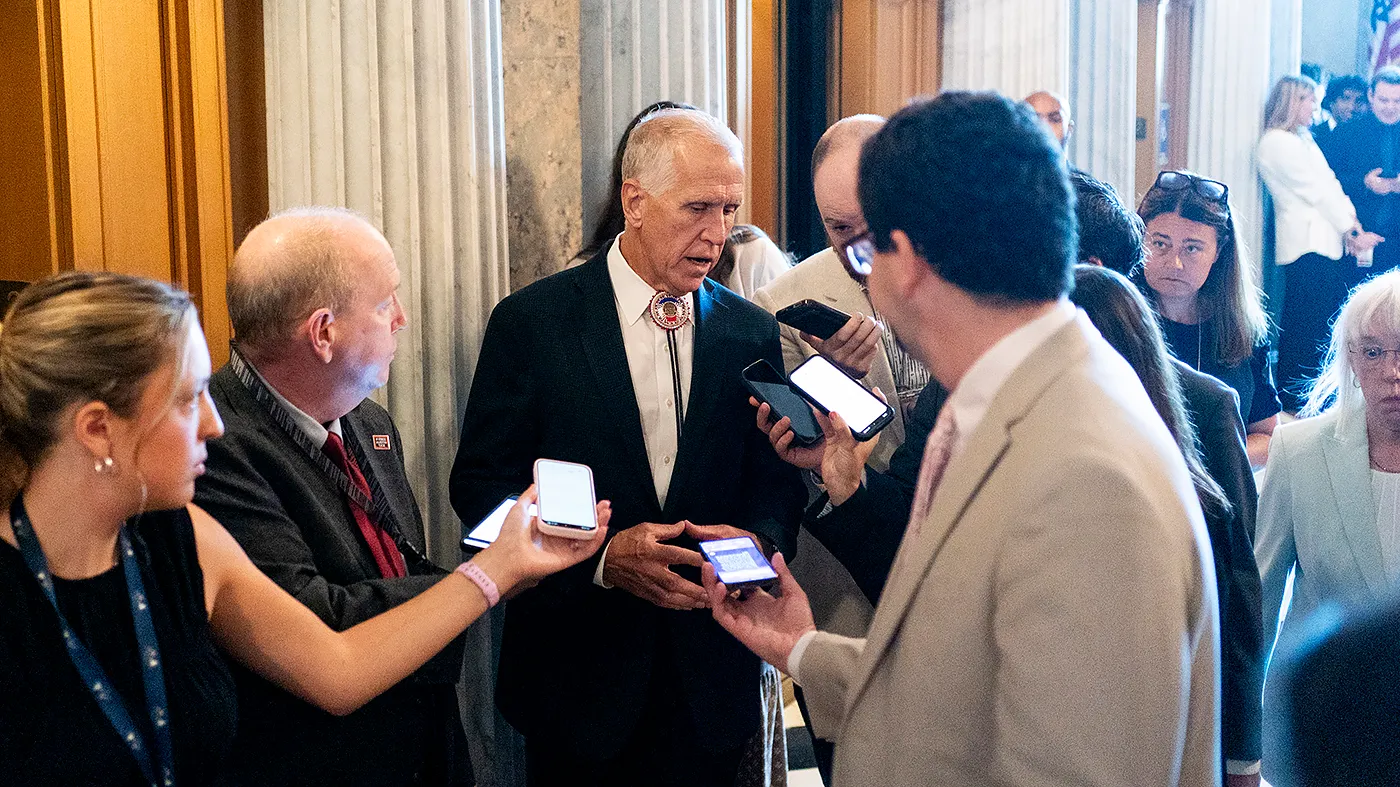
“If you’re really trying to curb the debt, you wouldn’t do a debt ceiling for two years. You’d try and use it as a lever to change things,” said Sen. Thom Tillis (R-N.C.), who warned that Social Security and Medicare will likely need to undergo significant reforms in the next few years to remain solvent.
“You just see interest rates, spending. Every indicator in my mind leads me to believe that before 2032 we’ll have to deal with at least one trust fund if not two that will be insolvent,” he said. “We’ll be incapable of writing a check so you’re going to be forced to do the cuts that we should have been doing the last 12 years.”
Social Security’s trustees warned in a June report that the popular entitlement program is on pace to become insolvent by the end of 2032, which could force as much as a 22 percent cut to benefits.
The program’s trustees moved up the date of insolvency by a year amid annual federal deficits of nearly $2 trillion .
Medicare’s hospital insurance trust fund is projected to become insolvent in 2033, according to the Medicare Trustees annual report from June.
Debt is becoming a bigger political problem as investors demand larger premiums to buy U.S. treasuries, which finance the debt. That in turn is pushing up the costs of mortgages and consumer debt.
The Hill’s Alexander Bolton has more here .
Welcome to The Hill’s Business & Economy newsletter , I’m Julia Shapero — bringing you the latest on the intersection of Wall Street and Pennsylvania Avenue.
Did someone forward you this newsletter? Subscribe here.
Key business and economic news with implications this week and beyond:
Gas station and travel center chain Buc-ee’s said it will seek out “conservative, business friendly” states for new locations after receiving pushback over its decision to go after small business owners with allegedly similar logos.
Paul Gigot, the editorial page editor of The Wall Street Journal, said investor Stanley Druckenmiller did not violate the Journal’s policies when he used artificial intelligence to write an op-ed the outlet published Monday.
United Airlines will add 10 new destinations next year — the largest international expansion in the Chicago-based company’s nearly 100-year history.
The Federal Reserve’s preferred measure of inflation remained flat in July, according to data from the Bureau of Economic Analysis released Wednesday.
Upcoming news themes and events we’re watching:
Federal Reserve Chair Kevin Warsh gives remarks before the Jackson Hole Economic Policy Symposium on Friday at 10 a.m. EDT.
Branch out with more stories from the day:
NEW YORK (AP) — Oil prices fell again on Tuesday, which helped ease worries in the bond market and …
Business and economic news we’ve flagged from other outlets:
The connections that turned Leopold Aschenbrenner into the fallen ‘Nostradamus of AI’ ( Wall Street Journal )
Dolly Parton was a trailblazer in business, too ( The New York Times )
A federal judge in Boston on Wednesday lifted a nationwide block on mail-in voting restrictions, temporarily clearing the way for the Trump administration to begin implementing them ahead of the November midterms. Read more
President Trump has ordered all American flags to be flown at half-staff in memory of Dolly Parton, who died Tuesday at the age of 80. Read more
Opinions related to business and economic issues submitted to The Hill:
Topics in this story
Gathered from external sources. Rights to this text belong to whoever originally published it.