Trump’s $8 billion farm lifeline won’t fully solve farmers’ diesel problem
The Trump administration’s $8 billion relief program for farmers is throwing a lifeline to the industry, but producers are still facing lower margins due to high diesel prices amid the Iran war — and experts say the move might only buy time for solving deeper challenges. Through the initiative announced earlier this week, farmers will…
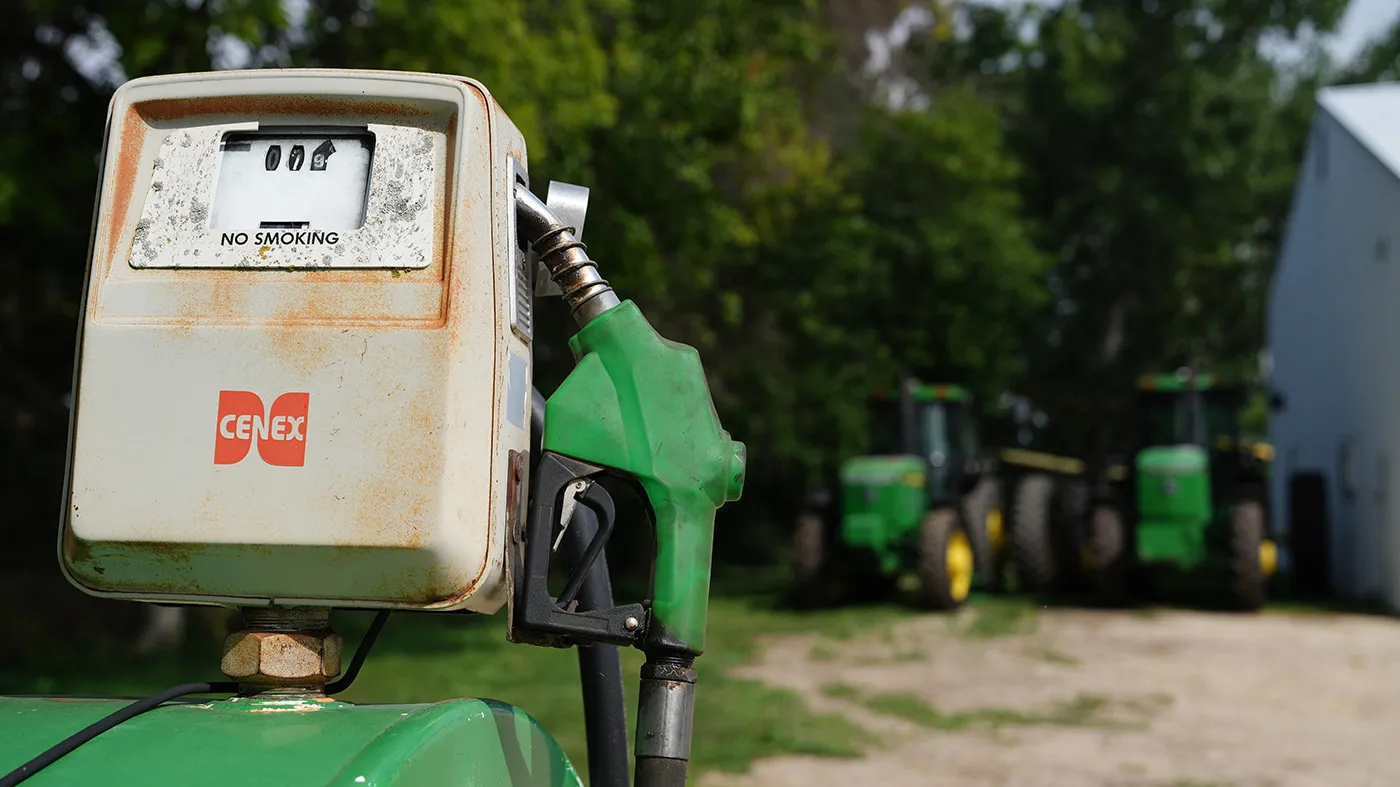
The Trump administration’s $8 billion relief program for farmers is throwing a lifeline to the industry, but producers are still facing lower margins due to high diesel prices amid the Iran war — and experts say the move might only buy time for solving deeper challenges.
Through the initiative announced earlier this week, farmers will receive “one-time” payments from the U.S. Department of Agriculture (USDA) in the midst of harvest season.
But diesel remains above $6 per gallon on average, and President Trump has not indicated he will wind down the nearly eight-month Iran conflict in the near future, even as Republicans in the farm-heavy heartland face national economic headwinds ahead of the midterms.
A gallon of diesel costs roughly $6.32 on average in the U.S., according to data from AAA . That is down about 20 cents from a month ago but still nearly $2.80 greater than a year ago.
And it could take up to two years for the diesel market to return to normal, with the clock only starting when the Iran and Russia-Ukraine wars end, says Max Pyziur, the director of downstream, transportation fuels and natural gas projects at the Energy Policy Research Foundation.
“I think it’s going to take a long time,” he said.
Diesel price spikes , in tandem with elevated fertilizer costs , dealt farmers a difficult hand during the spring planting season. The $8 billion program will help — especially going into 2027, says Dr. Faith Parum, the deputy chief economist at the American Farm Bureau Federation.
“It will help our farmers make … the math make a little bit more sense as they sit down towards the end of the year and think about what’s next, and what’s 2027 look like,” Parum told The Hill.
“This is really helpful as they sit down with lenders, extension agents, and all of those trusted folks to think about what their farm looks like in 2027,” she added.
Parum noted the agricultural economy, much like the rest of the country, is “very diesel intensive,” with high fuel prices posing a challenge to corn, soybean, wheat and other row crop farmers.
“All of your row crop guys have been in a consecutive downturn for the last four years. In fact, most folks … [are] losing money per acre,” she said, noting increased diesel costs “are just putting more pressure” on farmers.
Much of the machinery that farmers use, from tractors to combines, runs on diesel. Tractor sales were down by 16.4 percent year-over-year in September, according to data from the Association of Equipment Manufacturers.
Trains that carry grain across the country also rely on the refined fuel, as Scott Irwin, the chair of agricultural marketing at the University of Illinois Urbana-Champaign, noted Friday.
“It’s not an understatement to say that the crop sector runs on diesel. Without diesel, food production would ultimately stop,” Irwin told The Hill.
The USDA will calculate the amount of support farmers receive from the $8 billion pot through a formula that combines self-reported acreage data to the department’s Farm Service Agency (FSA), cost of production estimates from its Economic Research Service and yields and pricing data from its monthly World Agricultural Supply and Demand Estimates manual .
The FSA will release payment rates for “Title I” commodities, which include barley, corn, long- and short-grain rice, soybeans and wheat, in November.
A spokesperson for the USDA said the relief program is an “additional source of relief for years of elevated input costs, diminished export markets, and lackluster domestic agriculture policy.”
The administration earlier this year provided hundreds of thousands of farmers impacted by Trump’s tariffs a combined $12 billion in payments.
That relief was meant to be a bridge to nearly $14 billion in total risk and price loss coverage payments it sent this month under the One Big Beautiful Bill Act, which Trump signed into law in July 2025.
“The Harvest Fuel Relief Program is a short-term solution that will allow for long term success,” the USDA spokesperson added.
Trump touted the program on Monday during a campaign stop in Kansas, saying that GOP Sen. Roger Marshall (Kan.) “got it to happen.”
Marshall is facing a tough reelection battle against Democrat Adam Hamilton in Kansas, a heavy agricultural state.
Parum said farmers are “thankful” for the administration’s latest relief, while Irwin said it will be “quite helpful” for corn and soybean farmers. But looking ahead, diesel prices still project to strain producers’ bottom lines for the foreseeable future.
Pyziur, of the Energy Policy Research Foundation, said the Iran and Ukraine wars have resulted in a global shortage of about 1.5 to 1.6 million barrels of diesel per day. He attributed 70 percent of the diminished capacity to the Middle Eastern conflict and 30 percent to the eastern European war.
“It’s not the fact that you’re impairing transit or movements. It’s also the fact that you’ve damaged an awful lot of refining capacity,” he said, referencing Iranian strikes on refineries in Iraq, Kuwait, Saudi Arabia, the United Arab Emirates and Ukrainian attacks on Russian facilities.
Even before this year’s rise in diesel prices, agricultural producers were in a pinch, with the USDA estimating in September that farm debt would hit a record $605.1 billion this year.
The amount of farms that filed for Chapter 12 bankruptcies increased by 46 percent from 2024 to 2025, according to data from the Farm Bureau.
Irwin referenced Trump’s trade war with China, which reduced soybean exports last year, as a source of “uncertainty” for the industry. Inflation has also run above the Federal Reserve’s target of 2 percent for five and a half years, increasing this year during the Iran conflict.
“Farmers are paying much higher insurance costs … benefit costs, repair costs for all the machinery, all that’s gone up,” he added.
Parum also cited an “erosion of working capital” for why the economic landscape is squeezing farmers.
That erosion has caused many farmers to endure four to five straight years of “tight to negative” margins, she noted.
“They may have used a lot of their cash reserves and working capital to make it through previous years. And so that’s really where we’re starting to see that debt level become more worrisome,” Parum said.
“Ad hoc assistance is helpful, but we’re really looking for ways … [to] fix this structural issue,” she added.
Topics in this story
Gathered from external sources. Rights to this text belong to whoever originally published it.