September CMBS Maturities Carry Higher Refinance Risk
September CMBS maturities total $2.74B, but 26.96% of the balance has debt yields below 6%, raising near-term refinance risk.
This story was originally published on CRE Daily . Join 70,000+ commercial real estate professionals getting daily news, market insights, and industry analysis delivered straight to their inbox with the free CRE Daily newsletter .
September private-label CMBS hard maturities total $2.74B across 100 whole loans, down from $5.49B in August.
Loans with current debt yields below 6% represent 26.96% of the maturing balance, up from 18.13% one month earlier.
Retail carries the sharpest severe impairment, while office accounts for most special-servicing exposure in the September cohort.
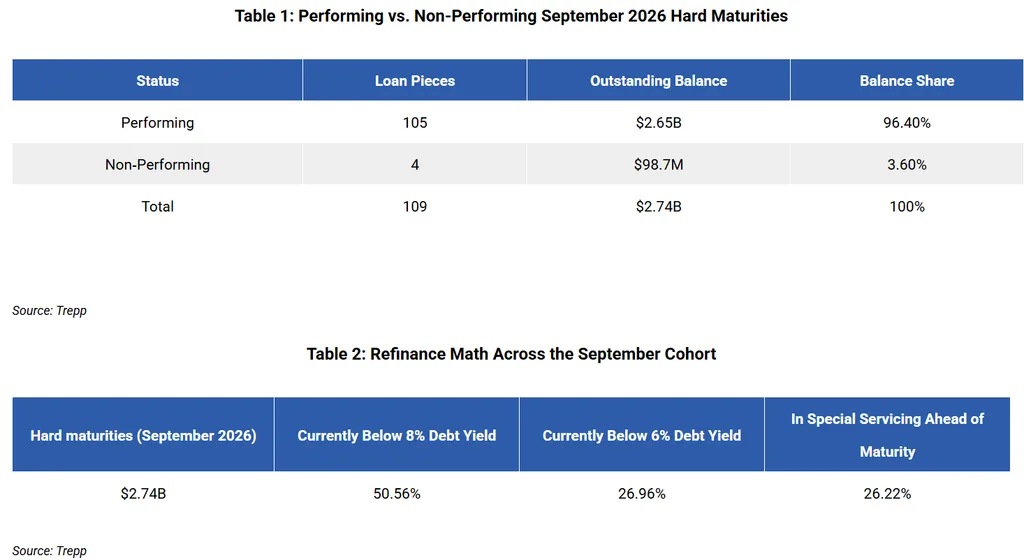
September brings a smaller private-label CMBS maturity cohort but a weaker refinance profile. Trepp's September hard-maturity analysis puts $2.74B across 109 loan pieces and 100 whole loans. That is down from $5.49B in August. Yet 26.96% of the balance has a current debt yield below 6%, compared with 18.13% last month. Trepp classifies that range as severely impaired for refinancing.
Most of the September balance is still current. Performing loans account for $2.65B, or 96.4% of the cohort, while $98.7M is non-performing. The larger forward risk sits inside loans that have not yet defaulted. Trepp found that 93.05% of the severely impaired balance is still performing ahead of maturity.
Half of the September cohort has a debt yield below 8%. The share below 6% is 26.96%, and 26.22% of the total balance is already in special servicing. Trepp's broader 2026 analysis identified $76.6B of hard maturities for the year, with 39% scheduled for Q4. It also found 36% of that annual balance at or below an 8% debt yield.
Hard maturities have no remaining contractual extension options. If a loan is still outstanding when that date arrives, the borrower must repay it or negotiate directly with the lender. Trepp excludes loans already past maturity or in foreclosure or REO, keeping the analysis focused on new refinance and resolution risk.
Retail represents $719.64M, or 26.22%, of September hard maturities. Its debt-yield profile is the most severe. A full 58.56% of retail balance sits below both the 8% and 6% thresholds. Two loans account for $375M of the $421.4M impaired retail balance.
One is a New York single-asset, single-borrower retail loan with a 4.86% debt yield. The other is a super-regional mall split across three loan pieces at a 5.69% debt yield. Both remain current and neither is in special servicing, leaving maturity as the key test.
Gathered from external sources. Rights to this text belong to whoever originally published it.