5 things to know from G20 finance summit
Treasury Secretary Scott Bessent hosted economic officials from around the world in Asheville, N.C., this week, seeking to rally support for the Trump administration’s financial agenda regarding Iran and China. During the Group of 20 (G20) finance summit, Bessent touted the Treasury Department’s beefed-up sanctions on the Islamic Republic and its benefactors and downplayed rising bond yields in the…
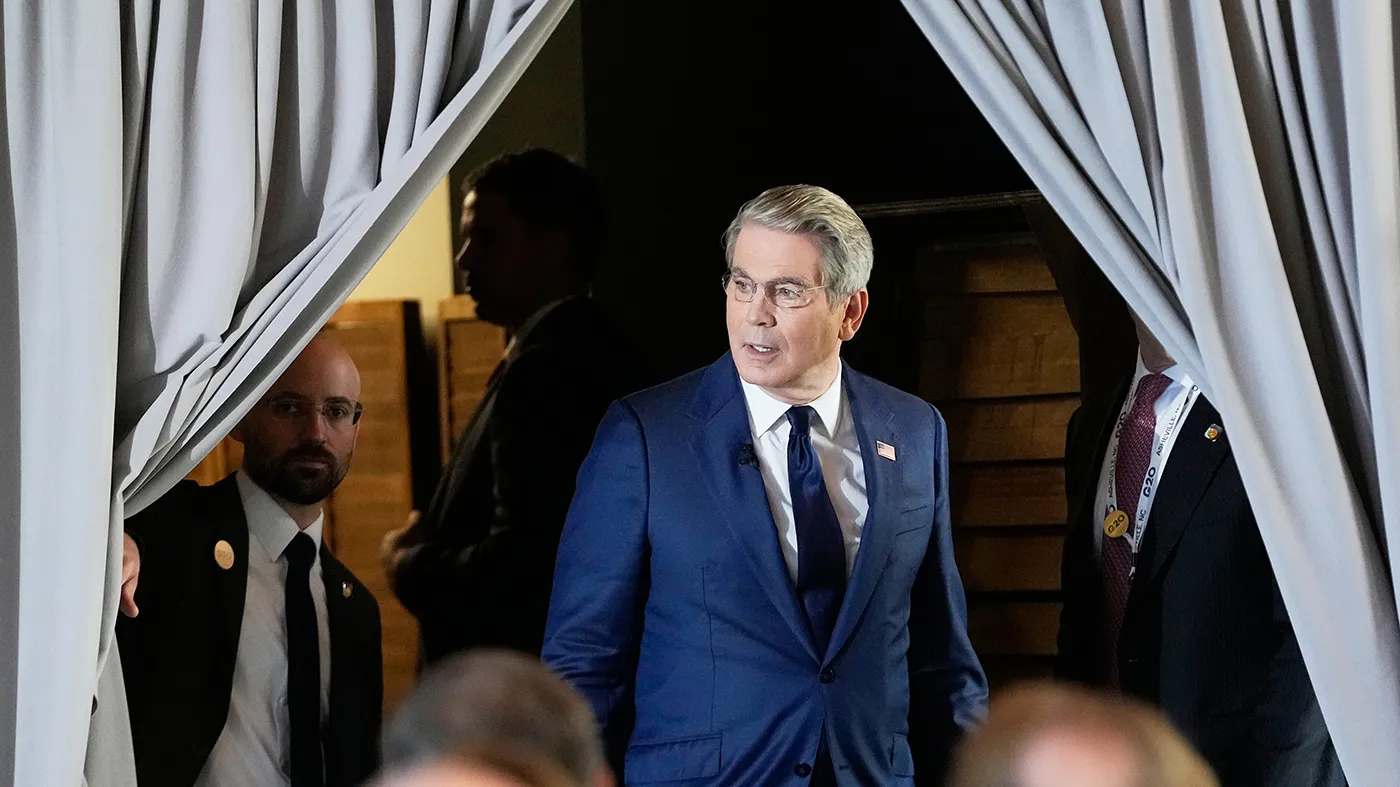
Treasury Secretary Scott Bessent hosted economic officials from around the world in Asheville, N.C., this week, seeking to rally support for the Trump administration’s financial agenda regarding Iran and China.
During the Group of 20 (G20) finance summit, Bessent touted the Treasury Department’s beefed-up sanctions on the Islamic Republic and its benefactors and downplayed rising bond yields in the U.S. and globally.
Here are five things to know from the gathering.
Chinese officials object to guidance on cheap exports
Going into the two-day summit, Bessent said he planned on encouraging foreign finance ministers and central bank governors to reduce their country’s reliance on Chinese goods.
“The world cannot have a China with a $1.2 trillion trade surplus,” Bessent told Reuters on Sunday . “In China, the economy is quite weak, and they are trying to export their way out of it, and they need to rebalance their economy.”
Through his tariffs, President Trump has sought to rebalance America’s trading relationship with Chinese firms. Last year, the U.S. trade deficit with China dipped to its lowest point since 2005, to less than $202.7 billion, according to data from the U.S. Census Bureau.
In his role as chair of the summit, Bessent issued a Tuesday statement arguing that “excessive and persistent” trade imbalances “pose risks” to the global economy.
Countries with significant external surpluses, a group China is part of, should “remove distortions that constrain domestic consumption,” the statement noted. Those with heavy trade deficits, on the other hand, should support “domestic savings and fiscal consolidation.”
Representatives from 19 of the G20 countries signed on to the statement, with the Chinese delegation alone in dissenting . The statement’s appendix noted Chinese officials objected to the section on trade imbalances, among other portions.
While not addressing Bessent’s statement, the Chinese Ministry of Finance said Wednesday that G20 nations should “adhere to genuine multilateralism” on trade matters.
“G20 parties should uphold free trade, promote inclusive economic globalization, and create a favorable policy environment for international trade and capital flows,” the ministry added.
The summit began a week after the Treasury Department unveiled new sanctions on the Iranian regime, with Bessent seeking to rally G20 nations to back his economic campaign.
“We are telling people, either you are with us, or against us,” he told Fox Business’s Larry Kudlow, a former economic official from Trump’s first term, on Tuesday.
The Treasury Department’s recent actions against Iran included sanctioning nearly 60 entities, individuals and vessels that “enable the Iranian regime’s recklessness,” including its illicit nuclear missile and technology procurement, cyber operations and oil-revenue generation networks.
Bessent told Kudlow his department is tracking “anyone who does business with” the Iranian Islamic Revolutionary Guard Corps (IRGC).
“We know where in the British Virgin Islands your accounts are at these trust companies,” he said Tuesday. “We know the $100 million houses you have around the world. And we are going to freeze those.”
Chinese Foreign Ministry spokesperson Lin Jian warned last week the latest U.S. sanctions on Iran “will only further tensions” between the two sides. China is Iran’s largest trading partner and primary purchaser of its oil exports.
But Bessent said Tuesday the U.S. has “more in common” than not with China regarding Iran.
“The Chinese agree, Iran cannot have a nuclear weapon. The Chinese agree that there should be … freedom of navigation in the Strait of Hormuz,” he told Kudlow, adding administration officials “have had private discussions” with Chinese counterparts.
Bessent downplays concerns about bond market
The summit came amid the backdrop of rising bond yields around the world , as mounting government debt and persistent inflation have raised concerns among investors.
The 10-year U.S. Treasury bond yield reached a high of about 4.82 percent Wednesday, a peak not reached since October 2023. Bond yields are also surging in France , Japan and the U.K. , among other economic powers.
Bessent sought Tuesday to alleviate concerns about the bond market, saying rising yields are a “growth story.”
Bessent also said Monday on CNBC’s “Squawk on the Street” that the 10-year Treasury yield is “flat” since Trump returned to office.
“If there were a problem in the U.S. bond market … then people would be selling U.S. bonds and buying other countries’ bonds. But we are the best performing market,” he told host Sara Eisen.
The 10-year yield, though, is up by roughly 17 basis points since the day of Trump’s second inauguration, an increase that will reflect in higher interest rates for many Americans.
Starting next Wednesday, the Treasury Department will double the maximum amount of the country’s long-term debt it can buy back, from $2 billion to $4 billion per operation. The increase will apply through Nov. 4, when the Treasury Department will issue its quarterly borrowing and debt management guidance.
Multiple business executives outlined their views on regulating the AI industry , during a separate G20 Innovation Ministerial in Chapel Hill, N.C.
Palantir CEO Alex Karp said he was not “anti-regulation” of AI but noted those who “understand” the technology must be the ones implementing guardrails.
“One of the biggest problems is it’s got to be done by people who understand the issues. And even if people … understand the issues, it’s very hard to see the downstream effects,” he told reporters Wednesday, according to a video captured by Duke University’s The Chronicle .
Nvidia CEO Jensen Huang said Wednesday that “every country” should be able to participate in what he called the “AI revolution.”
Huang, though, urged policymakers to “regulate practical and actual” harms of the technology instead of “theoretical and hypothetical” harms.
“The technology is still advancing. We want to make sure that the technology advances in a safe way and … the more advanced it is, the safer and more practical it could be,” he told reporters, according to CNBC .
More than two-thirds of respondents to a May survey by CBS News/YouGov said the U.S. government will likely or certainly not ensure AI is used in appropriate ways.
Lawmakers on both sides of the aisle, noting Americans’ concerns about the technology in an election year , have also called for varying degrees of restrictions on data center development .
Trump, meanwhile, said earlier this week local communities will be “backwards and poor” if they oppose data centers.
That remark drew praise from Anthropic co-founder Tom Brown, who said at the G20 Innovation Ministerial he “really loved” what Trump said.
“He was pointing out that the data centers are just an enormous source of prosperity. They produce a ton of jobs. They reduce taxes,” he told Commerce Secretary Howard Lutnick, CNBC reported .
The G20 gathering occurred as a trade war between the U.S. and Canada continues, with Canadian tariffs on a host of American goods set to go in effect Tuesday.
The Canadian government is imposing those “dollar for dollar” retaliatory levies in response to Trump’s 50 percent import taxes on Canada’s $27.6 billion in exports to the U.S.
But Bessent denied Tuesday that the U.S. is engaged in a “tit-for-tat” trade war with its second-largest trading partner.
“I don’t think you can be in a tit for tat with someone who’s 13 times larger than you are,” he quipped on “Squawk Box.”
The Treasury secretary later pondered whether Canada will “take their two set submarines from the Edmonton Mall and sic them on us.”
Bessent also said Canadian Prime Minister Mark Carney is prioritizing himself over his people, saying he “chose to walk away” from the “best trade deal” the administration has offered to any country.
“It’s unfortunate that he’s not doing what’s best for the Canadian people,” Bessent told Eisen. “He’s doing … what is best for the Liberal Party, what’s best for Mark Carney. And in the long run, the other Canadian people are going to see through that.”
After halting trade talks with the Trump administration last month, Carney said U.S. officials proposed “last-minute” changes to terms of a trade deal, provisions he called “unfair” and “uneconomic.”
Topics in this story
Gathered from external sources. Rights to this text belong to whoever originally published it.