Warsh wins credibility with Fed rate hike: 5 takeaways
While President Trump has not publicly criticized Federal Reserve Chair Kevin Warsh for the central bank hiking interest rates on Wednesday, the move was still the opposite of what the president wanted. “I’m relying on Kevin. But he’s got … a very tough board,” Trump told reporters in North Carolina on Wednesday, adding interest rates are “too high.”…
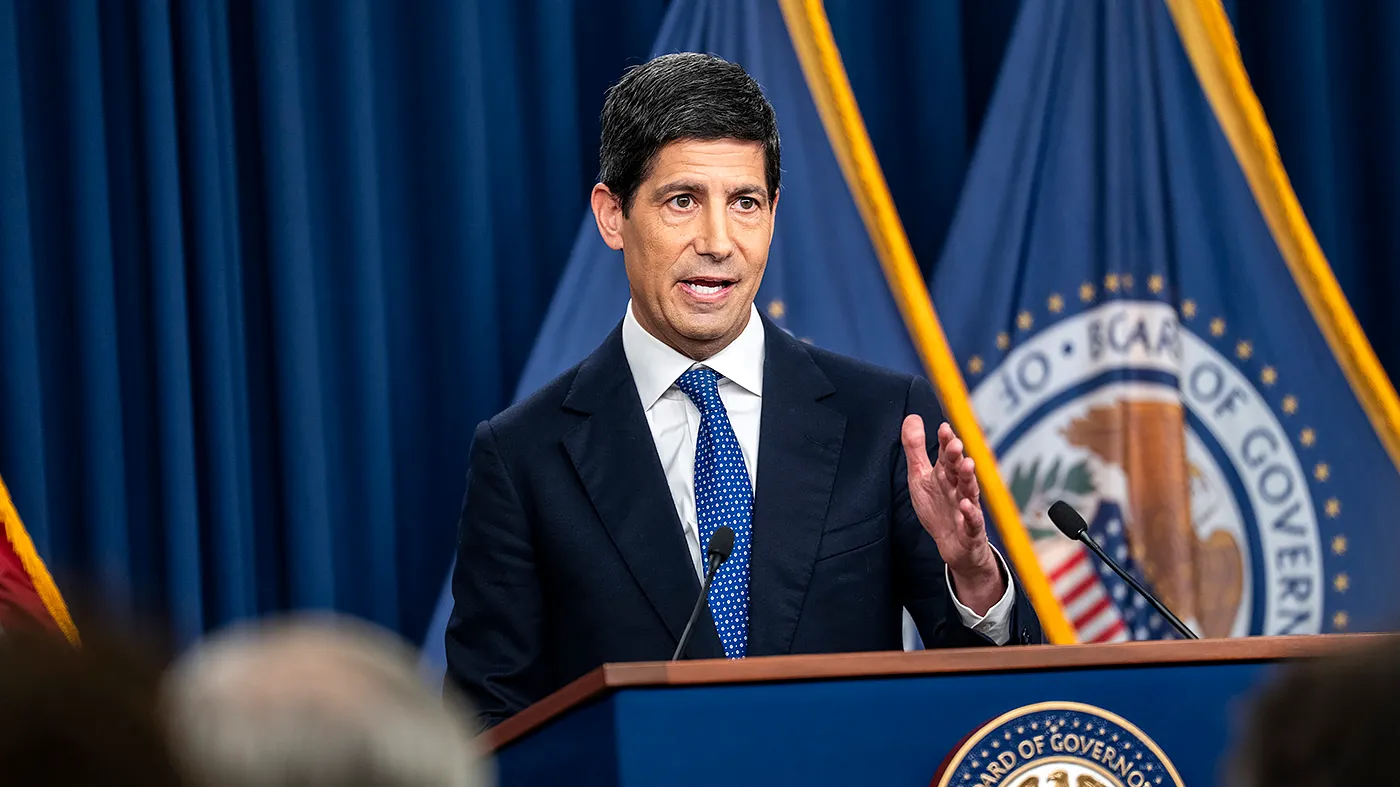
While President Trump has not publicly criticized Federal Reserve Chair Kevin Warsh for the central bank hiking interest rates on Wednesday, the move was still the opposite of what the president wanted .
“I’m relying on Kevin. But he’s got … a very tough board,” Trump told reporters in North Carolina on Wednesday, adding interest rates are “too high.”
The Federal Open Market Committee (FOMC), which includes Warsh, voted unanimously to raise its baseline interest rate by a quarter point, to a range of 3.75 percent to 4 percent. While speaking to reporters after the decision, Warsh cited persistent inflation for the hike.
Here are five things to know about the FOMC’s decision and the president’s reaction.
Warsh wins credibility, Fed shows independence
In raising rates for the first time in three-plus years, the FOMC did what markets overwhelmingly anticipated.
Hours before the vote, traders were pricing in a nearly 93 percent chance that the rate-setting panel would hike by a quarter point, according to the CME Group’s FedWatch tool .
“I would have argued for a rate hike,” Loretta Mester, a former president of the Cleveland Fed, told The Hill. “I believe there is a cogent case: Growth is solid, capex [capital expenditure] is strong and consumer spending is healthy.”
Warsh laid out why the Fed was hiking rates, noting inflation “remains elevated” above the central bank’s 2 percent target rate; annual inflation was 3.4 percent in August , as measured by the consumer price index .
“The plain fact is that inflation is too high and has been for too long,” the Fed chair told reporters .
On the day Warsh took over the Fed, Sen. Elizabeth Warren (D-Mass.) called him Trump’s “sock puppet.” But Warsh vowed in April, during his confirmation hearing before the Senate Banking Committee, to be an “independent actor” at the Fed.
“It’s the most important thing to me,” Warsh told Sen. John Kennedy (R-La.), referring to his own credibility.
The chair reiterated the importance of the Fed’s independence on Wednesday, saying the principle was a “two-way street.”
“I do think that Chair Warsh demonstrated with this action that the Fed is making monetary policy decisions based on the economics and independent from political considerations,” Mester added. “And markets participants likely felt some reassurance.”
Going back to his first term, Trump has called on the FOMC to lower interest rates. He specifically targeted former Fed Chair Jerome Powell, labeling him a “major loser” last year for voting to hold interest rates before backing three straight cuts to close out 2025.
But despite his continued preference for the Fed to slash rates, the president did not fault Warsh for Wednesday’s hike.
“He’s a good man, Kevin Warsh, but no matter how good a job [he does], he’s got a hostile board,” Trump told reporters in North Carolina, before stumping for GOP Senate candidate Michael Whatley.
The president also accused the other FOMC officials of raising rates for “political reasons” in an effort to damage him before the midterms .
Four of the 12 voting members of the FOMC are Trump appointees: Warsh, Powell, board of governors vice chair Michelle Bowman and board member Chris Waller.
The presidents of the Fed’s Cleveland, Dallas, Minneapolis, New York and Philadelphia branches also sit on the panel, along with Fed governors Michael Barr and Lisa Cook — appointees of former President Biden.
Trump maintained Wednesday he still has confidence in Warsh. But Peter Navarro, an economic adviser to the president, sang a different tune .
“That was a foolish, foolish decision by somebody who’s supposed to be a smart guy,” Navarro told host Blake Burman on NewsNation’s “The Hill.” “And to begin his tenure that way is damn foolish.”
Wednesday likely will not be the last time the FOMC raises rates this year, based on the panel’s quarterly summary of economic projections it released.
Twelve of 18 FOMC officials projected one more rate hike, with the committee set to meet again in late October and early December to close out 2026. Four officials projected two hikes, while the remaining two predicted a pair of holds.
Warsh did not provide a projection, keeping in line with his preference to stray away from issuing forward guidance.
“The unanimous decision to raise interest rates by 25bp to 3.5%-3.75% was in line with expectations, and we now expect the Federal Reserve to deliver one additional 25bp hike later this year before falling inflation allows them to move to the sideline,” said Michael Pearce, the chief U.S. economist at Oxford Economics, in a statement.
Warsh did not speak to future FOMC decisions on Wednesday, noting the economic “uncertainty” posed by the ongoing Iran war.
But considering the FOMC’s latest economic projections state inflation will not dip to 2 percent until 2029, experts are expecting another rate hike this year. That could lead to even further tension between Trump and the central bank’s board.
“The big news today is the Fed is signaling a ‘mid-cycle adjustment’ of 2 or 3 rate hikes,” Heather Long, the chief economist at Navy Federal Credit Union, wrote Wednesday on the social platform X.
“They are trying to act early and decisively to ensure they don’t have to hike much to get inflation under control.”
Markets rebound Thursday after brief slide
In the hours after the Fed raised rates, major stock indexes took a dip until closing. The S&P 500 and Nasdaq fell by roughly 50 points and 130 points, respectively, from Wednesday’s opening bell.
Both indexes, though, bounced back Thursday. The S&P 500 was up more than 80 points as of the early afternoon, while the Nasdaq had risen by roughly 430 points.
Stocks have risen as oil prices fell Thursday. The price of West Texas Intermediate crude, the North American benchmark, is down by roughly $1.20 but is still trading at more than $101 per barrel.
Oil prices have risen due to the Islamic Republic’s restrictions on shipping through the Strait of Hormuz, a crucial waterway for the global petroleum trade.
While Warsh did not reference the Iran war directly on Wednesday, he noted “geopolitical developments” are contributing to economic uncertainty.
“There’s no hiding from hot spots around the world, and our judgment about what is the most likely or least likely of the geopolitical situation has changed,” the Fed chair remarked, as the Middle Eastern conflict approaches the seven-month mark.
The direct impact of the Fed’s decision is that banks and credit unions will lend reserve cash to their counterpart institutions at a higher interest rate.
But there are spillover effects for Americans. Higher interest rates lead to higher mortgage, credit card and student loan payments, according to Rodney Sullivan, the executive director of the Mayo Center for Asset Management at the University of Virginia’s Darden School of Business.
“If the Fed demonstrates that it is willing to keep policy more restrictive for as long as necessary, it could restore its credibility as an inflation fighter,” Sullivan noted Thursday . “That could cause long-term yields to fall relatively quickly, even if short-term rates initially rise further.”
The average 30-year mortgage rate closely tracks the 10-year U.S. Treasury bond yield. The note was down below 4.95 percent as of lunchtime Thursday, after reaching a 19-year high on Tuesday.
Thirty-year mortgage rates continued their upward trajectory this week, reaching an average of 6.95 percent, up from 6.76 percent last week, Freddie Mac reported Thursday .
Topics in this story
Gathered from external sources. Rights to this text belong to whoever originally published it.