In Mayday, Ryan Reynolds Treads Familiar Sarcastic Territory, But Kenneth Branagh's Kooky Ex-KGB Agent Elevates the '80s-Style Buddy Comedy
Mayday Review: Ryan Reynolds and Kenneth Branagh team up in this likeable Cold War buddy action-comedy.
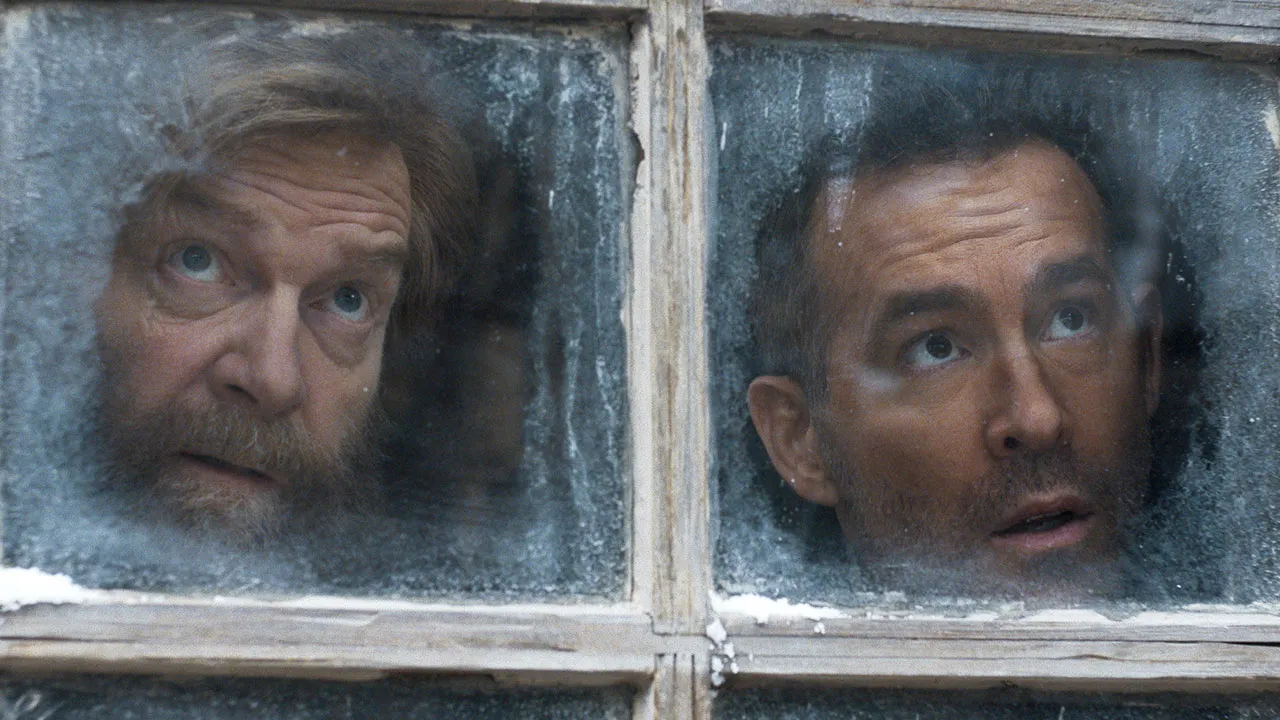
Mayday will be released on Apple TV on Friday , September 4.
The 1980s were rife with buddy comedies, and Mayday fits neatly within that genre, with Ryan Reynolds and Kenneth Branagh playing a US Navy pilot and an ex-KGB agent, respectively, who traverse planes, trains, and automobiles to escape Soviet Russia.
While many Hollywood movies of that era were rife with anti-Russian sentiment, from Red Dawn to Rambo III, writing-directing duo Jonathan Goldstein and John Francis Daley take a more Spies Like Us approach to the Cold War, serving up a sometimes amusing yet boisterously action-packed reflection on geopolitical tension.
Set in 1987, a year after the release of the cinematic jingoism that was Top Gun, the film features Reynolds as Lieutenant Troy Kelly, eagerly filling the shoes of Tom Cruise's Maverick, albeit with his brand of deadpan humor – a humor here that rarely colors outside the lines of what we've seen him do before. Troy goes rogue to save his wingman's faulty plane, claims to be the best pilot of his unit and loves that Top Gun's popularity means he can queue-jump his way into any club. He applies that ego and arrogance to his dim perception of Russia and its people. "You can't reform something that is fundamentally broken," he says frankly. "It's not a society, it's a prison… silence is complicity."
Soon he's enlisted for a covert mission to co-pilot a spy plane, the Lockheed SR-71 Blackbird, to capture images of missile silos 1200 miles inside the Soviet border. Thanks to the in media res opening, we already know the operation goes sideways. After a brief but effectively thrilling sky battle with Russian fighter pilots, the so-called "beast" of his plane becomes fiery debris on the floor of a snow-laden forest, with an injured Troy clocking a mysterious man approaching before he blacks out.
Troy wakes up in the cabin of Nikolai Ustinov, or "Nick" as he prefers, and the first thing he sees is Cruise's face on a Top Gun poster pinned to the wall. American militarist propaganda has penetrated the Iron Curtain, and given the film's lack of definitive identification of the rogue nation, it's easy to understand why it's Nick's favorite film. This is Branagh's third Russian action role in recent memory, after playing Viktor Cherevin in Jack Ryan: Shadow Recruit and Andrei Sator in Tenet , so it's refreshing to see him put those years of vocal coaching to more heroic use.
His Russian Americophile is less an overtly eccentric counterpart to Reynolds' straight(er) man but one with an earnest, subtly quirky appreciation of American "democracy, culture and food." There's also a lack of bravado when he outmanoeuvres both Troy and, later, patrons of a bar, in some neatly executed fight sequences. Both scenes employ wide shots and minimal edits to rivetingly capture how formidable Nick's combat skills are, adding another layer to the Branagh character, whose kind face should not lead one to mistake him for a man to be trifled with.
The rest of the film functions as a road movie, tracking their journey across Russia to find a means of escape, now that they are both enemies of the state, while being hunted by KGB official Alexander Volkov (Marcin Dorociński). He's far less menacing than, say, Christoph Waltz's Hans Landa from Inglourious Basterds, but still functions as an intimidating antagonist. Yet as much as it offers up action set-pieces like a face-off with a train full of Russian soldiers and a car chase involving a nuclear transporter in central Moscow, what's most compelling is how the very idea of American exceptionalism is dismantled. By breaking bread with common folk who welcome them into his home, conversing with Nick's activist daughter Anna (Maria Bakalova) and learning of a government cover-up that affected him personally, both Troy's prejudices and worldview crumble.
That Bruce Springsteen's Born in the USA album is as much of a running reference as Top Gun enriches the film's thematic core. Maybe it would have been too on-the-nose to include the record's eponymous anti-war song, but the fact that it's Nick's favourite cassette tape and one that Troy would prefer not to listen to for a 12-hour ride highlights the complexities and potential dysfunction of the American identity – as well as the universality of the Boss's love and lament for the working class. Borders and oceans might separate warring states, but the proletariat are very much the same: everyday people, suffering under government propaganda and class oppression.
Mayday doesn't get too deep in the weeds of political bureaucracy beyond what is required to push the plot forward, and perhaps its conclusion is a little too rosy. But that's Hollywood for you; idealism trumping reality so you can leave with a little more hope and understanding than despair.
Topics in this story
Gathered from external sources. Rights to this text belong to whoever originally published it.