Club Kid Is a Moving Indie Comedy by First-Time Feature Director Jordan Firstman
Club Kid review: Jordan Firstman’s moving indie comedy follows a gay New York club promoter and his surprise British son.
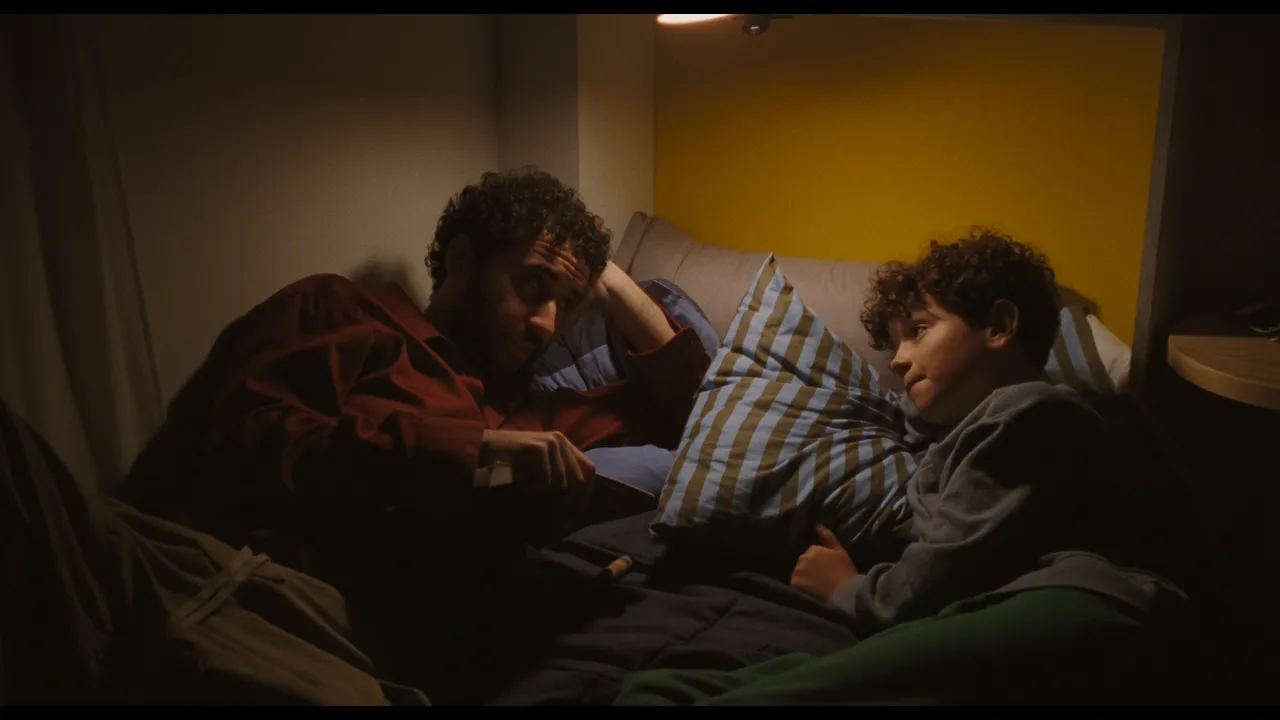
Club Kid receives a limited theatrical release on Nov. 6.
A gentle family drama told in the style of a sleazy New York indie, Jordan Firstman’s Club Kid is one of the year’s most self-assured gems. Picked up by A24 out of the Cannes Film Festival, Firstman’s directorial debut features him in the lead role of Peter Green, a washed-up gay Jewish club promoter who, at a personal and professional low point, discovers he has a ten-year-old son. The coming-of-(middle)-age story unfolds in and around New York’s bustling queer underground, which forms the colorful backdrop for a film of intimate emotional discovery, subdued heartache, and unexpectedly finding yourself through someone else’s eyes.
Opening ten years in the past with all the energy and misty allure of William Friedkin’s leather thriller, Cruising, the 35mm-shot Club Kid recreates the dim celluloid haze of ’70s and ’80s New York City with a more contemporary, upbeat lens. With one foot planted in queer culture’s past, Firstman depicts its liberated present through a hedonistic underground rave Peter organizes and attends, introducing us along the way to the movie’s catty ensemble. This includes his promoter business partner, Sophie (Cara Delevingne); his supportive ex-boyfriend, Devon (Nigil Whyte); and his ferocious trans DJ pal, Saffron (Saturn Risin9), among a cavalcade of other lively queens.
A drug-fueled threesome that evening, which Peter barely remembers, comes roaring back ten years down the line when an acquaintance from London drops off his surprise ten-year-old son, Arlo (Reggie Absolom). The kid’s mother has died, leaving him with no one else. Despite this morbid premise, Club Kid floats on a fabric of lurid, self-effacing comedy rooted entirely in character and community, starting with the gay Azerbaijanian teen and wannabe-philosopher, Nicky (Eldar Isgandarov), who Peter houses despite his own financial woes, and continuing through the aforementioned supporting characters introduced a decade prior, who all remain in Peter’s life.
The lengthy interim has seen Peter stall in arrested development, and his continued drug problems even lead to a professional falling out with Sophie right when Arlo shows up, leaving the new dad especially vulnerable financially and emotionally. A thirty-something with no direction, Peter is forced to reorient his life around fatherhood, a concept the polite 10-year-old Londoner seems remarkably more prepared for, though he disguises his grief beneath a dogged façade.
The more Arlo becomes a part of Peter’s life, the more the worlds of narcotics-fueled found family and unforeseen blood relation (and the responsibility it demands) collide for the fatigued impresario. In short, Peter needs to get his act together. But the party, and his desire to be at the center of it, has a certain magnetism he can’t ignore, to the point that the musically-talented Arlo soon begins showing up as an early-shift DJ alongside Saffron.
The film is absurdly funny and comes steeped in the postmodern, internet-meme-as-camp-culture queerness increasingly popular in online spaces and on TV shows like Drag Race while maintaining a consistent authenticity. Part of this is owed to the organic aesthetic approach of Firstman’s freewheeling handheld camera, which cinematographer Adam Newport-Berra nestles into tight spaces with incredibly fluid movements, making each scene of overlapping dialogue feel especially intimate. However, just as big a part of the film’s success is its naturalistic performance style. As Peter and Arlo, Firstman’s uncertainty and Absolom’s matter-of-fact-ness make for not only a knee-slapping comedy routine, but a mismatch of parental expectations through a subversion of vibe, energy, and traditional family dynamics, which Peter has to work especially hard to overcome.
As the story goes on and the two get to know each other, the care they find in one another draws you in with its conversational quality. Long-hidden volatile emotions are gradually unlocked through Peter and Arlo’s chats and disagreements, as well as Arlo’s sessions with child therapist Oscar (the object of Peter’s interest, played by a smoldering Diego Calva). However, it isn’t long before the legal complications surrounding Arlo’s adoption across borders adds an additional rigorous layer to the saccharine drama. This gradually forces the salacious, sweetly taboo humor to subside in favor of a more piercing buildup of emotional tension, which mounts gradually until it eventually overflows.
Realism is often overrated in cinema. But when it harkens back to New Hollywood’s style while maintaining contemporary verisimilitude, it’s hard not to be sucked in by the familiar comforts of a movie as unique, good-natured, and downright charming as Club Kid, which wears its heart confidently on its bedazzled sleeve. In a mere two hours, it feels like an entire lifetime of love and heartache.
Topics in this story
Gathered from external sources. Rights to this text belong to whoever originally published it.