Wicker Is an Immersive and Romantic Journey Starring Olivia Colman, Alexander Skarsgård, and Peter Dinklage
Wicker review: An immersive and romantic journey to a dark and whimsical reality just beyond our own.
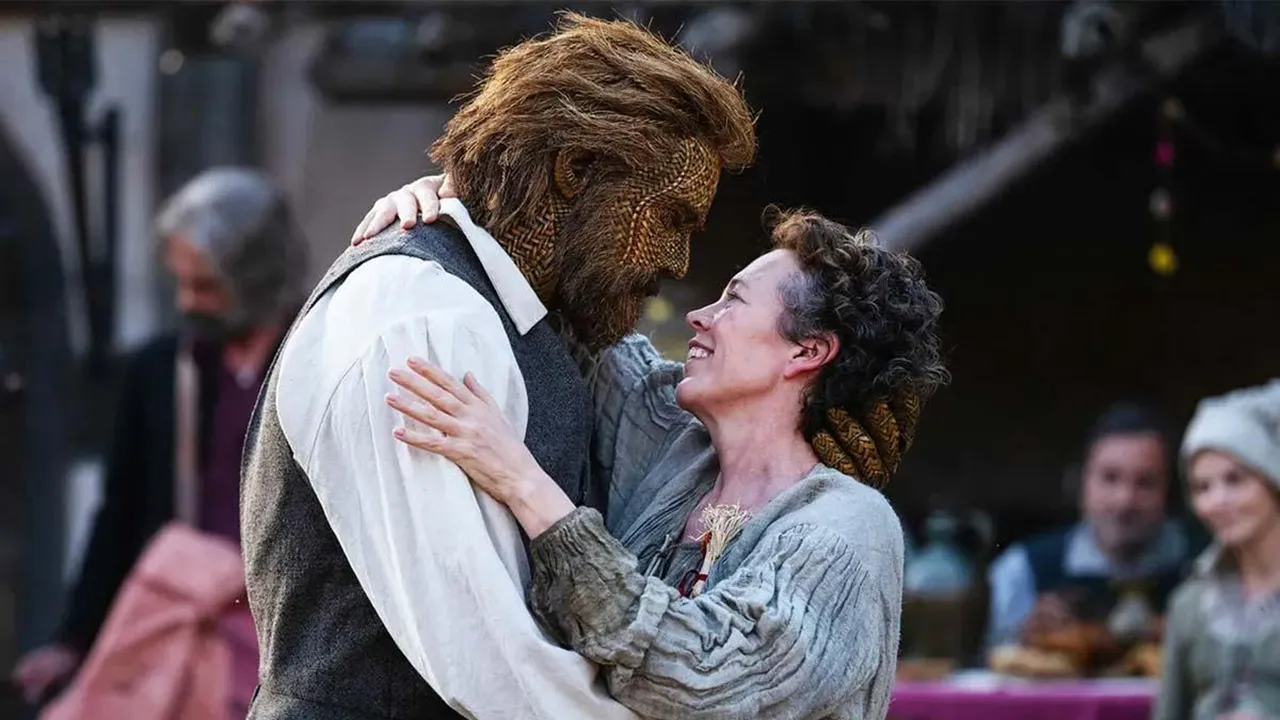
As we’ve learned from stories like Edward Scissorhands, Pinocchio, and Lars and the Real Girl, few things teach us more about what it means to be fully human and alive than creatures crafted by an artist's hands and the desires of one desperate for connection.
A lonely Fisherwoman (Olivia Colman) rebels against the limits, forced and chosen, of her lot in life and entreats a Basket Weaver with mystical skills (Peter Dinklage) to craft her a husband made of wicker (Alexander Skarsgård). Despite its unusual premise, Wicker is surprisingly straightforward in its sweetness and condemnation of small cruelties. There are darker elements to the fantasy, including implied violence, visible gore, and the stark reality that frequent death was a fact of this time period, but these ultimately highlight moments of beauty and affirm the need to savor life’s pleasures, be they exultant or sensual. On the whole, the film is warm and charming with real pathos, largely due to the exemplary cast led by Colman, who seemingly effortlessly elevates both the bawdy comedic beats and moments of sorrow and joy. In lesser hands, the humor might have read as pedestrian, and the relationships distant and unrelatable.
Based on the short story The Wicker Husband by Ursula Wills-Jones and directed by Alex Huston Fischer and Eleanor Wilson (Save Yourselves!), Wicker is set in a generic medieval village where all the townspeople are known only by their trade (if male) or their husband’s vocation (if female). The one exception is the Fisherwoman, who has either rejected, or been rejected by, the traditional confines of marriage and as such is known by her profession. The townspeople limit her participation in their world to the periphery, ostensibly due to her potent scent (an occupational hazard). But it’s the Fisherwoman’s refusal to fit into the tightly bound structures their culture demands — which the seaside village’s matriarch, the Tailor’s Wife (Elizabeth Debicki), enforces with an imperious smile — that truly drives her to the edges of their community.
These social constraints feel claustrophobic for everyone, most notably the Fisherwoman, who responds with rebellion, and the Tailor’s Wife, who tries to control others as much as she herself feels confined. That suffocating undercurrent is reinforced by the visual storytelling: The town reads as small and hastily constructed, and the interiors are often dim and candlelit even in daylight, shrouded in mystery (in the Basket Weaver’s workshop) or stifled by the darkness of ignorance (in the villagers’ homes). For the length of the film, we too feel trapped in this deeply flammable village (everything seems to be made of hay or wood!). By contrast, the Fisherwoman’s cottage, set apart from the village, is isolated but surrounded by space, fresh greenery, and a sense of liberation. When the Wicker Husband gets his hands on it, the cottage evolves into something artistically shaped and deeply cared for, a reflection of how he sees his wife; it’s as if the Basket Weaver has passed his artistry on to his creation.
The Wicker Husband himself is stunning, as are all of the Basket Weaver’s designs (even the most ghastly of them), particularly set against the grimier village, where most things and often people are covered in dirt or filth. Weta Workshop built the Wicker Husband with CGI enhancements to appear delicate and precious. When he is damaged, the audience understands that the harm illustrates our own failure to care for something of value. Though eerie, he has the essence of Skarsgård’s natural beauty, and is at once a thing other than human and something more. The actor’s placid tones reflect the character’s innocence, perfectly capturing the Wicker Husband’s ability to point out what isn’t working in the human world simply through his ignorance of it or non-participation in it.
Initially, the Fisherwoman’s purchase of her husband and companion is an act of defiance. She is taunting the villagers, turning their tendency to strip away humanity and objectify themselves and one another on its head. In a reversal of roles, she keeps her title as Fisherwoman while her mate is known simply as the Wicker Husband. This is particularly repellent to the Tailor’s Wife, largely because she longs for the freedom and purpose the Fisherwoman enjoys. In reality, work is both a necessity and a gift for the Fisherwoman, who lacks the privileges of those more embedded in society’s conventions. It gives her meaning but leaves her mostly friendless and often filthy. This exiled, misunderstood woman finds, in the prickly arms of a man made of wood, the acceptance and care missing from much of her village life. The Fisherwoman develops deeper affections for her Wicker Husband than she anticipated and in doing so falls prey to the frailties of real attachment, including jealousy and mistrust, even toward a husband she theoretically “owns” (and who could double as furniture).
The actors ground us in this heightened fable. Early in the film, in a glance of no more than 30 seconds, Colman and Debicki convey the entire shared history of two women who understand, envy, and loathe one another. More saliently, it’s here, with one double take from Colman, that we understand Debicki’s casual mean-spiritedness has sealed the town’s fate: The Fisherwoman will have her say, and with it, a husband the likes of which they cannot imagine — one who will challenge their way of life. Colman brings us into the Fisherwoman’s exuberance as she discovers the nightly joys the Wicker Husband offers, without making it so comical that we’re held at a distance from the character. She delivers a performance that gives the audience catharsis as she moves from deep vulnerability and self-sabotage to a woman who takes the gift she’s given and runs with it.
In a sense, the film asks the viewer to examine how much good we allow ourselves before we damage it, often out of fear that it isn’t real or earned and will therefore betray us. The Fisherwoman, who’s been told she’s not worth much, must wrestle with granting herself permission to feel pleasure (often in spades) and with believing that the sweet can, at the very least, equal the bitter in life. Through witnessing her unorthodox relationship, the whole village is faced with the same inquiry. This is the film’s most interesting idea.
Thematically, Wicker hits at patriarchy with the subtlety of a cudgel. Even in name, the women are reduced to property. The Tailor’s Wife is petty, passive-aggressive, and destructive, in no small part because her natural genius is underused at best and entirely suppressed at worst. We see villagers’ lives imperiled because no one has the will to say that those in charge of critical infrastructure are drunk, incapable, or (often) both. Everyone pays a price for these encrusted traditions. The film is an overt morality play, but with enough surreal humor to keep it from feeling laborious or patronizing.
To its credit, Wicker is seeded with more than just an indictment of utterly ruinous bias. It examines, lightly and with a lot of whimsy, why we all as men and women stay loyal to the restrictions that create pain and discomfort for us, be they social norms or internal limitations. It also asks about the bounds of nature itself, as the Basket Weaver defies the “no” life has given this village's residents. He’ll help them reach for their deepest desires so long as they’re willing to name what they want (whether anyone agrees or not) and care for the small miracles he provides.
Dinklage’s Basket Weaver stands apart from the town but, unlike the Fisherwoman, not in opposition to it. In that sense, he serves as the audience’s surrogate: a somewhat objective observer or Greek chorus who at times goes so far as to monologue or narrate events and who casts the final judgment. Dinklage brings a sense of delight to the role, embodying the Basket Weaver’s love of creating within challenging frameworks, and of doing more than he ever thought himself capable of. He also endows the character with empathy without overplaying his hand. His compassion is reserved chiefly for outsiders like the Fisherwoman, and he disdains the villagers’ inability to extend it to her or even themselves.
It takes a man made of wicker to show this town what it is to be complete and fully human. His way of seeing the world, free of the polluting influence of cultural programming, serves as an (often unwanted) mirror for the villagers, exposing the insanity of mundane life. Ultimately, the film celebrates the rewards of being bold and going for what you want (be that family, vocation, both, or something else altogether) without the need for approval. Though the storytelling in Wicker is fairly direct, Fischer and Wilson have steady hands, and the technical elements combined with the talented cast create an imaginative, immersive, and relatively quick (about an hour and 45 minutes) visit to a universe just to the left of our own, granting us enough distance to see ourselves more clearly.
Topics in this story
Gathered from external sources. Rights to this text belong to whoever originally published it.