Grand Theft Auto Artist Stephen Bliss Explains How He Defined the Series' Iconic Visual Style
As a senior artist at Rockstar Games from 2001 to 2016, Stephen Bliss defined the iconic pop art and comic book feel that has become the visual hallmark for Grand Theft Auto.
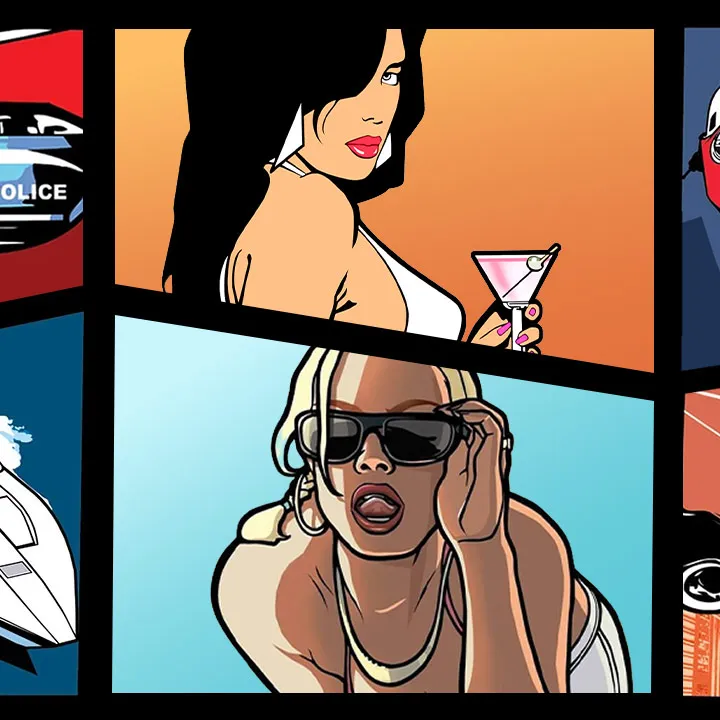
You might not immediately recognize the name Stephen Bliss, but I guarantee you'll recognize his work on arguably the most influential game franchise of our time. As a senior artist at Rockstar Games from 2001 to 2016, he defined the iconic pop art and comic book feel that has become the visual hallmark for Grand Theft Auto. IGN spoke to him at the Lucca Comics and Games festival about his work with the series, what he's been working on since, and finding the balance between making a name for himself away from the brand and seeing his artistic impact continue even as he works on other projects.
IGN: I was reading an interview with you where you said you didn't want to be known as the GTA guy, but you take it as an affirmation that people know your work and are inspired by that. Is that something that has been tricky to navigate in the past 10 years?
Stephen Bliss: I wanted to make a name for myself away from Rockstar in fine art and to make my own IPs, my own properties, and cartoons. And that's worked to a degree, and it's getting stronger all the time, my career. But I can't ignore what working at Rockstar has done for me. I'm very grateful for getting a job there and working there for such a long time. After GTA 3, Vice City, and Warriors, the team came in, Anthony Macbain [Director of Illustration at Rockstar for 13 years] and Steven Olds [former visualization director at Rockstar Games], who are both amazing artists. So when people tell me that they love my work, I might not completely be overwhelmed with the flattery of that, because other people did the work, and I don't want other people to think that I did all the work. When I said that quote before, what I meant was I don't want to take all the credit.
People have been bringing me GTA 5 covers to sign, and I say sorry, because I didn't work on that. And they look disappointed, but I've got to let people know what I did and what I didn't do. But I did contribute massively to Rockstar. And as I said, I'm grateful for that. And sometimes it can be like people are walking past my stand and they'll see all my personal work, Fear City work, and gig posters I did for bands and comics I've done, but they're really interested in more in the GTA getting that signed, or they're interested in a poster that's inspired by GTA for Lucca. But that's okay, because I did something well.
IGN: What you did, it set a standard; it set a style. I know there were other contributors to that, but as an artist, is that something that you see as an affirmation?
Stephen Bliss: Well, I looked at the GTA 6 cover, for example. I had nothing to do with that, but the fact they still use the box grid and they still put the helicopter in the top left corner, which was something that I developed, I'm flattered by that. It touches me that that heritage continues. And my influence is in the GTA 6 cover, but it's its own language. I just have little references in there. I'm like, 'Oh, that's nice that they used that.' But I'm absolutely not saying I contributed to that massively.
IGN: Is it difficult to convey something that is telling part of a story that sucks people in but isn't telling a whole story? Is that a challenge? Is that a puzzle that you have to solve as an artist?
Stephen Bliss: Yeah. What I'm missing with my work since I left Rockstar, for example, is that there's an emotional connection with people growing up and seeing that GTA work, which has actually been a good lesson for me recently. I realized that whatever I do from now on has to create an emotional connection. And even if I draw the anatomy badly or I'm being anal about getting everything correct, if it doesn't connect with someone emotionally, then that's where there's a disconnection. So I'm trying now to create some kind of emotional connection, which I'm not quite sure how I do that right now.
IGN: Is there a trick to that, or is it just kind of feeling your way through it?
Stephen Bliss: I know I've been trying to do it for 10 years since I left, and even Steroid [a t-shirt company Bliss set up with his brother], my project before I came to New York. I'm trying to revive that. And I've got the Fear City IP [a NFT series on the Ethereum blockchain], and I've got the Looby IP [an art-focused cryptocurrency], and my ambition now is to pull them all together as the Stephen Bliss brand. What I need is someone to finance that and market it. Those are the two major things that are missing. There have been people [who have come in with money], but they're full of shit really. But I'm hoping at some point someone will come in as a decent person and invest in it.
IGN: In an interview that Dan Hauser did with IGN , he mentioned you and the post-9/11 cover update. Is there anything that you remember about that process? Were they all-nighters where you just had to sit there and really lock in and change everything?
Stephen Bliss: Well, it was a lot to ask, to do a nonviolent GTA cover. But I understood because I personally was thinking, “Is entertainment from now on going to be all musicals and comedies and Disney? How are we going to be able to sell something that has a degree of violence in it?” And nobody knew. I was convinced it's all musicals [from- now on]. So when they asked for that, even though the [white] GTA 3 cover took me six months to paint, I'd always had in my head the grid system. “How can I chop these out? Chop out the nonviolent images, and what are you going to do with them?” I put them in a grid system because I grew up with Marvel and DC. I found a picture the other day - that really reminded me of that GTA cover - that I did when I was 10.
So for me it was almost... I mean, it was literally two nights. It wasn't an all-nighter, I don't think. Sometimes I'm pleased with myself; it's like I can get ideas really quickly. I may not be too bright on finance and investments, but I can come up with abstract ideas pretty quickly. And that was one of the big ones.
IGN: Were there any particular series or comics from Marvel or DC that really had a long-lasting impact or major impact with you, either on the GTA covers or your other work?
Stephen Bliss: Looking at the comic collection that I still have from when I was a kid, it was Spider-Man and the Titans. The Hulk and Spider-Man were the [ones] that I still have from when I was a kid. I still love Spider-Man and the Hulk. I still get excited about seeing them in the movies.
IGN: We were talking about Vice City and GTA San Andreas. There’s very obviously a Stephen Bliss style. I know you said other people contributed, but Vice City is obviously very colorful, and then you moved on to something a little bit grittier. Does that require a change in process? Or was it just like, “This is the brief, this is the game, this is how I'm going to take my style and bring it to life in a different environment?"
Stephen Bliss: Well, so after Vice City there was... I did Warriors on my own, and that was a real challenge, because I had to do a style that was completely different from GTA 3 but similar. And I started off doing it as GTA 3 because that's my style, that's my natural style. And then I just had to go completely out of the box and do that really kind of photographic painting. Somehow I had to find a way to do it. And that was always the case; find a way to do it. I still do that now with my freelance work. I say to my agent sometimes, I don't want to do it because I can't do it. And I do it because he always persuades me to do it. And I always feel pretty good about that, that I'm like, "Wow, I did something I didn't think I could do."
IGN: That's what art is, right? I mean, pushing yourself to do things that maybe you didn't know how you were going to do in the past, right?
Stephen Bliss: The challenge we had as a team was, "How can this look similar but different?" So we looked at San Andreas, and what are the colors in California? They're foggy. So that would've been the basis of the direction of the color, but it may take a few weeks to make that differentiation. And then how can we make that outline style, the black outline style, the same but different? I mean, Steven Olds came up with this idea, which was to have the sunlight blended into the face, and then on the other side of the face is a reflective light that's very crisp, kind of abstract, and almost like lightning bolt color. And he taught me that. I didn't know before he taught me that; and it's something I use now, and it's made my art so much better. Steven Olds is an incredible teacher, but the point being is we had the luxury of experimenting, but it always was a hell of a challenge.
Michael is Global Head of Partnerships at IGNE, where he leads all 3rd party partnerships across games and entertainment studios, including for tentpole events lilke IGN Live, San Diego Comic Con, gamescom, and IGN Fan Fest. He's spent 20 years working in the games and entertainment industry, and his adventures have taken him everywhere from the Oscars to Japan to Buenos Aires, Argentina. Follow him on Bluesky @MichaelPeyton
Topics in this story
Gathered from external sources. Rights to this text belong to whoever originally published it.