A Talent for Murder With Helen Mirren, Alden Ehrenreich, and Olivia Cooke Takes a Stab at Metafiction
A Talent for Murder review: What are you gonna do? Stab me?
A Talent for Murder is in theaters October 22.
Many a low-level employee has felt like a tyrannical boss or nightmare client is one inconvenience away from killing them, and have also felt the desire to do the same to them in turn. That impulse is the driving tension of A Talent for Murder , a new not-quite/not-quite-not murder mystery thriller from director Anton Corbijn.
Adapted from the Joanna Murray-Smith stage play Switzerland by the playwright herself, A Talent for Murder is a not-quite/not-quite-not chamber piece (you may notice a running theme here) about a young employee of a New York literary agency sent on a mission to Switzerland to track down famed novelist Patricia Highsmith (a fictionalized take on the real person) at her home and convince her to write one more book starring her most famous creation, Tom Ripley. Such affairs would not typically involve the threat of murder... but if they didn’t, we wouldn’t have much of a movie, now would we?
Alden Ehrenreich stars as Edward Ridgeway, who’s been ordered to get Highsmith (Helen Mirren) to sign a contract for one more Ripley book or he'll face the unemployment line. Highsmith is predictably highstrung (hah), irritable from the start, and domineering to the end. She wants nothing more to do with the talented Mr. Ripley, the suave sociopath who’s paid her bills for so long and is most known to audiences for being portrayed by a young Matt Damon in 1999. Not one to be deterred so easily, the seemingly naive Edward manages to worm his way into staying for one night at Highsmith’s hideaway house, giving himself time to see if he can pitch the plot for a new novel to the insular author, who may or may not have killed the last hapless employee saddled with the same objective. To say that there’s more to what’s going on here would be stating the obvious, but it would also, perplexingly, be overstirring the pot.
For when Edward and Highsmith reconvene to begin plotting a novel that would excite the author enough to actually write it, A Talent for Murder unspools into what actually takes up the majority of the runtime: a dramatization of the hypothetical book they’re discussing. This story within a story has some parallels to the “real life” plot, what with a young man with more ambition than he lets on charming his way into the life of a woman who’s his ticket to potential profit, and enlists Ehrenreich into a double role by playing the Ripley analogue that Edward and Highsmith are crafting. It’s a neat idea at first glance until you realize that it’s essentially like watching a narrated pitch meeting for the more straightforwardly satisfying thriller that A Talent for Murder wants to be. The metafictional conceit is a double-edged sword that winds up slashing both plotlines, ensuring the “real” story is lacking in suspense and rendering the “fake” story devoid of stakes.
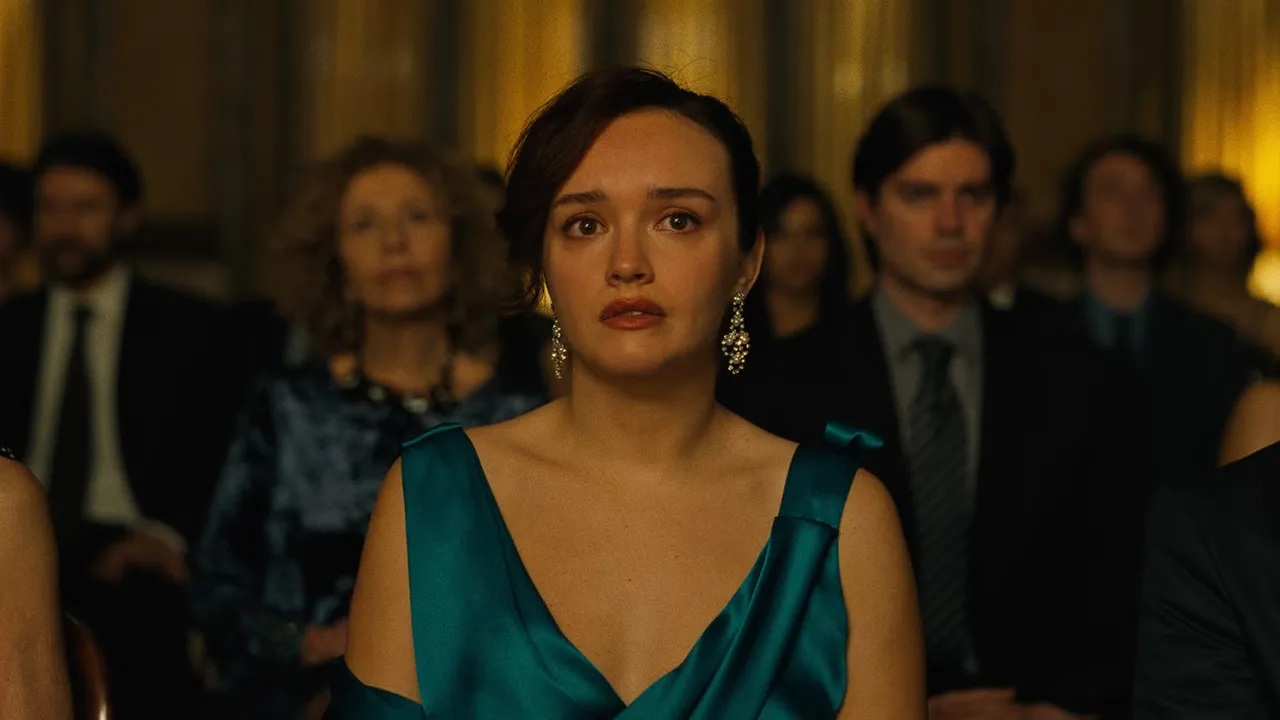
That’s not to say A Talent for Murder doesn’t have its merits. Mirren and Ehrenreich have solid adversarial chemistry, and the latter acquits himself admirably playing two characters who begin to bleed into each other as the movie marches on. Olivia Cooke proves herself a reliable if somewhat unchallenged performer by the unambitiously written but fancifully named Clementine Balfour, a woman Edward meets on the train into Switzerland whom he mentally recycles into the love interest/con victim of the same name that makes for the second lead of the novel. The location cinematography from frequent Yorgos Lanthimos collaborator Robbie Ryan is gorgeous and colorful, and the film’s costume and production design is first rate. To quote a common meme, the film has “great gowns, beautiful gowns”; what it’s ultimately lacking in, sadly, is surprise.
Despite featuring two plotlines and plenty of room for intrigue, the “story with a story” concept robs the film of urgency. No matter how much murder and mayhem Edward and Highsmith’s character may get up to in his quest for Clementine’s fortune, what is actually happening is two people sitting in a room talking about a novel that does not exist. The multiple layers of abstraction result in a film that struggles to convey the looming dread that drives the best minimalist mystery fare. Typically a movie or play in this style features multiple big twists that completely recontextualize the scenario — think something like Anthony Shaffer’s Sleuth or Ira Levin’s Deathtrap. But A Talent for Murder lacks punch by never having a massive "rug pull" moment to hang its hat on.
With the caveat that I haven’t seen the play this is based on, I can’t help but feel that a significant contributor to A Talent for Murder being too leisurely for its own good is a playwright who is too precious about adapting her own material. Although this is not Murray-Smith’s first film credit, she’s not a screenwriter by trade, having spent much more time in the world of theater. The energy required for a great mystery film is similar but not identical to that needed for a compelling stage play, and that mismatch of form is the biggest anchor holding the film back, even if it’s not enough to sink it entirely.
Topics in this story
Gathered from external sources. Rights to this text belong to whoever originally published it.