Werner Herzog's Bucking Fastard Teams Real-Life Sisters Kate and Rooney Mara in an Unusual Almost True Story
Bucking Fastard review: Werner Herzog casts Kate and Rooney Mara as synchronized sisters based on unusual real-life twins.
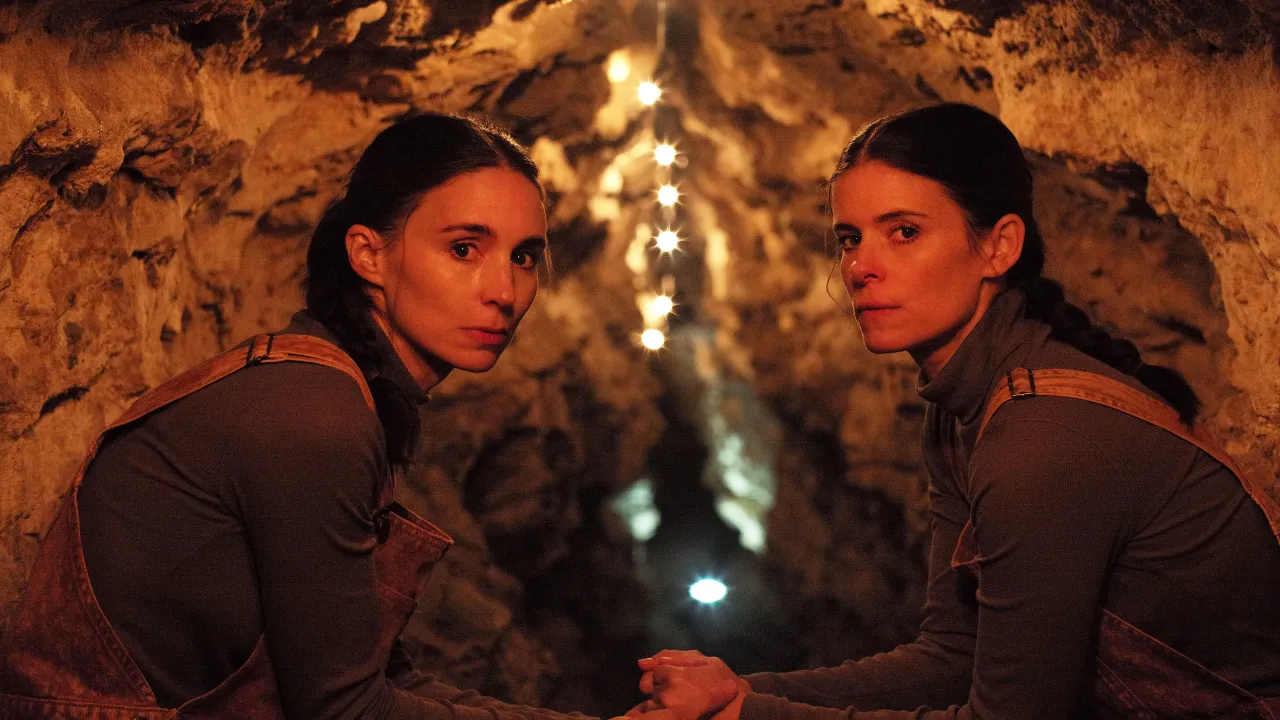
This review is based on a screening at the Venice Film Festival. Bucking Fastard does not have a release date yet.
Basing his film loosely on Yorkshire twins Freda and Greta Chaplin, who notoriously spoke and moved in sync, Werner Herzog unfurls a real-life tale of codependence into a unique episodic drama about sheltered adults entering society for the very first time. The result, Bucking Fastard, is strange and wistful, verging occasionally on the surreal — it’s fittingly dedicated to David Lynch in its opening titles — and though its final notes lack the intended impact, the result is fantastical and worthwhile.
A large part of this comes down to the challenge of casting and directing such an idiosyncratic endeavor. Sisters Kate and Rooney Mara have had parallel careers which finally collide in Herzog’s latest. They play Jean and Joan Holbrooke — respectively, though it rarely matters. When the movie begins, the American siblings (“We’re not twins, we’re sisters,” they clarify emphatically and in unison) are placed on trial in Ireland, where they were raised, for stalking and harassing their suave neighbor, Mr. Mulroney (Orlando Bloom), who they claim to be in love with and married to after a number of eager threesomes. The stakes here are low — a restraining order rather than a criminal conviction — allowing the story to take on mischievous hues as their obsessions play out in flashbacks.
Two things become immediately clear during this opening act: one, that the Mara sisters are a delight to watch together, delivering overlapping or echoing dialogue interspersed with wry smiles and knowing looks at one another; two, that the Holbrookes have a tragically incomplete understanding of the world despite their attempts at sexual independence. They have an antiquated way of speaking, moving, and dressing, so much so that the movie’s time period is practically obscured. Freda and Greta’s own harassment trial was in the 1980s — the film’s title comes from a verbal slip they made together in court — so it’s easy to assume a similar setting on screen until the first iPhone appears some thirty minutes in (courtesy of a curious onlooker demanding a selfie once the sisters become local celebrities).
The real twins were the subjects of their own documentaries , but Herzog, who actually met them, circumvents the need or desire to craft a traditional biography. Instead, he extrapolates the isolation and self-loathing that he imagines might have defined their adult lives, as a pair of women so in tune with one another that they could barely communicate with the outside world or function apart. He also imbues his fictitious stand-ins with a certain naïveté of which men throughout the movie threaten to take advantage, creating an imposing uncertainty whenever the sisters step outside. In male-dominated pop culture, twin girls and women tend to occupy either a scary or salacious place; think the twin ghosts from The Shining, or the pornographic fantasy of bedding two identical women. These ideas loom large over the Holbrookes, as Herzog has them unknowingly wrestle with these forces during mundane interactions with men who are either devious or paternalistic, and whose benevolence might just come with invisible strings. Doubt always looms, even if the sisters seldom feel it themselves.
However, once the film moves on from their trial and follows their attempts at living alone — which is to say, just the two of them — it takes on a more subdued tone, and not without good reason. Bucking Fastard seldom delves into the details of their past, but instead reverse-engineers its drama from fleeting mentions of their complicated upbringing by parents we never see and who want little to do with them once their impish antics begin to encompass arson. The absence of real love and acceptance hovers over the Holbrookes, causing them to misunderstand their own feelings at every turn, even if what they feel is pure. They are, in a sense, alien — twin souls who have no one but each other since the world rejects them both.
The movie is at its most poignant once they move far away from society to the lush Irish countryside. Once the sisters visit their ailing aunt Louise (Marion O'Dwyer) and befriend her sweet, burdened neighbor, the elderly shepherd McFarlane (Brendan Conroy), Bucking Fastard presses pause on its whimsy so that Jean and Joan can more carefully reflect on what they want from humanity and what it gives them in return. The answer isn’t always kind, but this setting affords them poetic promises of escape via a local legend surrounding a nearby cave, which — although they don’t have the capacity to digest its fiction — sparks something deep within them.
The film has a bittersweet lust for life, which Herzog finds nestled in still and painterly scenes between his crowded fish-eye close ups and uncanny framing (the camera, fittingly, moves in sync with both his leads). And although its eventual abstractions don’t quite reach meaningful catharsis or enlightenment — if anything, it ends on a surprising downswing — Herzog’s gentle tragedy of two women cast out by the world veers between amusing and straightforwardly touching, like an adult fairy tale about yearning for connection.
Topics in this story
Gathered from external sources. Rights to this text belong to whoever originally published it.