Peacock’s The Paper Explores the Messy Reality of Workplace Romances in Season 2 and Takes Big Comedic Swings to Escape The Office’s Shadow
In our The Paper Season 2 review, we explore how Peacock's The Office spin-off leans into messy workplace romances and massive comedic swings to finally escape Dunder Mifflin's shadow.
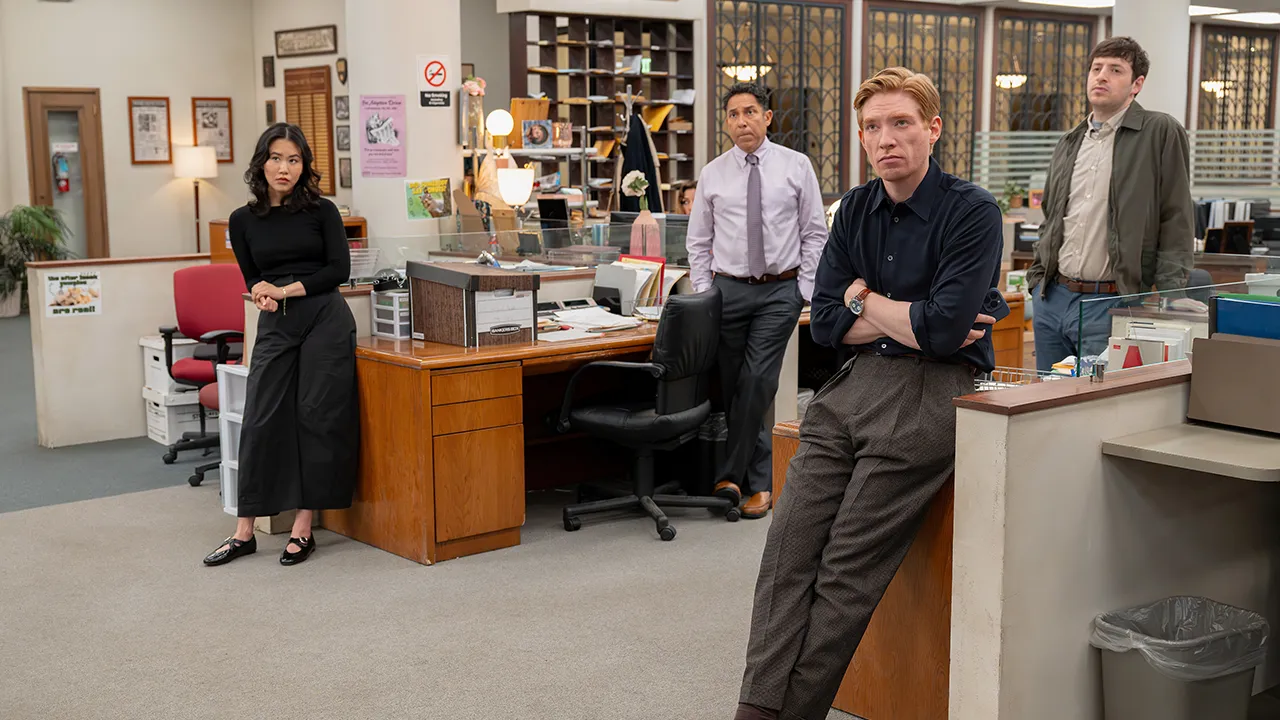
Mild spoilers below for The Paper Season 2. All episodes stream September 9 on Peacock .
At the Toledo Truth Teller, love is in the air. And in a ditch. And at a gun range, on a podcast, and everywhere else you turn. In Season 2 of Peacock’s The Paper, the employees of the fictional Ohio-based newspaper are tangled up in so many office romances that it’s sometimes hard to keep track. The most recent batch of episodes of the Office spin-off puts relationships at the center, often to hilarious effect. It’s a season of television that swings for the fences, daring to explore what happens when you move beyond the classic “will they, won’t they” sitcom trope and dive into the actual consequences of workplace love affairs.
In Season 2, The Paper hangs nearly its entire narrative on the budding romance between competent, if often flailing, newspaper editor-in-chief Ned (Domhnall Gleeson) and star reporter Mare (Chelsea Frei). In the wake of the Season 1 finale, in which the staff of the Truth Teller swept the Ohio journalism awards, the two characters begin a secret office romance. From romantic getaways involving Orwellian food delivery carts to sweet FaceTime dinners, Ned and Mare often echo The Office’s Jim and Pam at their best. But whereas The Office’s central romance spent multiple seasons trapped in a cycle of yearning and missed opportunities, The Paper moves at a quicker pace. By the Season 2 premiere, Ned and Mare are fully together and enduring all the tribulations that come with a new relationship.
Nearly every episode of Season 2 centers around Ned and Mare’s romance intersecting in some (often hilariously) inconvenient way. Ned gets jealous when Mare (who’s ex-military) is a better shot than him when they visit a gun range to schmooze a local cop. They co-host a debate-style podcast where they manage to flirt and vehemently disagree at the same time. They cut short a romantic weekend away when the rest of the office can’t be trusted to handle an election-related story.
It’s a refreshing approach to sitcom relationships that shows the romantic progression between two characters who share the same passions (in this case, print journalism) and uses the relationship to make the workplace shenanigans more meaningful. That makes it all the more frustrating when Mare and Ned’s romance hits a predictable speed bump late in the season. I won’t spoil the blow-up here, but in typical TV comedy fashion, it involves miscommunication and a moldy muffin.
Similarly, the sheer volume of secondary characters who are involved in their own romantic entanglements (spanning everything from subtle flirtations to getting too close for comfort in a roadside ditch while a tornado passes overhead) can be overwhelming at times.
Resident attention seeker Esmeralda (the always-hilarious Sabrina Impacciatore) and corporate hack Ken (Tim Key) engage in a series of hijinks that frequently verge on a pseudo-relationship. Oscar (Oscar Martinez) concocts a scheme to snag a cute nursing home employee. Staffers Detrick (Melvin Gregg), Adelola (Gbemisola Ikumelo), Nicole (Ramona Young), and Troy (Eric Rahill) each deal with office crushes of their own. Even parent company CEO Marv (Allan Harvey) makes a play for love near the end of the season. Each of these storylines is benign enough on their own, but in aggregate, they risk turning The Paper from a cutting mockumentary about the state of journalism into a late-aughts romantic comedy with too many intersecting storylines.
Apart from the myriad romances, Season 2's most notable trait is the big comedic swings the show takes, moving beyond the small-ish comedy of The Office (golden tickets and rabies scares aside) into moments that are big, broad, and verging on farce. Yes, smart humor is still present (there’s a runner about newspaper tycoon William Randolph Hearst’s mistress that might be the funniest scene of the entire series), but Season 2 often pushes itself out of the confines of the mockumentary format into a show that’s more universal.
This sometimes doesn't work, like when, late in the season, Esmeralda goes “undercover,” Michael Scott-style, as a teenage boy to investigate her son’s school. But when the humor lands, it’s brilliant, like when Ned fakes a rat bite and nearly allows a pretend nurse to inject him with a giant syringe just to prove a point to Mare. Or when a secret office task force recreates a crime scene with condiments. It’s a scattershot approach that misses as often as it hits, but frequently fosters moments of pure comedic gold.
Beyond an expanded style of humor, The Paper adds a series of characters in Season 2 that enrich the world of the series. Chief among these is Lisa, the new wildly inappropriate HR representative, played by Lisa Gilroy. In a series of interactions with various Truth Teller employees, we see Lisa be competent, spiteful, manic, and hilariously bawdy. She’s the classic Office-universe character: decent at her job but somehow completely inept and infinitely watchable. Joining Gilroy this season are sitcom mainstays Andy Richter, playing a fleeting love interest for Esmeralda, and the legendary Jon Lovitz as a sandwich-loving new colleague. While the principal cast of The Paper is top-notch, these new additions fit perfectly into the series’ expanding scope.
Over the course of two seasons, The Paper has moved beyond its origins as an Office spin-off and created its own identity outside the walls of Dunder Mifflin. The Paper is at once more socially conscious (it is about under-resourced journalists, after all) and universal in its humor. But for fans of The Office, the seams of that series are still visible throughout The Paper, for better or for worse: A character spends the majority of the season away from their colleagues when they’re reassigned to another office (Dunder Mifflin Stamford, anyone?); Ned has his employees dress up like old-timey newspaper staff to celebrate the Truth Teller’s 125th anniversary; in a move right from the Dwight Schrute playbook, Nicole disguises herself as Lisa and stalks Detrick on a road trip after he shuns her romantic overtures; Esmeralda is seen in a very “Michael Klump”-esque fat suit.
The callbacks are obvious, welcome, and frustrating all at once. Given the pedigree of the team behind The Paper (the show was co-created by Office boss Greg Daniels and Office alums, including Matt Sohn, Dave Rogers, Jen Selotta, Ben Silverman, and Paul Lieberstein (Toby Flenderson himself!)), it’s understandable how The Paper brims with echoes of that beloved series. And while it’s occasionally fun to dive into the warm bath that is The Office nostalgia, The Paper has built up its own universe to such an extent that, after 20 episodes, the team behind it could probably stand to fully drive forward with their own gimmicks, archetypes, and inside jokes and leave Scranton, Pennsylvania in the dust.
Topics in this story
Gathered from external sources. Rights to this text belong to whoever originally published it.