We Build LEGO Mayor Manor: A Spooky, Not-So-Scary Halloween Build
We build LEGO Mayor Manor, a new spooky-but-not-scary set that's perfect for Halloween season.
The new LEGO Midnight Valley Collection theme is the rough equivalent of the LEGO Winter Village Collection , only instead of centering around Christmas, this theme is based on Halloween. Assuming it follows the same trajectory as its predecessor, we'll likely see one major addition to this whimsical, haunted village each Autumn.
The Mayor Manor, out now, is the theme's debut set ( see it at Amazon ). It's an engaging, enjoyable build, with a cool visual motif for LEGO to elaborate upon in the years to come.
The Mayor Manor is not a "closed" building ; it is open in the back like a classic dollhouse, allowing the builder to observe and stage the interior to his or her liking. It comes in nine bags – paper rather than plastic, thanks to LEGO's ongoing sustainability initiative . The switchover has been gradual, starting in 2020 and ramping up considerably in the last two years or so.
[A note about the paper bags: Make sure you shake and flatten them out completely before discarding them. Paper is not as slippery as plastic (nor as see-thru), and so if you're missing a piece, it might be stuck in the scraps. It happened to me twice during this build.]
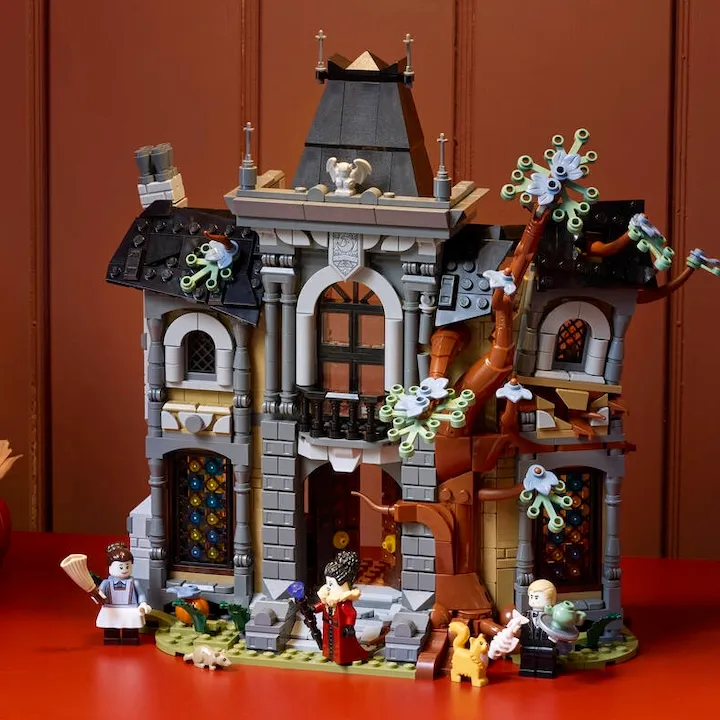
The design is very '90s Tim-Burton-meets-Addams-Family. You have traditional spires mixed with stained glass windows, along with a foreboding gargoyle perched on the roof. The tree leaves are off-color blue and green, which creates the impression that you're viewing this house in the twilight rather than the bright light of day.
The house interior is well-appointed, featuring a fireplace which functionally connects to the house chimney on the exterior – a nice bit of logical, functional coherency. On the second floor, there's a grandfather clock with a golden pendulum and a face stuck at midnight. There's also a bookshelf, with the books inserted at various depths, which gives the space a bit of quirk and whimsy. If you enjoy putting together little builds, which you then insert, as furniture or other knick-knacks, into a larger build to create a whole? Then you'll really enjoy what's going on here.
The designers draw a clear line of distinction between the facade of the house, versus the house itself . The house has structural integrity; it's a two-story, traditionally built structure with defined rooms, level floors, and straight lines. But the facade of the house – the way it presents itself externally – is skewed, as if it's actively falling apart. LEGO accomplishes this by clipping crooked walls and roofs onto the underlying building. It's a convincing visual effect that'll make you do a double take.
Because half of the house appears destroyed and half appears relatively intact, we can imagine, in our mind's eye, how the house once appeared when it was whole. And it's especially cool to contrast that to the ruined state of the house, and see how this jagged split in the wall over here matches – like a high-concept jigsaw puzzle – to the broken wall over there.
Have you ever seen Ripley's Believe it or Not! museums in tourist areas? They're these self-billed "Odditoriums" that capitalize, P.T. Barnum style, on the off-beat and strange: "Come see a real shrunken head!" "Gaze upon an Iron Maiden torture device from medieval times!" "Young lady, have you ever laid eyes on a two-headed goat?"
I used to love these museums growing up, and I especially loved looking at their optical illusion facades from streetview, which made them appear as if they were sinking into the ground or experiencing the aftershocks of an earthquake. The closer I walked, the less convincing the illusion. But that also taught me something about myself – that knowing the 'trick' behind these illusions deepened my love for them rather than diminishing it.
I thought about this while putting together the Mayor Manor, particularly its East Wing. LEGO tells a story through its presentation; a stubborn intrusive tree has grown into the house's foundations, and over time, it's punctured through the walls and wrapped itself around half of the second floor. It implies that the house is very, very old, but also that the inhabitants of the house – the pale-faced matron with the fur-lined shawl, and the maid and butler who wait upon her – are either indifferent to what's happening or are unable to prevent it.
Are they ghosts or the undead? Were they once inhabitants of this house when they were alive? How long have they roamed these hallways in the years since? They don't look unhappy, strictly speaking.
This sort of imaginative "what-if?" roleplay is essential, I think, to your full enjoyment of adult-geared sets like these. Because unlike many other 18+ sets, this is not a painstaking replica or a pop culture artifact; this is a playset, with the dimensions and features of one. Children have the ability to construct elaborate play scenarios—a skill we often lose as we grow older. LEGO sets like these give adults tacit permission to indulge in those joys once more.
But even if you don't have the suspension of disbelief to throw yourself into fantasy entirely, there is still childish joy and escapism in imagining the inner lives of these minifigures, and in staging dramatic scenarios when putting them out for display.
LEGO Mayor Manor, Set #11383, retails for $119.99, and it is composed of 1420 pieces. It is available for purchase now at Amazon and the LEGO Store .
Kevin Wong is a contributing freelancer for IGN, specializing in LEGO. He's also been published in Complex, Engadget, Gamespot, Kotaku, and more. Follow him on Twitter at @kevinjameswong.
Topics in this story
Gathered from external sources. Rights to this text belong to whoever originally published it.