Blade Runner 2099: What Happens When the Replicants Are Running the World?
In an exclusive interview with IGN, Blade Runner 2099 showrunner Silka Luisa says the new series will be an "undercover police story" that’s "quintessential Blade Runner."
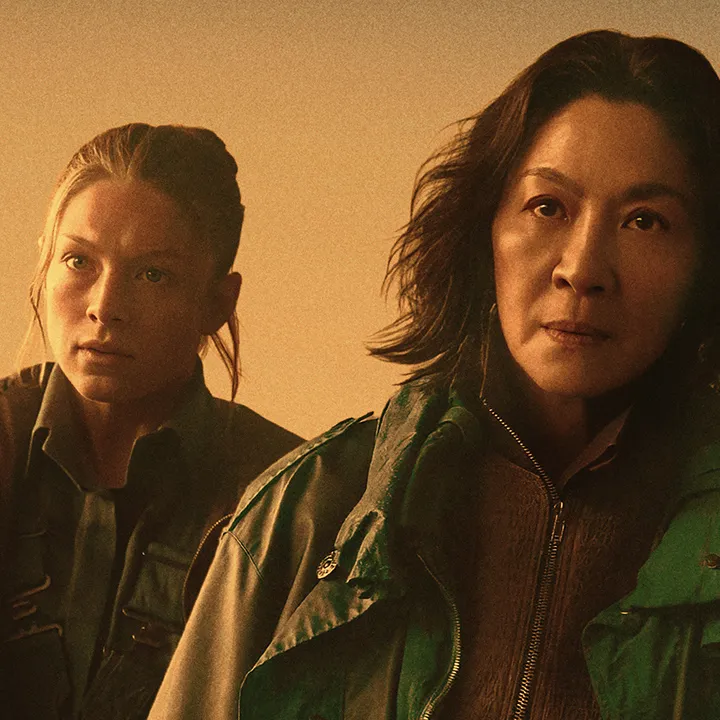
So says Michelle Yeoh’s Olwen, one of the two leads of Prime Video’s upcoming series Blade Runner 2099 . Picking up 50 years (obviously) after Blade Runner 2049 , the dystopian future world that was first brought to the screen by Ridley Scott is in many ways the same in the show as it was in that 1982 film – vast cityscapes, flying cars, teeming masses, and big-as-hell shoulder pads.
But in other areas, things have changed significantly. Perhaps most notably, the Replicant underclass – androids designed by man as slave labor – have overtaken their human overseers after a war between the two races. Now it’s humankind that lives under the heel of the Replicants. And as Olwen says, it’s their time now…
In advance of Blade Runner 2099’s New York Comic Con panel on Saturday , we spoke to series creator Silka Luisa and production designer Paul Inglis about recreating the world first envisioned by Scott, and then Denis Villeneuve for Blade Runner 2049, and how channeling the Replicants versus humans dynamic – and the blurring of the line between the two groups that both films did so well – informed not only the design choices behind the new show, but also how the characters of Yeoh’s Olwen and Hunter Schafer’s Cora would take the latest chapter of Blade Runner to a new level.
An Undercover Cop Story… in a Dystopian Future
The Blade Runner films (and the 1968 book on which the original film was based, Philip K. Dick’s Do Androids Dream of Electric Sheep?) have always played with the idea of identity, be it the age-old question of whether or not Harrison Ford’s Rick Deckard is a Replicant, Ryan Gosling’s Agent K’s delusions of grandeur about being some kind of “chosen one,” or now, in 2099, Schafer’s Cora playing a human who is forced to pretend to be a Replicant Blade Runner… who, by the way, now hunt down rogue humans rather than Replicants. It seems to be getting harder than ever to tell the difference between human and Replicant.
“That's always been baked into the concept of the franchise – the idea that there could be something that looks just like us but is slightly other,” says Luisa. “And that is such an interesting, complicated character dynamic to explore. In our world, with the power dynamics flipped, it's also interesting to think, okay, what comes after us and do they have more right to be here than us at some point?”
There’s a moment in Episode 1 where a human says, “No one gets by me,” and a Replicant Blade Runner responds, “You’re human. Your whole world has already gone past you.” And indeed, that is the vibe of the show as things begin. Having lost the war between Replicants and humans at some point between the events of Blade Runner 2049 and this series, the humans now live in a world that not only did they ruin, but that the Replicants are trying to rebuild. Ecologically wrecked and polluted, Earth seems to have a shot once again at healing now that the Replicants can apply their terraforming skills from decades of off-world colony experience. A new life awaits you… on Earth!
This new status quo, which was seeded in Blade Runner 2049’s Replicant rebels, allows Luisa and her team to pay respect to what has come before in this universe but also chart new ground, as with the unlikely partnership between the Blade Runner Olwen and her new partner, Cora, who is essentially pulling a Matt Damon from The Departed. Forced to pretend to be a Replicant and a Blade Runner, she finds herself living a double life where she can trust virtually no one.
“It was important to be aware of and to respect the canon of the films in terms of historically what happens in them and the tentpole moments,” says Luisa. “The benefit of having this shift in status quo is that it's a new entry point for everyone, and that makes it accessible to new audiences and to fans because everyone is learning about this new world and the new dynamic and all the new characters.”
As for the idea of making Cora an undercover agent of sorts, Luisa points out that the films have always had an “investigatory police” element.
“Even though the world is fantastical and phenomenal and just stunning and surprising, there is a narrative engine that is familiar in a way that helps pull you through this very foreign world,” she explains. “And building on that, I was like, an undercover police story would be an interesting way to pair a Replicant and a human together and to figure out, can you tell an enemies to ally story within that structure?”
A key aspect of the show is also Yeoh’s character’s lifespan. Back in the original Blade Runner, the Replicants had four-year lifespans and then they shut down – died, actually. It seems Replicants get more time these days, but not enough, and Olwen is very aware that she is on her way out.
“This is the last week of her life,” says Luisa. “Blade Runner has always been about mortality. Part of the human experience is dying and it's inevitable, and Replicants know exactly when they're going to die, which in some ways makes it even harder because it's sooner than it should be. And that knowledge, I don't know if we're meant to have that. Can you ever stop fighting the desire to want to be here and to see how the story continues? That felt very fundamental.”
Re-Creating ‘Quintessential Blade Runner’ Tech for 2099
The spinners are certainly one of the most recognizable aspects of the Blade Runner world – the flying cars first conceived by the iconic designer Syd Mead for Ridley Scott’s original film. They carried through to Blade Runner 2049, and now they’re back once again for the new series. As Luisa says, they’re “quintessential Blade Runner.”
“Our [police] department spinners are intentionally quite muscular,” explains Paul Inglis, who served as supervising art director on Blade Runner 2049 and is now the production designer on the series. “They're intentionally quite industrial and quite harsh looking – maybe a nod to the fact that you want a sense of power to them, you want a sense that the people flying them come with muscularity, come with intent.”
“There's certain components of them that I don't think you can shift, because then they no longer are the Blade Runner you know and love,” says Luisa. “So what I really appreciated about Paul's design that he developed with George Hull was that it didn't stray so far from the films that you were no longer remembering the quintessential spinner. We talked a lot about them being heavier and having a weight to them. From the human perspective, Blade Runners are terrifying now and those Spinners arriving should feel like an undercover cop pulling up into your neighborhood where everyone knows who it is and you just scatter.”
Living in the actual Los Angeles also helped to inform how the future Los Angeles of the show should look, sound, and feel, and that included the sound of these spinners.
“I live in Los Angeles and something that really was startling when I first moved here was the sound of helicopters all the time,” says Luisa. “It's just something that is so unsettling, and in the sound design we talked a lot about. If you have these spinners that are police vehicles flying overhead, how do you give a sound to them that is just in your bones and it creates a sense of police state all the time?”
Says Inglis, “They very much were designed to [invoke] a ‘look at us, we're Blade Runners’ [feel] every time they land. There is a certain amount of trepidation that comes with seeing one of those flying through the air.”
It’s not just the spinners that are similar to their predecessors. Luisa and the rest of the team behind 2099 intentionally wanted to call back to the world of the original Blade Runner, which was set 80 years earlier in 2019, for story purposes.
“That came out of my initial conversations with Ridley,” says Luisa. “When you think of the show, it really is post-war. We're in the aftermath of this Replicant uprising and the city is no longer up and running in the same way it was in 2049. Manufacturing would've stopped. There would've been a regression in that sense. So we returned to the original aesthetic of the first film, much more so than 2049, where the idea is that the inner components that typically are hidden are visible and accessible. That was a design principle that he talks about a lot, was that everything on the inside is on the outside and it gives you a very analog and nostalgic feel, but from a practical sense it's actually incredibly useful because it's easier to repair things, it's easier to use components from different parts. And when thinking about the world, that made logical sense because these humans are scavenging from all different pockets of what they have left to assemble what they need now.”
“You have synthetic humans, you have flying cars, but some things are actually very set in the past,” says Inglis. “A lot of what we do to build this world is we look backwards to look forwards, but then we add things to that historical reference to bring them to a Blade Runner space. And I think that's what makes this distinct from a lot of other science fiction. It's almost like we have science fiction events, but in a non-science-fiction world in that our backdrop is tactile. It's tangible. It wants to feel as real as possible. And we're always trying to find materials, finishes and aging that gives the world a sense of [the viewer] wanting to reach out and touch it.”
Of course, considering the premise of this new iteration of Blade Runner, the question has to be asked: Can the Replicants really be the saviors of the future?
“In 2049, it felt like the environment was dying and there is a benefit – Replicants who had been terraforming and who had been building atmospheres on and off worlds, they can offer something to us in the sense that we could barely breathe our air and do they know how to rehabilitate it?” says Luisa. But there is another aspect to Earth’s new overlords as well.
“It's the idea of, they don't have childhoods, and so they don't develop empathy in the same way that we do. And then what would that do? How would that shift their worldview? How would you shape a city? How would you shape governance without that, without empathy?”
Blade Runner 2099 debuts on Prime Video on November 25.
Reporting by Jim Vejvoda and Amelia Emberwing
Talk to Scott Collura @scottcollura.bsky.social , or listen to his Star Trek podcast, Transporter Room 3 . Or do both!
Topics in this story
Gathered from external sources. Rights to this text belong to whoever originally published it.