Modern Warfare 4 Rescues The Reboot Series By Replicating Call of Duty’s Greatest Era
Modern Warfare 4's great campaign is a fun rethink of COD's finest hour, turning Modern Warfare 2's iconic moments into exciting new missions.
This is an IGN opinion piece from Matt Purslow, who has been playing campaign shooters since he was old enough to master WASD+mouse. He has completed every Call of Duty campaign at least once.
Warning: this article features some minor spoilers for Call of Duty: Modern Warfare 4.
We’re in the final months of the year, so it’s time for the annual coin flip: is the latest Call of Duty campaign one of the good ones? The FPS series struggles with a curse few others do, zig-zagging between highs and lows, its annual cadence only making this undulating quality all the more prominent. In the last three years alone we’ve had one of its best campaigns sandwiched between two of its very worst. Thankfully, that on/off nature continues in 2026, which means it's a good year for Call of Duty. Modern Warfare 4’s campaign is one of the series’ best , and much of that is down to the fact that it replicates the formula of one of the greatest shooter campaigns ever made.
You see, Modern Warfare 4 is Modern Warfare 2.
Infinity Ward was riding high in the late 2000s. It had successfully pivoted Call of Duty from its 1940s origins to contemporary battlefields with the first Modern Warfare, which presented a somewhat quieter, eerier approach to the studio’s slick combat killboxes – all green night vision, silencers, and decaying Soviet architecture. But for its 2009 sequel, Infinity Ward brought the noise. Set during a Russian invasion of America, it pulled on the iconography of World War 2 movies to create epic battle sequences. The shattered streets of France were replaced by the burning picket fences of Suburbia, USA. You battled through houses, government buildings, and burger joints as you fought back those invading your homeland. But the frontlines weren’t your only battleground – threaded alongside those missions was a tale of special operatives, led by Captain Price, trying to strike against the Russian mastermind behind it all.
Swap out the streets of the United States for the roads of South Korea, and the Russian invaders for North Korean aggressors, and that synopsis of Modern Warfare 2 becomes the CliffsNotes for Modern Warfare 4 . And I don’t mean that disparagingly – this formula is a perfect vehicle for what Call of Duty is very good at: a mix of WW2-scale military action and smaller, espionage-style missions. And considering it’s been 17 years since Modern Warfare 2, I think we can give Infinity Ward a pass here, especially considering it desperately needed to get the Modern Warfare series back on track after two lackluster chapters.
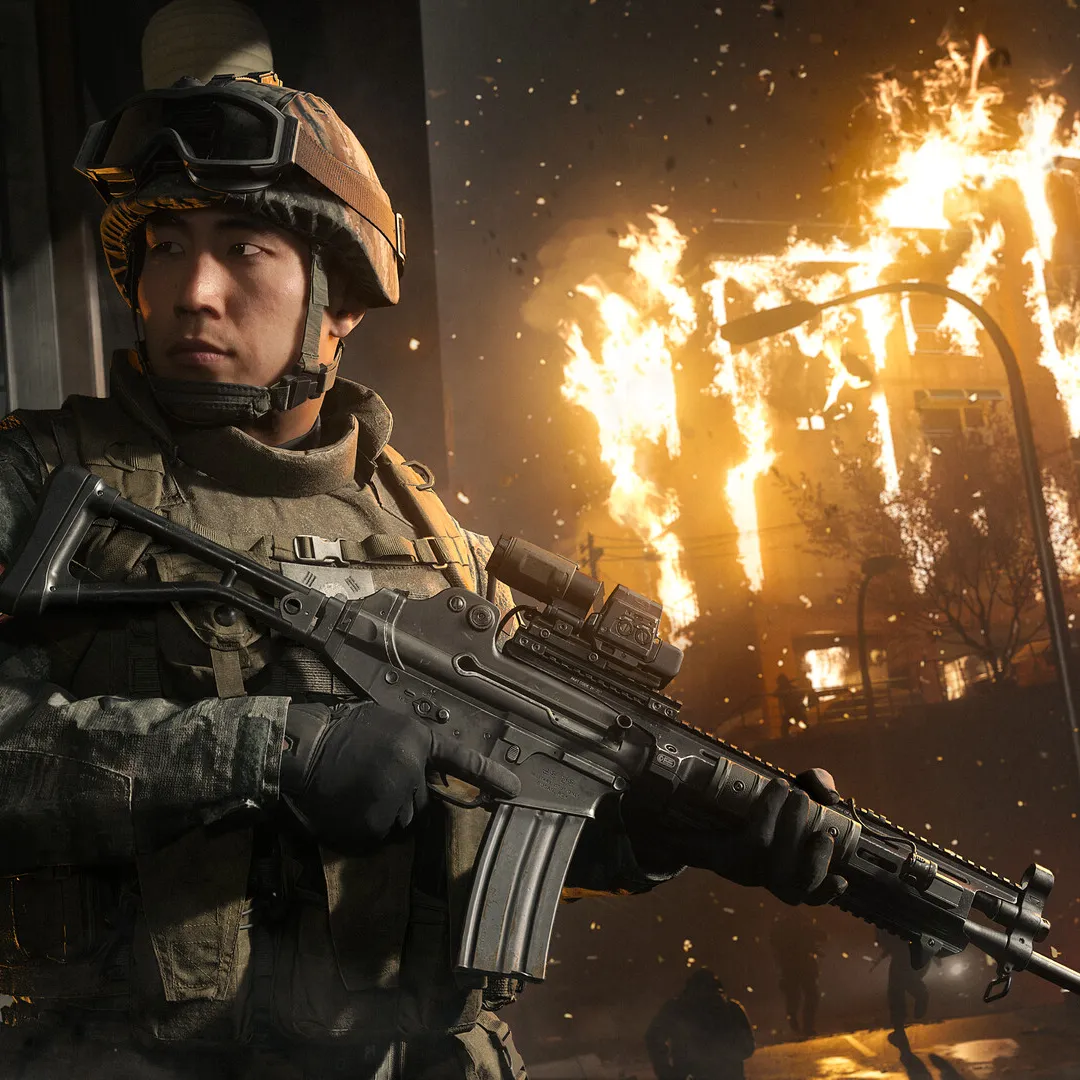
What rescues Modern Warfare 4 from feeling like a copy/paste of Modern Warfare 2 is how it uses the same broad outline as a canvas for very different characters and scenarios. While the headlining Captain Price and his vendetta against Mads Mikkelsen’s The Archer is more or less MW2’s pursuit of Makarov, the real heart of the story is Young Mazino’s Park Hyun-Jun. Park is a junior soldier, only holding a rifle due to being conscripted as part of the South Korean Military Service Act. Unlike the special forces operators that we’ve played as across the entire reboot series thus far, Park has no interest in being a professional soldier. And yet the unexpected invasion of his homeland by the North Koreans means his backyard is transformed into a warzone, forcing him into combat.
The campaign doesn’t have space to fully explore the emotional toll this has on the inexperienced Park, but there are small moments that let this great concept shine through – animations like a nervously twitching leg, or Mazino’s softer, more downbeat delivery. And so while much of Modern Warfare 4’s scenario design pulls directly from Modern Warfare 2, be that enemy paratroopers descending into a regular city, civilian architecture punctured by bullets and bombs, or clearing housing blocks of invaders, the tone is markedly different. It’s a similar blend of horror and excitement, painted in much darker colours. In this sense, it treads much the same ground as 2019’s Modern Warfare reboot, which explored very similar topics to the 2007 original, but augmented them with a darker tone ripped from films like The Hurt Locker and Zero Dark Thirty.
Contrasting Park’s explosive life on the frontline is Price’s off-grid attempts to eliminate The Archer. The missions featuring the moustachio’d captain (and, of course, Soap MacTavish) in Modern Warfare 2 were all Bond, Bourne, and Hunt homages, from snow-covered stealth infiltrations to exhilarating boat chases. The same can be said about Price’s approach in MW4. His Parisian excursion is the highlight, elegantly switching from on-rails shooter to driving mission, to on-foot firefight, and back to on-rails shooter, all within European streets torn from Christopher McQuarrie’s filmography. Here, the difference is technical – that Parisian car chase feels substantially more immediate and dangerous than Modern Warfare 2’s snowspeeder sequence thanks to almost two decades of video game graphics and level design evolution. As a result, it’s the most authentic Mission: Impossible set piece you can have outside of the cinema. Meanwhile, Price’s new (and admittedly very imprecise) hand-to-hand combat skills give this version of the espionage story a more brutal edge, its bone-busting and skin-slicing finishers feeling particularly nasty.
There is, of course, something that Modern Warfare 2 is much more (in)famous for. The sharp shock of No Russian may now have finally diminished, but its challenging depiction of a terrorist attack on an airport remains one of Call of Duty’s most memorable missions . Modern Warfare 4 has its own take, albeit delivered in a very different shape. The crux of No Russian is its interactivity – do you follow orders and slaughter dozens of civilians, or keep your finger off the trigger? And so MW4’s variant is appropriately called “Following Orders”, the idea given new context by casting you as a North Korean soldier asked to hunt down an enemy of the totalitarian regime. As you storm houses and question terrified civilians, you’re given the opportunity to either toe the party line or defy your monstrous leaders. Do you bring up the medical contraband you found? Reveal the woman you found beneath the kitchen floor? Question an ally’s use of torture? And will you hold the rope that hangs the alleged defector?
While it paints a very broad image of North Korea’s political situation and doesn’t contribute to the overall story in quite the same way No Russian does, Following Orders is nonetheless a fascinating component of Modern Warfare 4’s repainting of Modern Warfare 2’s canvas. It’s a more modern take on a similar concept, providing a greater array of choices for how you get involved, and pushing you to consider your own morality and position within the machine thanks to a (slightly) sharper line of questioning.
Compare Following Orders to Passenger, the rebooted Modern Warfare 3 ’s more direct attempt at No Russian, and the difference is night and day. Rather than examine and rebuild the mission’s experimental combination of narrative and gameplay, Passenger is simply a terrorist attack involving a plane. And while you technically do play Passenger, it’s largely a first-person cutscene where most of your interaction is walking forward between scripted sequences. Considering the entire point of No Russian is player agency, it’s a woeful misunderstanding of why you’d include an interactive terrorist attack in a video game.
More broadly, Passenger is emblematic of how the Modern Warfare reboot’s middle chapters stumbled. 2019’s opening act was undeniably related to the Modern Warfare of a decade prior, but it was very much its own thing. The tense room clearing of Clean House was a remix of two original Modern Warfare missions – Death From Above’s chilling matter-of-fact murder and All Ghillied Up’s quiet and methodical movement – but together they created a new Call of Duty icon that defined the reboot’s intended direction. But rather than continue that creative approach, 2022’s Modern Warfare 2 was content to play weak covers of the greatest hits. Its catalogue was filled with new versions of Crew Expendable, All Ghillied Up, and Death From Above, with little more than extra gloss to justify their existence.
At least there was gloss, something that can’t be said about 2023’s Modern Warfare 3 and its stapled-together chunks of Warzone’s Verdansk map. It’s an odd, barely-finished experiment in freeform mission design seemingly born out of constricted development timelines. Modern Warfare 4 does its very best to pretend its predecessor doesn’t exist by brushing all its loose threads under the bloody rug as fast as it can through its first few missions. And it gets away with it, simply because Modern Warfare 4, like the reboot’s first chapter, understands the mission. A reimagining must honor the past as much as it must reinvent it. It must be recognisably its namesake, while offering something that name has never offered before.
And so we arrive at Modern Warfare 4, which is Modern Warfare 2 but different. It’s a concept that, just a few weeks ago, I’d have hated, especially considering Raven Software’s brilliantly experimental Black Ops 6 set a new bar for what Call of Duty should be – every mission a different beast, every new corner an opportunity to push the gameplay in unexpected directions . And yet Modern Warfare 4 has proved exactly what Call of Duty needed this year: a loud and cinematic celebration of the series’ most classic strengths. World War 2 with laser-guided missiles and EMP strikes. A revival of old ideas through new eyes.
Modern Warfare 2, with all its wild brilliance, but different.
Matt Purslow is IGN's Executive Editor of Features.
Topics in this story
Gathered from external sources. Rights to this text belong to whoever originally published it.