Avatar: Seven Havens Bends It Like Pavi and Nisha in the First 3 Episodes of the Latest Installment in the Franchise
Avatar: Seven Havens episodes 1-3 recap and review: Twins take on the challenge of a post-apocalyptic world.
This review contains full spoilers for Avatar: Seven Havens Season 1, Episodes 1-3, which debut October 9 on Paramount+.
The experience of watching the first new Avatar series in 12 years — Avatar Aang movie and Netflix’s live-action adaptation aside — is an overwhelming one. While there have been numerous (pretty excellent) comic book tie-ins and extensions released in the intervening decade plus, insuring that the world created by Michael Dante DiMartino and Bryan Konietzko has never fully gone away, they’ve all felt like mere footsteps from the stellar runs of Avatar: The Last Airbender and The Legend of Korra — reinterpretations of information we already had on hand instead of something really truly new.
Avatar: Seven Havens, on the other hand, is really truly new. Set 225 years after the events of Legend of Korra in a post-apocalyptic landscape where all that remains of humanity is based in the Seven Havens of the title, the show evolves the animation style and setting in a way that’s closer to Miyazaki or recent surreal hits like Scavengers Reign or Common Side Effects rather than what we might expect from an Avatar series.
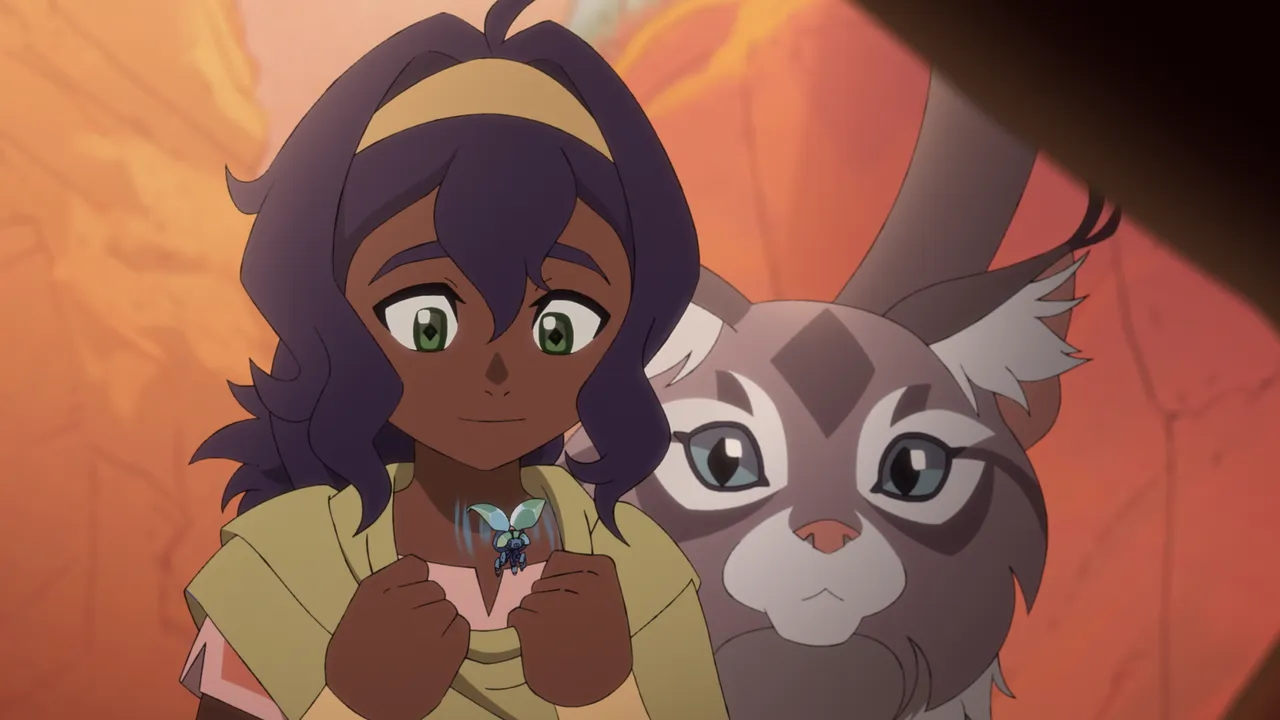
But even with the different animation, there’s something both alien and familiar about watching Seven Havens. On one hand, you’ve got a kid Avatar in Pavi (Saheli Khan) — more on that in a second — just like Aang in the original series. But unlike Aang, who had a very clear path forward (stop the Fire Lord, save the world), Pavi has been living on the outskirts with only bugs, rocks, and her cat-monkey (voiced by Dee Bradley Baker, the voice of Appa and Momo in the original series) as friends, with no clear path to saving a world that maybe doesn’t want to be saved.
The sly humor that DiMartino and Konietzko have woven into previous series is back, and an early sequence in the premiere, “On The Horizon,” with Jae (Major Curda) surfing his way through the Haven of Ellora is an utter delight. But if Korra took the franchise in darker, more adult directions, Seven Havens is both a reflection of the world we live in today and of the anger some fans felt toward the character of Korra. The plot involves something Korra did two centuries earlier that broke the world, leading to the survivors hating and fearing the Avatar; it’s also clear in the first three episodes that this story isn’t done, and it also isn’t what the world thinks. It’s just speculation, but it very much feels like DiMartino and Konietzko are saying, “Oh, you hate Korra so much? Well, here’s why you’re wrong , and we’ll lay it out for you over the course of 26 episodes.”
That aspect could be a little (well, a lot ) navel-gazing, but there’s the outward focus the creators are bringing to the story as well, diving harshly into both the divided nature of our own real world and the coming climate apocalypse. Animation is never going to have the pace necessary to really reflect the world outside our window — it usually takes at least two years for an animated season to make it from script to screen, unless you’re South Park — but thanks to an Avatar classic (a play at a festival performed by children), we discover why the world hates the monster Korra and how the Seven Havens were formed together but now stand far apart. In the third episode, “The Order,” the airbender Karthik (Akshay Khanna) — now promoted to Commander of the Bending Brigade in Ellora — suggests they reach out to the other Havens as fewer and fewer benders are being born every year. He’s flatly turned down: Ellora can stand for itself.
This isolationist stance has been bubbling over in our real world for a long time now, and it’s hard not to watch scenes like that without thinking about Brexit or America’s increasing push to close its borders. Similarly, the threats in the first few episodes — other than a menacing red diamond; more on that in a second — are all climate based. A tornado is the “villain” of the premiere, and a massive green storm nearly destroys Ellora in Episode 2, “Into The Storm.” Again, it’s not one to one, but with our own climate disasters increasing year by year, it’s clear that DiMartino and Konietzko are setting up Seven Havens as both a commentary and a warning, while also delivering a fun mythology-building Avatar series.
Speaking of mythology-building, the first two episodes essentially function like one pilot, and are surprisingly sparse on action and plot… laudably so, as the series in those initial 40ish minutes sits in the silences and lets us feel what the characters are feeling instead of thrill at Cool Bending Fights, though there are plenty of those too. The two plot tracks follow Pavi as she rides her cat-monkey, trying to hide while a festival celebrating the rise of the Seven Havens takes over Ellora; and Jae as he works with his bending team from the town’s Bending Brigade to help fix a crumbling bridge.
Pavi is, per the title of “Book 1,” all about survival and that’s it. Jae also ties into that theme; he’s focused on protecting Ellora to a fault, though having been raised in a post-Avatar society, he doesn’t seem to understand what he’s protecting or why. When Pavi ends up accidentally causing havoc at the festival by freeing some bugs, she uses her earthbending and alerts Jae to a rogue bender. Traveling out into a storm, Jae appeals to Pavi with kindness, but they get interrupted by a tornado, which Pavi helps shut down by revealing she can also airbend. This reshapes Jae’s whole thinking: What if the Avatar isn’t a monster, but in this case a nine-year-old girl with one leg who’s just trying to live?
Jae brings her back to headquarters to try and figure out what to do, trusting his superior Karthik with the info, while Pavi sneaks off only to discover another Avatar — specifically, her twin sister Nisha (Aishu Devan). Shouts to Paramount for doing a good job hiding this secret despite it being pretty obvious that front-loading twins as the main characters of the series would imply they’re both the Avatar. Given what we find out shortly — that Nisha has a lot of Korra’s impulsiveness and anger in her, while Pavi has Aang’s wackiness while being all refusal no call — it’s a neat way of splitting and analyzing what made previous Avatars work (or not) thanks to the twins.
It also kicks us into our central mystery in Episode 2: Who are Pavi and Nisha, why don’t they remember each other, and how are they both the Avatar — the first time in the Avatar cycle that two people have held the title at the same time? Shades of Buffy and Faith on Buffy the Vampire Slayer, perhaps? Rewinding time, we get to see a little bit about how Nisha has been training in secret under the guidance of Karthik and desperately wants to go out and help. She gets her chance thanks to the aforementioned giant green storm.
While we get to see Ellora activate the Bending Brigade to mitigate the damage of the storm, which is pretty neat, the focus is on Pavi and Nisha, who eventually join together to help, only to be confronted by a strange red, pulsating diamond crackling with evil-looking energy. After it does something to Karthik’s commander, who fled at the sight of it, Pavi and Nisha manage to trap it, only for the diamond to envelop them, send them to another dimension, and then hit them with what are likely missing memories. The diamond then disappears, leaving behind red crystalline structures throughout the wrecked Ellora, and again it seems pretty clear that this may not be evil so much as something reaching out — likely from the Spirit World, and potentially even an aspect of Korra; TBD on that.
This brings us to Episode 3, which thanks to an opening title sequence laying out the plot in classic Avatar style — thank goodness; it was missed in the first two half-hours — feels like the first real episode of the show. The main thrust here is that Jae is completely melting down at keeping the secret of the re-emergence of the Avatar(s), while Pavi and Nisha are at odds over doing Avatar training with the surprise return of the Order of the White Lotus, a group of wise men and women who often will help guide the Avatar. This comes together when the three characters all calm what looks like an armadillo-camel that’s been corrupted by the red energy; it acts like a pill bug rolling around Ellora, and we’ve had armadillo-bears and armadillo-tigers before.
Here we get another key component of the series — the music . Jeremy Zuckerman returns after working on The Last Airbender and Legend of Korra, and he’s created a heart-aching, gorgeously poignant score for the series, particularly the theme that haunts Pavi and Nisha in the first two episodes. But it isn’t until Episode 3 when Pavi plays the theme on the kalimba that it becomes clear what the real purpose of the score is. Memory is spurred on by music, and the song we’ve been hearing for two episodes so far is actually a song that Pavi and Nisha’s mother used to sing to them, complete with lyrics. It’s a goose bump-inducing moment when this is revealed, as the duo sing together on instinct, calming the animal and sparking various memories.
If there’s a criticism to be made here, it’s that it’s hard to tell exactly where this is all headed. We do get an indication when Pavi and Nisha discuss needing to go find their parents, and if this is a more emotionally driven story than the world-ending stakes facing Aang, or the threats to Republic City — and sometimes the world — that plagued Korra, it should be an interesting swerve. The show already tugs at your heartstrings from the opening moments, so this viewer at least is invested in seeing Pavi and Nisha find happiness.
But we’re also three episodes in and have thus far encountered one (1) Haven, and even with the show just starting, you can feel time ticking away. It’s also laudable to deal with a climate apocalypse, but a green storm, a tornado, and a red diamond are not exactly the terrifying and complex villains this franchise is known for. Perhaps that’s coming: Demon-masked antagonists show up right at the end of the third episode, and likely will spur our three main characters to flee and explore more of the world, thus setting up our stakes. Maybe as our own world has gotten murkier and more confusing, the world of Avatar has as well. There’s no one evil bad guy you can defeat to save the world; it’s up to the next generation to fix things as best as they can.
These are minor quibbles when it feels so good to get back to this universe with new characters, new settings, dazzling animation, and soaring music. Welcome back, Avatar; yip yip.
Avatar Easter Eggs, References, and Connections
While most of the easter eggs and references in these episodes are pretty blatant, it might be helpful to lay some of them out for more casual viewers (or since it’s been, you know, well over a decade). Let’s start with the play about Korra performed by a bunch of kids in the town square of Ellora. Plays have been built in since “The Ember Island Players” debuted in The Last Airbender Season 3, showing off the adventures of the characters in the series via a ridiculous play titled “The Boy In The Iceberg.”
In Episode 2, Karthik reveals the lost history of the Avatars — everyone only knows Korra — and shows off a scroll depicting the older Aang with the dumb chin beard as seen in Legend of Korra, Avatar Kyoshi, and Avatar Roku. There are, FYI, a lot more Avatars than that, including some secret ones that were revealed in the Avatar Aang movie.
In Episode 3, we also get to see some pictures of previous members of the Order of the White Lotus. The beloved Iroh is right in the middle, with Jeong Jeong to his right and Pakku to his left — all three members of the Order during the time of The Last Airbender. Curiously, it’s harder to identify the waterbenders on the left and right side of the display; the woman all the way on the left could potentially be Katara, but she doesn’t have the icon’s little hair loops. Other waterbenders known to be part of the Order include: Ayunerak, aka Mama, who appeared in The Dawn of Yangchen novel and has never been seen visually; Kavik, also from The Dawn of Yangchen, who has a very handsome picture but doesn’t look like the guy on the right otherwise; Ivalu, from — you won’t believe this — The Dawn Of Yangchen; and Aupilaarjuk, who was from Kyoshi’s era and only appeared in the Avatar Legends role-playing game. Sadly not pictured on the wall of fame is crazy old Bumi, the earthbending King of Omashu.
Also of note? The entire Haven of Ellora seems to be laid out like the symbol for the Order, which certainly implies a lack of coincidence in the Avatars ending up there. That said, we have yet to see the other six Havens, so maybe they’re all laid out the same with their own divisions of the Order.
Less an easter egg than a nice, progressive note: Jae has a boyfriend named Datu (Topher Ngo). While things don’t go further than some embraces and a kiss on the cheek, this is a far cry from the surprising swerve of Korra and Asami getting together in the final seconds of Legend of Korra, a move that was lauded (yay representation!) and lambasted for its execution (the quickness and generally unclear way they “got together”). Baking in Jae and his boyfriend right in the third episode seems like a clear way to be more explicit about the inclusive world of Avatar. Similar to DiMartino and Konietzko stepping back and letting more racially appropriate voices write, direct, and act, this shows a welcome growth from where they were a decade ago; they’ve clearly been listening and learning.
Finally, let’s talk about that odd red diamond. The dark energy does seem to be some sort of conduit to, or from, the spirit world, and given that we don’t know what Korra did or how Pavi and Nisha connect to this — or why there hasn’t been an Avatar in centuries — it raises a lot of questions we’ll surely explore as the show continues. Let’s throw out a crazy idea here: What if this wasn’t Korra’s fault; what if was Aang’s ? This is something that was dealt with before in Legend of Korra, but there’s something about this energy that’s reminiscent of energybending, the forbidden practice that Aang used to take away Fire Lord Ozai’s bending at the conclusion of The Last Airbender. Is it possible Aang broke something there that Korra was trying to fix, rather than the other way around? This is pure speculation, but why not? We’ve got plenty of episodes to be way off about these theories.
Topics in this story
Gathered from external sources. Rights to this text belong to whoever originally published it.