Aaron Ashby is on a historic heater
The Brewer lefty is operating in rare air
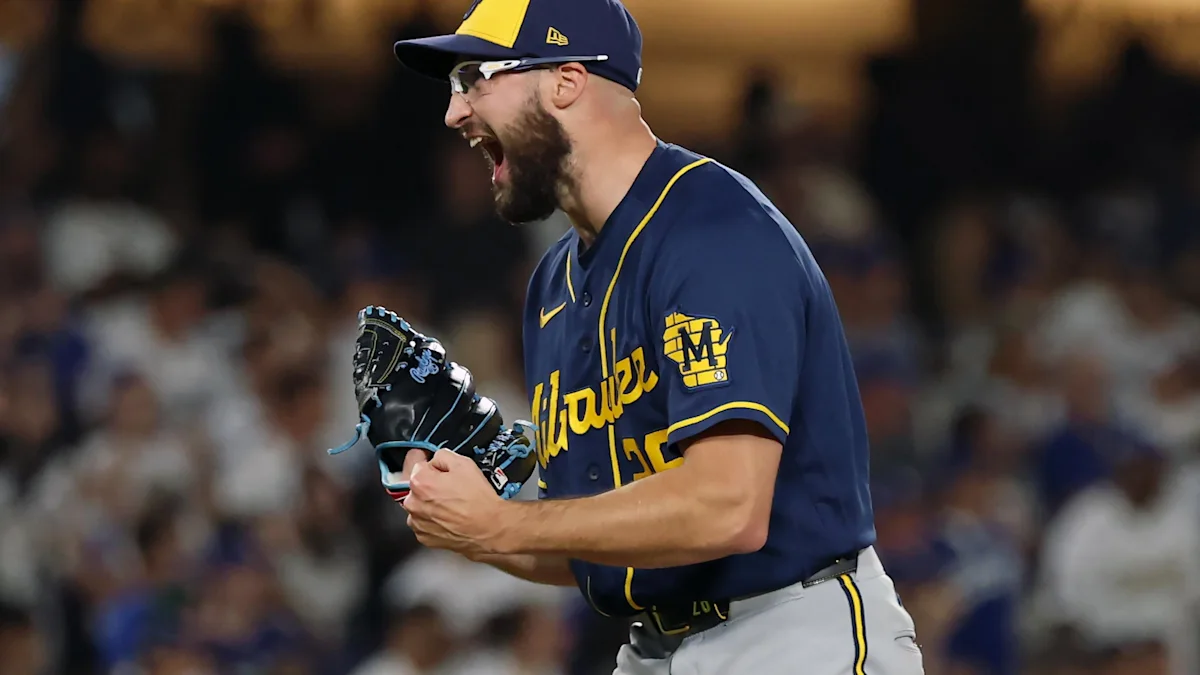
Aaron Ashby did not have his best season in 2026. He pitched a ton: he tied for sixth in the league in appearances, and only Houston's AJ Blubaugh surpassed his 87 bullpen innings this season (Ashby added another 2 1/3 innings in one appearance as an opener). Ashby's 89 1/3 total innings are his most in a season since 2022, when he was primarily a starter; he'd only thrown 95 innings in the big leagues total since a shoulder injury cost him the entire 2023 season. That much action — arguably overuse — sapped Ashby's effectiveness a little bit from 2025, when he was one of the best relievers in baseball:
2025: 66 2/3 innings, 2.16 ERA, 2.70 FIP, 1.170 WHIP, 10.3 K/9, 3.2 BB/9
2026: 89 1/3 innings, 3.12 ERA, 3.11 FIP, 1.310 WHIP, 11.7 K/9, 4.1 BB/9
Ashby was evolving, though, and underlying metrics suggest he wasn't actually a lesser pitcher in 2026 despite more walks and a slight downturn in results. His "Stuff+" metrics, which attempt to put a number on how "nasty" a pitcher is, mostly held in 2026; his sinker and slider, two of the best pitches in the majors in 2025, were a little worse, but his curveball and changeup were both a little better. His Statcast profile in 2026 shows just as much red as it did in 2025; in both seasons, Ashby ranked among the elite in ground ball percentage and barrel percentage. In 2026, Ashby was in at least the 88th percentile in all of expected batting average, expected ERA, whiff percentage, and strikeout percentage — all higher than last season. His average fastball velocity was up a tick, from 97.4 to 97.7 mph.
So, while Ashby's ERA was a run higher and an increase in walks created occasional problems, Ashby's stuff was just as good as it was the previous season, in about 40% more innings. Watching Ashby was not always a comfortable experience this season — his command would come and go, and his 10.7% walk rate was higher than in any previous season — but his pitches were essentially as hard to hit as ever.
Maybe it should not have been a surprise, then, what we have seen from Ashby in the postseason.
Ashby pitched in three of four games against the Padres in the NLDS. He went multiple innings in two of those three outings, and picked up a win in the Game 4 series clincher when he went three scoreless, hitless innings to bridge the game from starter Robert Gasser to the big guns at the back of the bullpen, Abner Uribe and Trevor Megill. In those three games in total, he pitched 5 2/3 innings, allowed two hits and two walks, didn't allow a run, and struck out five.
In the sweep of the Dodgers, Ashby also pitched in three of four games. In a tight Game 1, Ashby pitched the seventh and eighth in a one-run game and allowed only a walk. He picked up saves in Games 2 and 4, and his Game 4 performance — he pitched the final three innings, and twice, with the tying run on third with one out, got out of the jam — will go down in Brewers lore. His full numbers against the Dodgers: 6 2/3 innings, two hits, one walk, six strikeouts.
Through two series, Ashby has pitched in six of Milwaukee's eight games. He has totaled 12 1/3 innings; he has a win, two saves, he's allowed four hits, three walks, and no runs, and he's struck out 11.
This run is getting into historic territory. There's a whole other series to go, and who knows what will happen, but: there have been only 26 instances in the history of the postseason where a pitcher went at least 12 innings with an ERA below 1.00. If you want to drop the ERA down to zero, where Ashby's currently sits, there are only six others:
Ken Dayley, who pitched 12 shutout innings in nine appearances for the 1985 Cardinals
Mariano Rivera, twice, in the Yankees' World Series runs in 1998 and 1999
Another Yankee, Hall of Famer Goose Gossage, in 1981, who had six saves in 14 1/3 innings
Cody Allen, during Cleveland's run which ended in their Game 7 loss to the Cubs in 2016, had 10 scoreless appearances that totaled 13 2/3 innings and six saves
Finally, a surprising name: John Rocker, who didn't allow an earned run in 13 innings in the 1999 postseason (but who did allow two unearned runs)
Ashby is already at or near the innings pitched totals of all of these guys. He's in relief ace territory at this point, and there's a real argument that he should've won NLCS MVP; the cinematic nature of Jake Bauers' exploits in the series probably clinched it for him, but Ashby was certainly just as deserving.
Ashby's work in this postseason so far reminds me of two other players from the not-so-distant past. The first was another well-regarded prospect who didn't work out as a starter but who became, briefly, a shutdown reliever and a major figure of the postseason: Andrew Miller. By the time he was 26, Miller had been a top 10 prospect; he'd already thrown almost 300 big-league innings in a variety of roles, and he'd been traded twice — once as the linchpin of one of the biggest trades of the 2000s, when the Tigers traded him and others for Miguel Cabrera and Dontrelle Willis. Miller struggled as a starter but finally found success in his seventh season when he became a full-time reliever; over the next five years, Miller was as good as any relief pitcher in baseball and played a major role on several postseason teams. The 2016 campaign was the most magical, though: in 19 1/3 innings across 10 appearances for Cleveland, Miller allowed three runs (a 1.40 ERA), struck out 30 batters, and walked only five. For his entire postseason career, Miller allowed just four runs in 38 2/3 innings, giving him a lifetime 0.93 postseason ERA.
The other player I'm reminded of is Wade Davis, yet another big-time prospect who failed as a starter but who finally clicked as a full-time reliever. Davis was drafted by the Rays, but it didn't work out there; he was traded to Kansas City in the James Shields trade, but had a disastrous 2013 season as a starter. In 2014, the Royals put him in the bullpen… and over the next four seasons, Davis had a 1.45 ERA in almost 250 innings. In the 2014 postseason, Davis allowed one earned run and struck out 20 in 14 1/3 innings across 12 appearances as a setup man, including 10 innings of a 0.00 ERA across the ALCS and World Series. The following season, when Kansas City won it all, Davis did not allow a run in eight appearances; he struck out 18 and walked three in 10 2/3 innings, the Royals won every game he pitched in, and he earned four saves and a win.
From a storyline standpoint, I remember Davis and Miller dominating the postseason discussion for those three years in the mid-2010s. The idea that the role of starting pitchers in the postseason was diminishing was still quite new at the time, so it was a big deal that you had these guys coming in and mowing everybody down. They just felt like the most dangerous weapons in their respective playoff runs. Miller came up a game short (and indeed, two of the three runs that Miller gave up in that 2016 postseason run came in the Cubs' Game 7 triumph), but Davis is forever etched into the history of Kansas City baseball.
Ashby might already be there for the Brewers; even if things don't go particularly as planned in the World Series, few will forget his heroics in the first two rounds. But for a guy who, like Miller and Davis, didn't work out as a starter, and for a guy who had not had a good postseason career before this season (in 10 appearances across three seasons, he had a 7.71 ERA in 9 1/3 innings and as many walks as strikeouts), Ashby has written himself into the Milwaukee record books. If he can keep it going in the World Series, he just might join a truly elite list of postseason relief runs, the likes of which have only been seen a handful of times.
Topics in this story
Gathered from external sources. Rights to this text belong to whoever originally published it.