Grading the 34 Long-Term NHL Contracts Signed During the 2026 Offseason So Far
Every offseason, NHL teams award major contracts hoping those players become long-term building blocks and core roster members. Those deals can come through free agency, following a trade acquisition or by retaining an existing player.
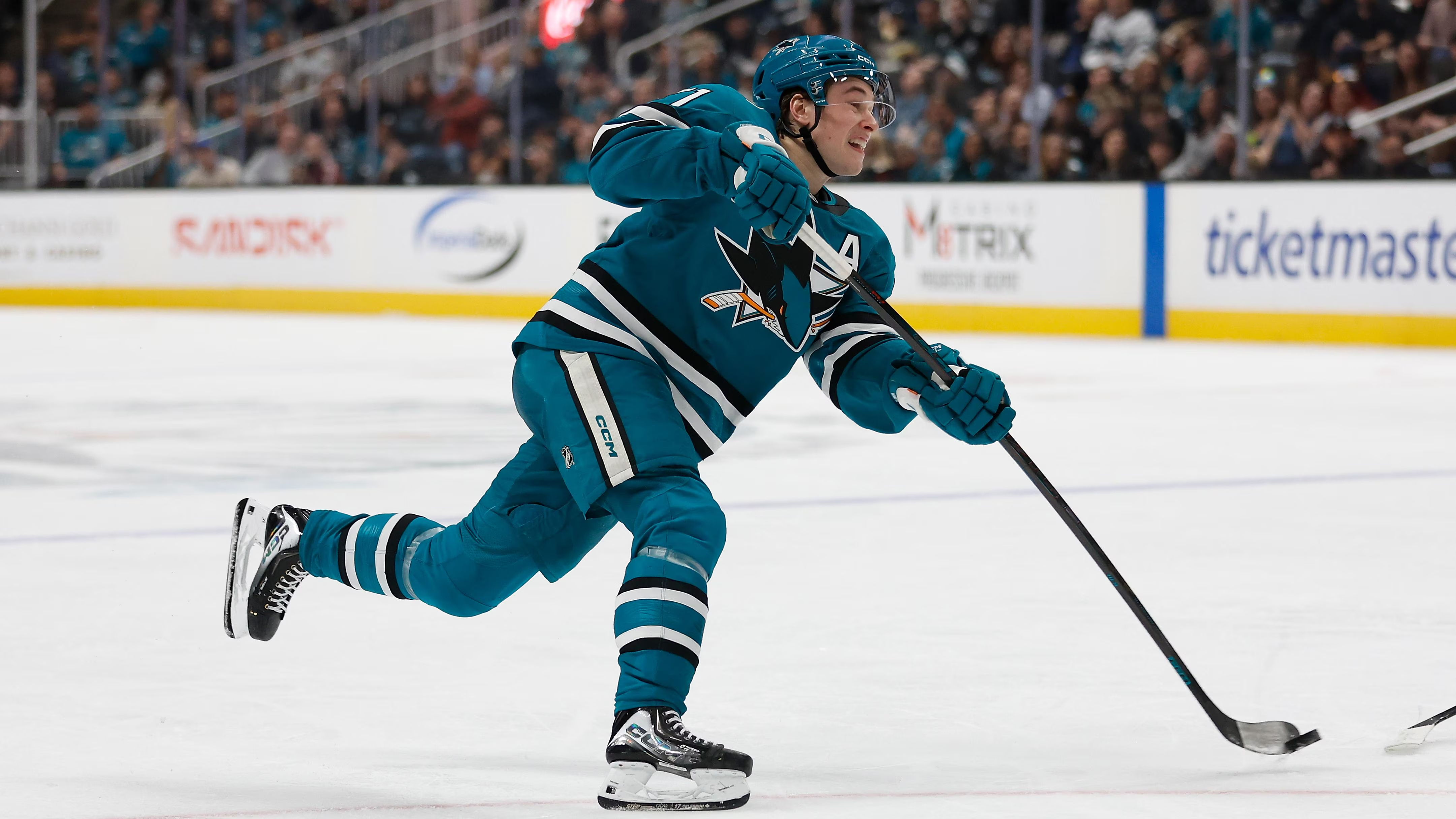
Every offseason, NHL teams award major contracts hoping those players become long-term building blocks and core roster members. Those deals can come through free agency, following a trade acquisition or by retaining an existing player.
In some cases (especially when it comes to free agent investments) those long-term deals can carry significant risks based on the reality you are paying top-dollar on a long-term contract for a player that has likely already played their best hockey for somebody else.
In other cases, the best contract a team signs is the big-money, max-term deal for a player they already have that has not yet reached their prime years.
Given all of that, there have been 34 NHL contracts signed this summer that are five years in length or longer.
We are going to assign a letter grade for all them based on the initial vibes, potential, and long-term risk that come with each one of them. Some teams might end up getting a bargain. Other teams might already be regretting it.
All signings are listed in the order in which they were signed this offseason.
Contract: Six years, $20 million ($3.3 million salary cap)
Michael McCarron is the type of player NHL executives love to obsess over in a way that seems completely disproportionate to the role they play. Depth player, great size and wins face-offs. Teams will crawl over each other to acquire players like this.
For that role, McCarron is a fine player, and the $3.3 million salary cap number isn't anything that's going to break the bank for the Wild.
But signing a 31-year-old version of this player at that number for six years just seems needlessly excessive.
Contract: Eight years $68 million ($8.5 million)
The Maple Leafs needed to address their defense in a major way this offseason, and Raddysh was the top defenseman to enter the market. They acquired him in a sign-and-trade with the Tampa Bay Lightning and made him a key part of their core with an eight-year, $68 million deal.
If Raddysh is able to duplicate his 2025-26 performance, that's a great contract.
The question is whether or not he can do that, and whether or not he can do that for several years.
He did not become an NHL player he was 25 years old. He did not become a full-time player until he was 27 years old. His first two years were good, but not great. His first truly great, breakout year came when he was 29 years old.
They are banking on his most recent performance being a sign of what is to come over the next eight years. As we have seen time and time again in the NHL (and all professional sports) what you did most recently is not necessarily what you will do next. Or consistently.
It could work. He could just be a late-bloomer. But they are taking a big risk in that.
Contract: Five years, $20 million ($4 million salary cap)
The Edmonton Oilers have to do a better job when it comes to preventing goals.
Part of that has to fall on the goalies. Another big part has to fall on the defensemen. But the forwards have to play a role in that as well, and Dickinson is at least a really, really good defensive player down the middle. He's not going to score much, but he can definitely help shut opposing teams down and will be a solid depth presence defensively.
The criticism here is largely due to the five-year term.
Contract: Six years, $34.5 million ($5.75 million salary cap)
Bobby McMann does a lot of things well, and can be a very effective player. He's going to be a menace on the forecheck, bring some speed to the lineup and probably score 20-25 goals.
There's a place for that on a good team.
The problem is Seattle might not be a particularly good team, and he is pretty much a representation of what its roster is already full of: Good, but not great players that are not really difference-makers.
The salary cap hit for what he is in the short-term is pretty much right where it should be. But he is going to be 30 years old when that contract begins. How well is his production and style of play going to hold up into his mid-30s?
Contract: Five years, $20.5 million ($4.1 million salary cap)
Stan Bowman loves his former Chicago Blackhawks, and he apparently sees Murphy as a big part of their defensive turnaround this season.
At his best, Murphy was an outstanding defensive player on some bad Chicago Blackhawks teams where he never had much chance to shine (or find team success). He's a little older now, has maybe lost a step, and probably isn't quite as effective as he was earlier in his career.
Even with that, he should still be one of the better defensive players on the roster, but there is a concern as to how this contract will age and if Edmonton is going to lean on him to do too much or play too big of a role.
Contract: Eight years. $84 million ($10.5 million salary cap)
The Washington Capitals made some big splashes this offseason, and in the process addressed two of their biggest issues from the 2025-26 season: Goal-scoring and generating offense off the rush.
The trade for Jordan Kyrou and acquisition of Alex Tuch should go a long way toward fixing both.
Tuch's contract is the classic case of a deal that's probably going to work out very well in the short-term, but age very poorly by the time it is over.
He has been a pretty consistent 30-goal scorer the past few years, and he might still have a few more years of that level in him before he really starts to slow down. The Capitals should not count on that same level of production from a 34, 35 or 36-year-old Tuch. If they can win big before it gets to that point, with Tuch playing a big role in that, nobody in Washington is going to care.
Contract: Five years, $22.5 million ($4.5 million salary cap)
Kulak was a really strong mid-season addition for the Avalanche, and had some big moments for them in the playoffs. He's also been a really underrated player at times throughout his career. All good signs.
But the downside here is that he is going to be 33 years old this season, and is probably going to start ending up on the downside of his career sooner rather than later, if he already has not.
As a depth player on a contender, he can be a very effective role player. But a five-year term is a little much. He will probably be playing for somebody else before that contract expires.
Contract: Seven years, $52.5 million ($7.5 million salary cap)
Now this is the type of contract that can pay off long-term for a team.
Benson's 2025-26 season (and playoff run) was a little bit of a breakout performance offensively as he scored 13 goals with 43 points in only 65 games. He folloed that up with an outstanding playoff showing as the Sabres reached Game 7 of the second round.
The important thing to remember with all of that: He is still only 20 years old. His best days are still coming.
He might not ever be a big-time scorer or the player you build the team around, but he will score enough to be effective while also being one of the NHL's best pests for the next decade.
Contract: Five years, $37 million ($7.4 million salary cap)
Ken Holland has made some curious and regrettable deals with his defense since taking over the Los Angeles Kings (signing Cody Ceci and Brian Dumoulin to long-term contracts; trading Jordan Spence), but the Clarke contract is not one of them.
He is already a good player, is still only 23 years old, and is now signed throughout his prime years at what should be a below market rate for a top-pairing defender (which Clarke already is).
Compared to some other contracts signed by similar age defensemen this summer, including several that are not as good as Clarke, this is a big win for Holland and the Kings.
Contract: Seven years, $77 million ($11 million salary cap)
You have to give the New York Rangers some credit here for making a sizable investment (both in terms of trade assets and money) into a player that is actually in the prime of his career, and is not some former big-name that is simply trying to drag their decaying bag of bones across the finish line of their career.
This is a new twist for the Rangers, and when you combine it with adding some defensemen that can actually skate and move the puck a little bit they have had a sneaky good offseason.
Is Dorofeyev the type of player you are going to build the whole team around and make the focal point of your roster? No. But is he a player you want on your team that can make a big impact for you? Heck yes. He is going to score a lot of goals, and that is important. Good player. Good move. Good contract.
New general manager Chris MacFarland brought a lot of his former players with him from Colorado, and Drury was one of them. He gave him a nice raise at five years and $22.5 million, which is a little steep for a player that's right on the line between the third-and fourth-line. Even if he is good at that role.
The one nice thing he has going for him is that he still only 27 years old, so there's not a huge risk that he is going to totally fall off anytime soon.
If anything, this is a good reminder as to how much salaries are rising with the salary cap going up.
Contract: Six years, $75 million ($12.5 million salary cap)
Bowen Byram's deal with the Chicago Blackhawks is going to be hockey's version of a Rorschach test for the next six years.
Everybody is going to see something different.
Some people are going to look at this and see a defenseman that plays a lot of minutes, on a bad team, and puts up 55-60 points and say that he is worth the cost and worth the trade (picks No. 4 and 45 and defenseman Louis Crevier) to acquire him.
Others are going to look at this and see a flawed defensive player that does not really drive possession or control the game and wonder why he is being paid like a No. 1 defenseman when he does not actually play like a No. 1 defenseman.
There was nothing wrong with Chicago trading the No. 4 overall pick (or the No. 45 overall pick) for somebody that can help them right now. They need to get better, and they need to get better quickly. It is tough to question that mindset.
It is a little easier to question if they spent all of that on the right player.
Byram will not be a bad player or a liability. He should improve them. He just might not be what they are paying him to be, or improve them as much as the current management thinks he will.
Contract: six years, $17.5 million ($2.91 million salary cap)
Beck Malenstyn's contract with the Sabres is very similar to the McCarron deal with the Wild. The cap hit is fine. It's not something you're going to lose sleep over and he can be an effective depth player. But why do you need to sign a depth player like this for six years? These guys are always available and they are always affordable. There is also not much upside here to be more than what he has already showed himself to be.
It's not a terrible contract, but it's the type of little thing where if you make too many of them they eventually add up into a big problem.
Contract: Six years, $24 million ($4 million salary cap)
Even though their goalies attempted to sabotage it for most of the regular season, the Golden Knights were one of the better defensive teams in the league in 2025-26 and Lauzon played 68 games for that group. He is not going to provide much offensive from a goals and points perspective, and he is probably best suited for a third-pairing role. That makes the six-year contract a little much, especially as he enters his age 29 season. He's a depth player that is going to play most of this contract in his 30s. There is some big risk with all of that.
Contract: Eight years, $40 million ($5 million salary cap)
It is easy for a player like Eetu Luostarinen to get lost on a team like Florida where there are All-Stars and big-name players all over the roster. But he is a perfect fit for the role they need him to play and a really, really good two-way player. He defends extremely well and scores enough to be an effective two-way complementary piece on a contending team.
He is also at an age (28) where the contract should age fairly well into his 30s.
The $5 million cap hit is also only going to look better as the cap continues to rise.
Contract: Five years, $58.5 million ($11.7 million salary cap)
In terms of value against the salary cap, overall production, age of the player and quality of the player this is one of the best signings and contracts of the summer.
Hischier is a legit top-line center that plays a complete two-way game, and along with Jack Hughes gives the Devils one of the best center duos in the league.
Is the team around them good enough to compete? Not yet. But they have two really important pieces in place, and between the two of them they are signed for less than $20 million over the next few years.
Contract: Seven years, $59.5 million ($8.5 million salary cap)
The Vegas Golden Knights roster construction always seems to follow the same three-point play.
Re-sign big-name player to huge contract
Ask questions and figure everything else out later
Vegas has played in three Stanley Cup Finals in its first nine years in the league and is a serious contender every year. They are doing something right.
Sometimes, however, even the best and most successful teams can get themselves in trouble and fly a little too close to the sun and get burned in the process.
I fear this is what is going to happen with Andersson on this contract. I'm not sure how good he is still is right now (despite the big offensive numbers this past season), or how well he is going to age now that he is into his 30s.
Contract: Six years, $9 million ($1.5 million)
Acquiring Brady Tkachuk and Radko Gudas in the same offseason, and putting them on a team with Matthew Tkachuk, Brad Marchand and Sam Bennett, is one of the most diabolical roster constructions in the league. Every game is going to turn into a circus. And maybe that is what Florida wants?
The cap hit here is negligible, but there is something weird about signing a 36-year-old player to a six-year contract.
Florida isn't going to be asking Gudas to play a major role, but even in limited action there is some question as to how good he can still be. There might even be a risk he does something reckless in a big moment to cost them. Then again, you could probably say that about half of the roster.
Contract: Eight years, $73.2 million ($9.15 million salary cap)
The Canadiens have put together one of the best young cores in the league and have managed to get all of them signed to long-term deals that should age tremendously over the years. Demidov's eight-year deal this offseason is the most recent of those contracts.
While he has only played one full season in the league, he has shown every sign of being an All-Star level scorer and dynamic playmaker for the next decade (or more).
In most normal years his 19-goal, 63-point season at age 20 would have made him a near Calder Trophy lock. But because he was playing in the league at the same time as Matthew Schaefer he had to settle for second place.
Assuming he continues to progress, his $9.15 million salary cap hit through his prime years in the NHL is going to look like a steal as the cap continues to climb.
Contract: Five years, $27.5 million ($5.5 million salary cap)
Vladar was awesome for the Flyers in 2025-26. He was probably more than awesome. He was not only one of the better free agent signings in the 2025 class, he was one of the biggest difference-makers in getting the Flyers in the playoffs and through to the second round.
That earned him a new long-term contract with the Flyers.
Here's the problem and why I don't love it -- at no point in his career has he ever shown an ability to play at that level consistently. In fact, prior to the 2025-26 season he was consistently one of the least productive and least effective goalies in the NHL.
Goalies are weird. Sometimes everything clicks at a random point in their career and they go on a completely different path and figure it all out.
The counter to that is sometimes bad goalies just have a random great year and never repeat it.
Contract: Eight years, $56.8 million ($7.1 million salary cap)
This might be one of the more underrated long-term contracts of the offseason.
Foerster does not get as much attention as some of the other young players in the Flyers' rebuild (Matvei Michkov, Porter Martone), but he has quickly become one of their most important and effective players for both now and the future.
He is still only 24 years old, is already a tremendous defensive player in some of the toughest minutes on the team, and has proven himself capable of scoring more than 20 goals over a full season. His 13 goals in 29 games in 2025-26 had him on track to blow past that number.
That level of offense, combined with his defense, makes him one of the game's better young two-way wingers, and the Flyers have him locked through all of his prime years at a very affordable rate.
Contract: Five years, $12.5 million ($2.5 million salary cap)
This feels like a direct response (and maybe overreaction) to the Florida Panthers bulking up their legion of goons (said with love). And if you want to respond to that as a divisional rival, fair enough. More power to you. But five years? Excessive.
Contract: Five years, $33.75 million ($6.75 million salary cap)
Marchment's deal with the Sharks was one of the bigger free agent contracts, and while it is a little pricey, it's exactly what the Sharks needed.
So much of San Jose's 2025-26 season was dependent on Macklin Celebrini carrying the team. They were absolutely dominated during 5-on-5 play when he was not on the ice, and building up the depth (at both forward and defense) had to be a priority this offseason.
They addressed the defense with the Darnell Nurse trade and Jacob Trouba signing.
The addressed the forward situation with the Marchment signing.
He's an outstanding two-way veteran that can defense and chip in legitimate second-line offense. It might not age well by year five, but it will be a big upgrade the next couple of seasons.
Shea is coming off a really good (and surprising) season for the Pittsburgh Penguins, and the Oilers are hoping some of that solid play can transfer out west.
If they are counting on him to be a third-line defender, and maybe occasionally slide up into the second-pairing, they should be happy with what they get. It's a little long on the term for a depth player, but the price is fair.
It's not an exciting move by any means, but it should help.
Contract: Five years, $90 million ($18 million salary cap)
The Philadelphia Flyers shocked the hockey world by signing Carlsson to a five-year offer sheet in restricted free agency, making him at the time the highest-paid player in the league.
The Ducks eventually matched it, and they pretty much had to given Carlsson's importance.
Bottom line -- this is an overpay, and probably not a small one. That is the only thing that keeps it from being an A. Carlsson is still really good. Outstanding, even. He is on his way to being a No. 1 center and is Anaheim's franchise cornerstone. But he's not an $18 million player in this market. Not now. Probably not ever. Almost certainly not within the next five years.
But it doesn't mean it's a bad contract for the Ducks. They are still going to get value out of it, and if you are going to overpay somebody, the top-line stars are the easiest to make it work.
Contract: Six years, $33 million ($5.5 million salary cap)
Under the leadership of McFarland in his first year running the team, the Nashville Predators decided not to begin a rebuild and shed veteran players, but to instead keep trying to win with the core they had and complement it with a number of depth players.
Mavrik Bourque is one of the more intriguing additions because he still has some untapped upside that could see him reach a higher level of production.
Bourque has played just two full seasons in the NHL, and saw his production take a big jump from year one to year two, going from 11 goals and 25 assists as a rookie, to 20 goals and 41 points this past season.
Even if Bourque stays at that level of play, a 25-year-old forward that can score 20 goals is well worth a $5.5 million salary cap hit through their mid-late 20s. If he progresses beyond that, it's a steal.
Contract: Five years, $36 million ($7.2 million salary cap)
This felt like a bit of a panic move given the threat of a potential offer sheet, which Anaheim already had to deal with in the Carlsson situation. It's also probably a little more than they wanted (or intended) to pay him this summer.
Mintyukov has played three full seasons in the NHL and flashed top-four potential at times, but his game is still a very unfinished product.
He's being paid like a top-pairing defenseman but has not consistently been there yet. That doesn't mean he won't get there.
Given his contract, as well as the departures Anaheim has had on its blue line this offseason, he is going to need to have a big breakout season to keep Anaheim from regressing in the standings.
Contract: Five years, $36.25 million ($7.25 million)
The Flames are deep into a rebuild and had a surplus of first-round picks over several years and decided to cash two of them in to acquire Nemec from the New Jersey Devils, and then sign him to a five-year deal.
It's an intriguing move because Nemec definitely fits in with the right age group the Flames should be looking for, and there is some potential here offensively. The key to this contract being a win, and the Flames improving as a team, is going to be Nemec rounding out the rest of his game to become a more impactful player in ways beyond just producing points.
Contract: Five years, $30 million ($6 million salary cap)
Winnipeg is going to need a lot of things to go right this season to bounce back from a dreadful 2025-26 season, and a big breakout season from Perfetti has to be high on the list.
He's been a pretty consistent scorer in terms of what his production looks like (about 17 goals and 40 total points over 82 games), but the Jets probably want to see a little more.
For $6 million per season over five years they are going to need a little bit more.
At the moment it's maybe a small overpay, but nothing outrageous. A little improvement and a little more offense could make it a slightly below market deal.
Contract: Six years, $40.5 million ($6.7 million salary cap)
The Blues are taking some big gambles this offseason, and McMichael is one of them.
He was one of the key pieces in the trade that sent Jordan Kyrou to the Washington Capitals.
He's a perfectly fine player right now. A good, middle-six player that can score and is still in his mid-20s. The question that has to be answered is whether or not he can take another step forward and go from a 15-20 goal scorer, to a more consistent 25-30 scorer.
Even if he doesn't, a $6.7 million cap hit is not a terrible overpay for what he is. But the Blues really need players like him and Mason McTavish to work out for their plan to work.
Contract: Five years, $75 million ($15 million salary cap)
Given the contracts for some of the other top young players in the league this offseason, getting Bedard at $15 million is probably just about right. The only potential flaws are that for as good as Bedard is offensively, he is still a very unfinished product defensively and has already started to build up a concerning run of injuries early in his career.
The five-year term also continues a trend of young players signing shorter term deals, going right into unrestricted free agency.
Given how bad the Blackhawks been early on on Bedard's career, there has to be some pressure to show him they can build a contender around him. So far, they have failed.
Contract: Eight years, $54 million ($6.75 million salary cap)
John Marino is not the flashiest defenseman in the league, and he is not going to put up the biggest numbers, nor is he going to play an overly physical game. But he is simply a rock-solid, steady defensive player that has found a home in Utah.
Is there some risk with an eight-year contract for a 29-year-old defenseman? Sure there is. But a $6.75 million salary cap number for a legitimate top-four defenseman is going to be a really strong deal in the coming years.
Marino and Nate Schmidt also helped form one of the NHL's most effective (and underrated) defensive duos in the league this past season.
Contract: Five years, $94 million ($18 million salary cap)
Some contracts you simply do not need to overthink.
Celebrini is not only the best young player in the league, he is one of the best players in the league regardless of age.
He is also still just entering his age 20 season and is likely to only get better.
It's a huge win-win contract for both the team and him. From a team perspective, they do not have to deal with him as a restricted free agent next summer. From his perspective, he gets to be one of the highest-paid players in the league and still set himself up for another massive payday when he is still in his mid-20s.
Contract: Eight years, $32 million ($4 million salary cap)
The most shocking long-term contract of the offseason was the Pittsburgh Penguins decision to sign forward Ville Koivunen to an eight-year contract worth $32 million after just 50 NHL games and only two goals.
But the Penguins view it as a low-risk with a potentially high reward.
If Koivunen can turn into an effective second-or third-line scorer (which he absolutely has the talent to do) it's going to be a very cap-friendly deal.
If he doesn't, because of his age they can buy him out within two years and only be on the hook for a salary cap hit of $750,000 each year as a part of it.
Koivunen's underlying numbers were some of the best on the Penguins this past season, but he needs to turn it into more tangible production and offense.
Topics in this story
Gathered from external sources. Rights to this text belong to whoever originally published it.