Will Burnham find PMQs as 'nail biting' and 'nerve wracking' as Blair did?
Curiously, the questions at lunchtime may well feel like a minor extension of what he faced on Tuesday, the BBC's political editor writes.
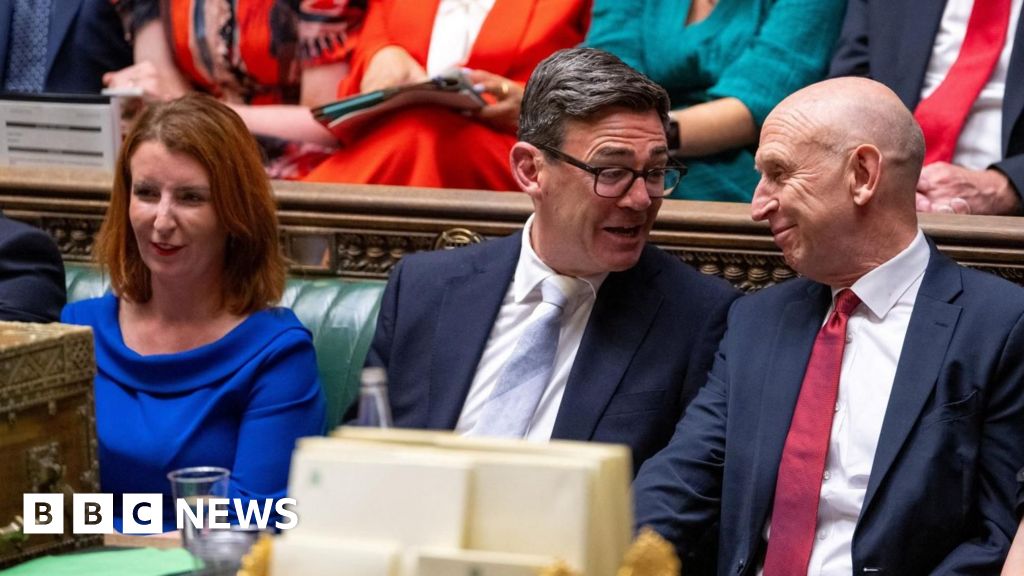
The weekly ritual that sits at the heart of Westminster's public image beckons, the half an hour or so of verbal jousting at Prime Minister's Questions (PMQs).
Prime ministerial memoirs tell the stories of how central a moment it is in the week of any occupant of 10 Downing Street.
Sir Tony Blair wrote that "PMQs was the most nerve wracking, discombobulating, nail biting, bowel moving, terror inspiring, courage draining experience in my prime ministerial life, without question".
Now, for the first time, it is Andy Burnham's turn to feel those nerves. And yet, curiously, the questions at lunchtime may well feel like a minor extension to the three and a half hours of questions he faced on Tuesday afternoon.
And this is because Parliament is playing catch-up: six weeks into the job, Burnham is encountering the moments that would typically arrive in the opening days, the routine moments of scrutiny in the House of Commons.
His arrival in office coincided with the departure of MPs from Westminster for the summer, and so the prime minister had a month or so that felt rather like a soft launch, heatwaves plentiful, Commons questions absent. Now plenty of them are coming, all at once.
I observed Andy Burnham's opening moments in the Commons as prime minister from the Press Gallery. He hovered by the Speaker's chair waiting his turn, flanked by Labour's Deputy Leader, Lucy Powell, who appeared to brush some fluff from the back of his jacket, and Louise Haigh, his first secretary of state.
Burnham promises more devolution and public control of essential services
Five takeaways from Burnham's Commons debut as PM
The dangers of politicians being 'too online' - or not online enough
The customary roar of approval from Labour MPs followed as he took his seat. Incidentally, MPs tend to manage this partisan and rather performative audible endorsement almost irrespective of the political weather their boss is encountering or indeed their role in creating it.
But having pondered whether to stick or twist a few months back, stick with Sir Keir Starmer or twist with another card, this was their first chance to see how he – Burnham – gets on in the role.
His opponents privately acknowledge his more upbeat demeanour, his sunnier disposition, is politically savvy, but they also spot laden political clouds to point at: prisons, overcrowded; defence, underfunded; social care, unreformed. A mere trio to zoom in on.
The new prime minister looked at ease making an argument and articulating his political creed. But beyond a few nuggets of news – he will attend the COP climate summit later this autumn, he blames Brexit for damaging the economy, he suggested, without detail, he would find the money to crank up defence spending – we did not learn much we did not already know.
His team hope this to be a pattern that becomes familiar – that ideas and plans are carefully dripped into the national conversation, taking shape and solidifying over time rather than appearing out of nowhere.
They are also keen to double down on the idea that Andy Burnham is seeking to be tonally and stylistically different in how he does the job. He has posted on social media:
"I want to be talking to you, the public, not just the House of Commons, so let's make it People's Major Questions rather than Prime Minister's Questions, so send me what you want to ask me and I'll answer them after the other PMQs."
It is an interesting idea that it will be interesting to keep an eye on – both today and over the coming months and years.
Topics in this story
Gathered from external sources. Rights to this text belong to whoever originally published it.