The Woodstock museum ensuring that we shall remember them
Soldiers of Oxfordshire Museum staff and researchers share stories about Oxfordshire war heroes.
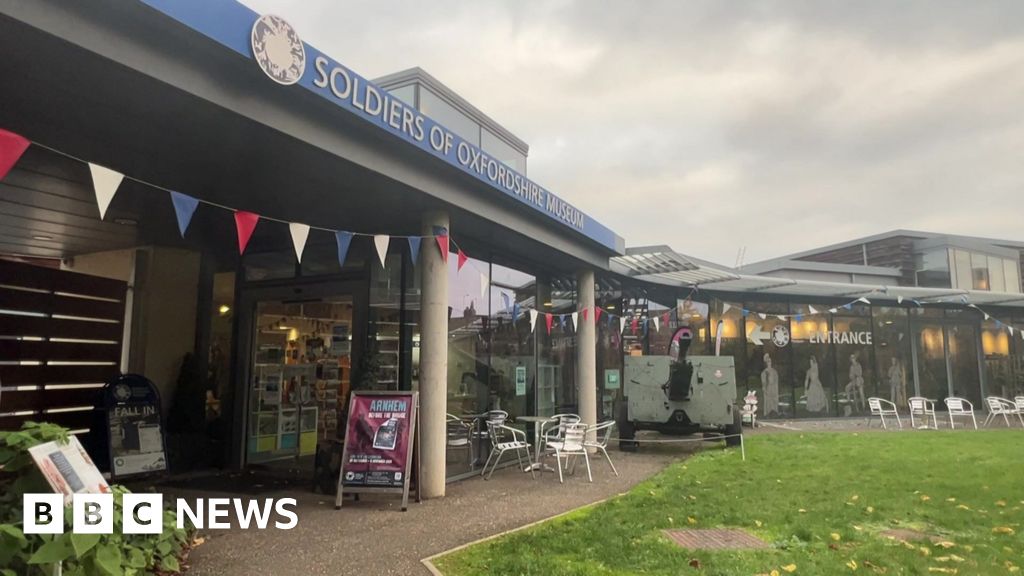
Once a year we promise ourselves to remember them and help their memory live on.
On Remembrance Sunday, the country honours those who died while serving in the armed forces.
In Woodstock, the Soldiers of Oxfordshire Museum (SOFO) is home to exhibitions, memorabilia, archives and stories that reflect the breadth of the county's military history.
Here are stories from its staff, researchers and veterans that you could learn about and experience when visiting this museum on the edge of the Cotswolds.
"When we first opened the museum we were trying to gather as many news stories as we could and this is my absolute favourite story even 12 years on," says SOFO director Ursula Corcoran.
Charles Oliver Stone was an Oxfordshire man whose family emigrated to Australia when he was quite young, but when World War One was declared, he came back and joined the 69th Australian squadron of the Royal Flying Corps.
"He did his training at Queen's College in Oxford and he did many training flights out of London and one day in 1917, he was on his biplane and he crashed into a field of Brussels sprouts," Corcoran says.
"One of the farmer's daughters, Poppy, came out and Charles Stone got out of the biplane and this fantastic romance bloomed between the two of them."
Corcoran said: "He's documented as a World War One flying ace - not only was he bombing certain sites, but he was also getting into aerial combat, and we know that he got into aerial combat with the Red Baron".
Listen to the latest news from Oxfordshire
Researcher Trent Harron says the connection between James Bond author Ian Fleming's family and the museum is "very strong".
"[His father] Valentine Fleming was a Member of Parliament for the Division of Henley leading up to World War One and also a member of the Queen's Own Oxfordshire Hussars (QOOH).
"He was not only a remarkable statesman, but also an accomplished soldier and one who was revered by his peers and by the soldiers in the unit."
"Valentine's brother, Philip Fleming, who he served with in the QOOH, survived the war and went on to establish a charitable fund which largely contributed to the museum's foundation."
Harron says Valentine Fleming and Winston Churchill were "close friends" and when Fleming died on 20 May 1917, Churchill wrote an appreciation.
"This news will arouse sorrow in Oxfordshire and in the House of Commons," it read.
"Alert, methodical, resolute, untiring, he did his work, whether perilous or dull, without the slightest sign of strain or stress to the end."
SOFO marketing manager Duncan Parsons has a personal connection to the museum.
He says his great uncle, William Charles Parsons, took part in the third and final airborne operation on D-Day, Operation Mallard.
"He died of wounds on 20 June, so he was likely a casualty to that."
"As a kid, we would still go over to Normandy and see the graves and we'd always be going out to military museums - it was always something that felt present with the family."
Blenheim Palace social historian Antonia Keaney, whose husband is chair of SOFO's trustees, says she first came across World War Two's Spitfire Woman Molly Rose through her granddaughter.
"[She] used to babysit for my children when they were little and I hadn't realised at the time quite what a special woman she was," Keaney said.
Through her work, she learned that at the end of WW2 there were more than 600 Spitfires found on Blenheim land and that there used to be a runway.
Molly Rose, originally from Cambridgeshire, developed a fascination for flying from her older brother who could fly and had an aircraft "tethered in their back garden".
When the war broke out, pilots were needed not only for conflict, but also for transportation.
"That's where Molly Rose came into her own - she had a pilot's licence, and she was one of the girls that used to fly planes from A to B," Keaney said.
Damaged aircraft such as Spitfires and Hurricanes were then taken to the Cowley Works for repair.
The historian says she recently read that throughout the entire period the women "shifted over 300,000 planes or they made over 300,000 flights".
"One of the things I also find really remarkable about women like Molly Rose is that they were actually in quite great danger and they knew there was a certain risk attached to it," she added.
"Go to St Aldate's police station and ask to see the John Howard memorial they've got," says former SOFO trustee David Innes.
He says the exploits of Major John Howard and his men "are still very fondly and very warmly regarded"
He led men from the Oxfordshire and Buckinghamshire Light Infantry to seize Pegasus Bridge over the Caen canal on D-Day in the Coup de Main Operation.
Innes says that thanks to the Coup de Main group "the eastern flank of the invasion was secured early on and made it much more difficult for the Germans to reinforce their positions above the beaches".
Starting as an Oxford City policeman, Major Howard joined the army when the threat of war started to loom.
"He very quickly proved himself to be an aggressive and determined and a man for detail," Innes says.
Later, Major Howard was wounded and was involved in a "really horrific road traffic accident, which largely immobilised him".
"But he was a great character, he was very fondly regarded by his men," Innes says.
"We go back with his family every year to Pegasus Bridge to mark the anniversary of D-Day.
"We've now marked 82 years since those days and the name John Howard is on everyone's lips when we go over there."
Dance celebrates Holocaust survivor's legacy
Military museum celebrates its 10th anniversary
Topics in this story
Gathered from external sources. Rights to this text belong to whoever originally published it.